|




| |
Digger Bread & The Free Bakery (ies)
Made with love. "The only stipulation is that you always give it away."
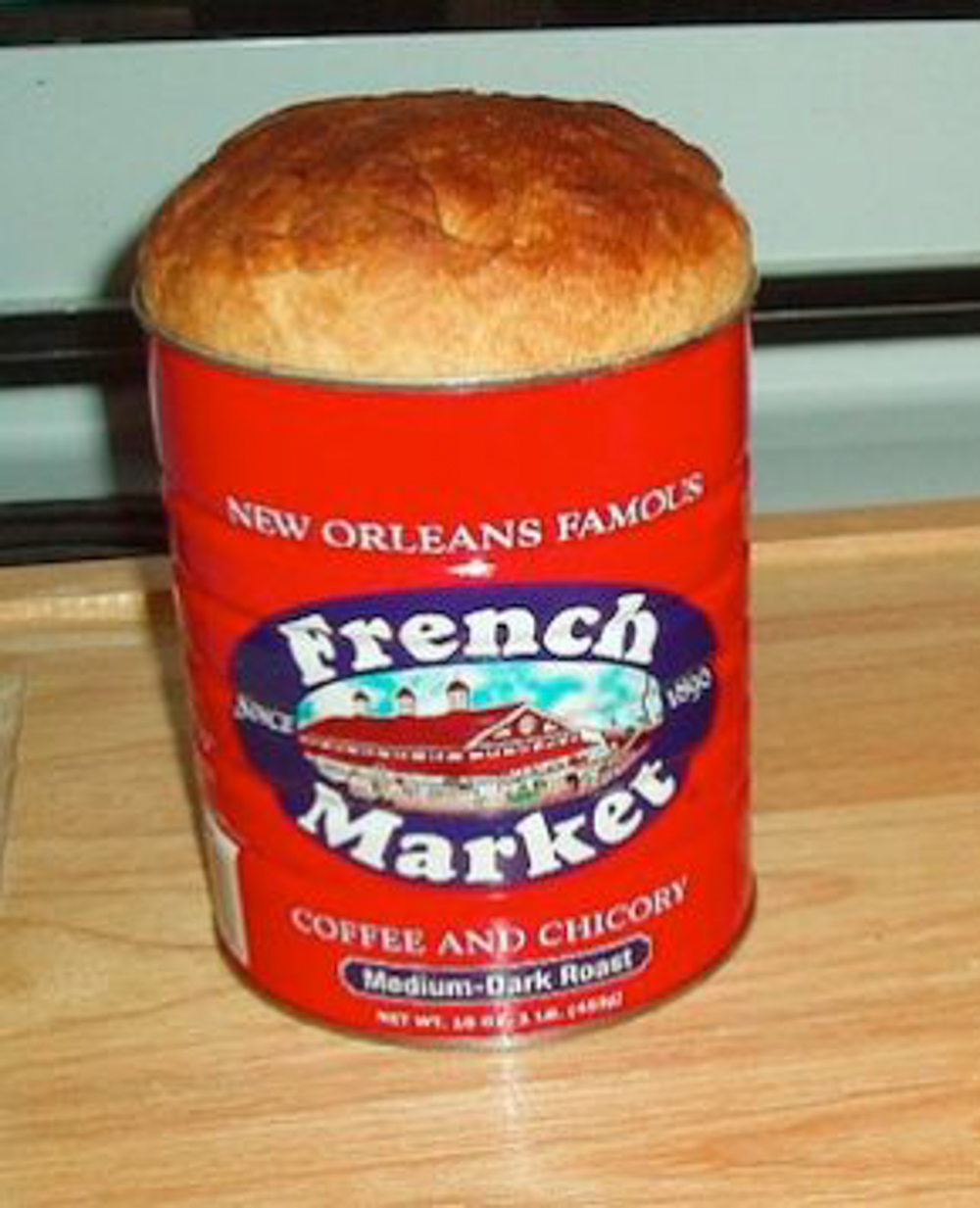
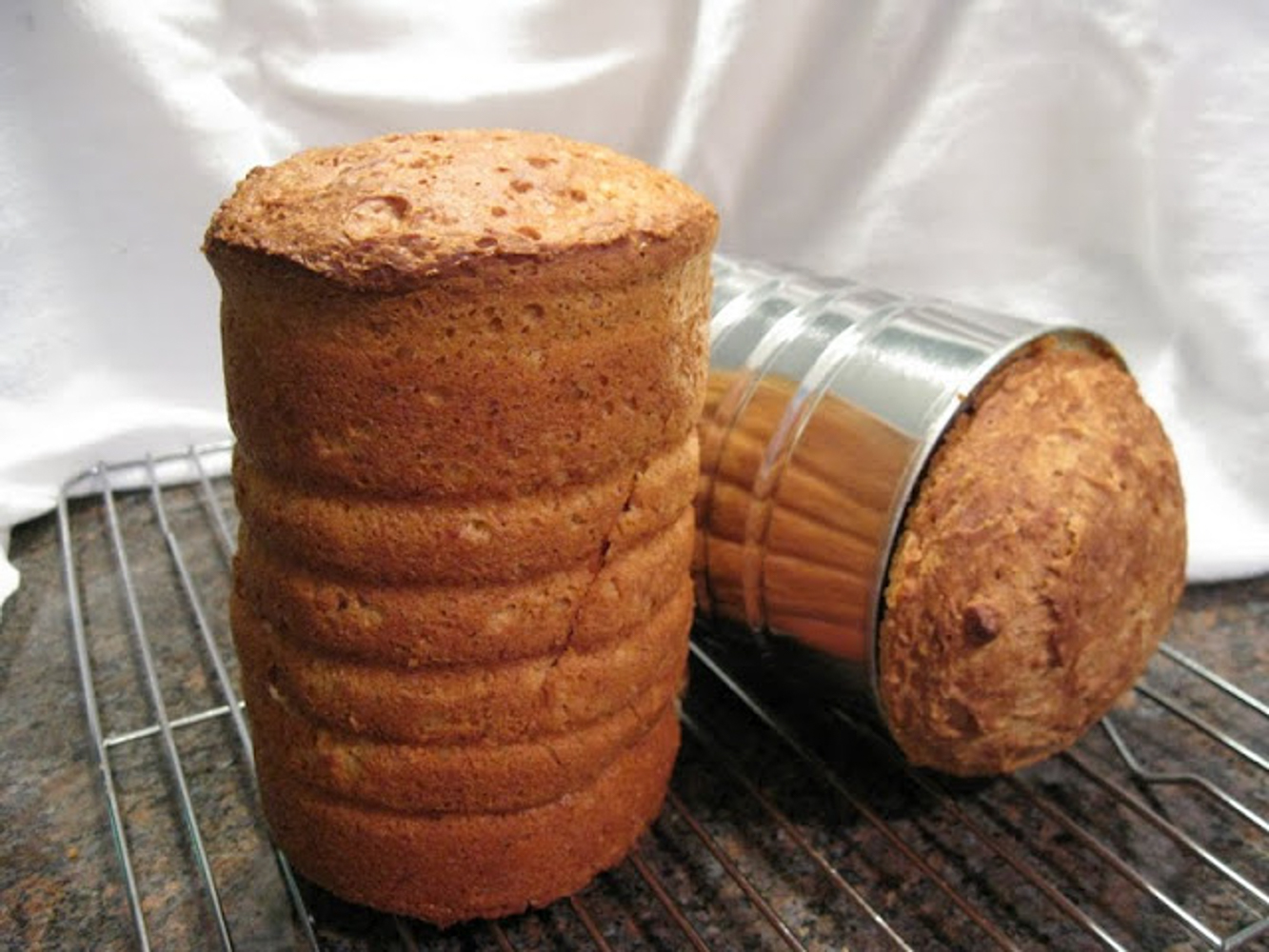
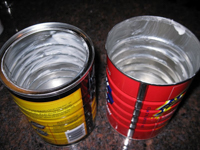
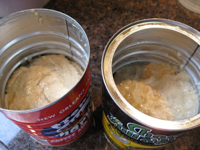
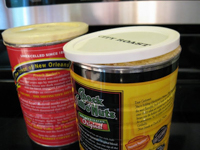
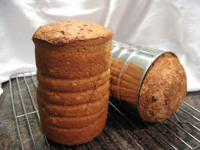
Digger Bread was immediately recognizable for the shape of the one- and two-pound
coffee cans that the Diggers used to bake it. The story of Digger Bread involves
a serendipitous chain of free bakers and bakeries that were devoted to the magical
process of making bread and also to the idea of giving it away for Free. There
are seven Free Bakeries in this history but innumerable others that have come
and gone and some that may still be operating unto this very moment.
Walt Reynolds started the first Free Bakery in 1967 at 1350 Waller
Street using the equipment in the kitchen of the All Saints Church. He
and his wife came up every Saturday for three years to bake bread. Walt
showed up one Saturday with the supplies (400 lb of flour and
ingredients) and held a "bake-in" that drew people into participating
with a sense of group purpose. Walt had purchased flour wholesale from a baker
in "Whiskey Gulch" (foot of University Avenue) in Palo Alto
[who would play a role in the saga of the Digger ovens]. One branch of the Diggers
was using the office at All Saints and learned how to bake bread from
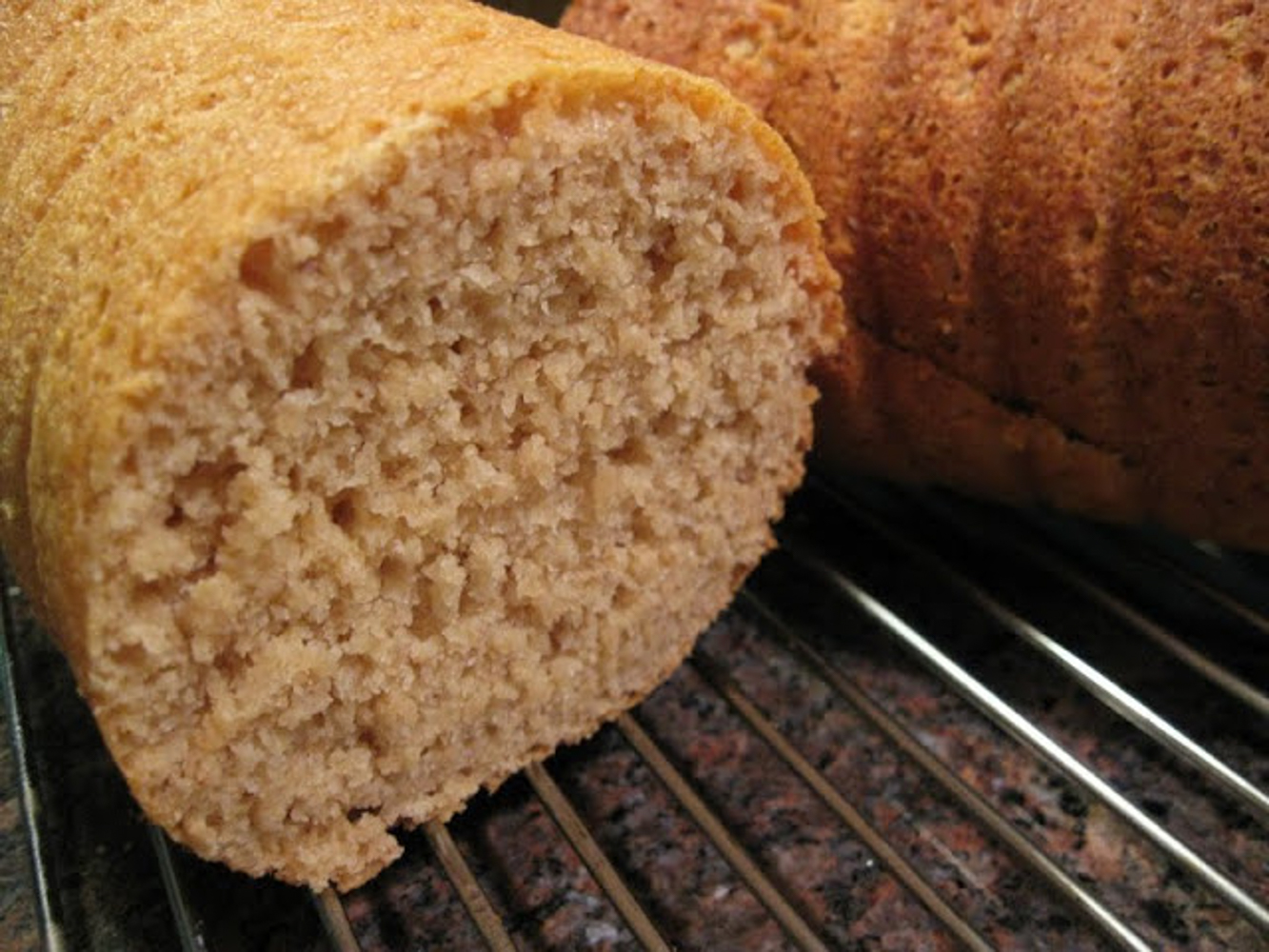
Walt and his wife. The Reynolds were adamant about only using whole grain wheat flour for the baking,
and their passion for whole wheat bread was adopted throughout the
counterculture (as evidenced by articles from underground newspapers). Walt had the idea of using coffee
cans for baking the loaves of bread since they didn't have standard
bread trays in the All Saints kitchen. Thus was born the trademark
identity of Digger Bread.
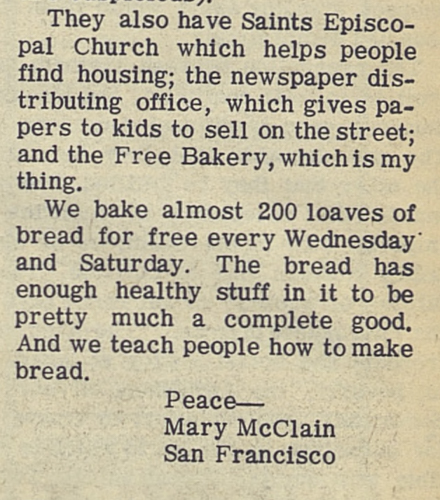
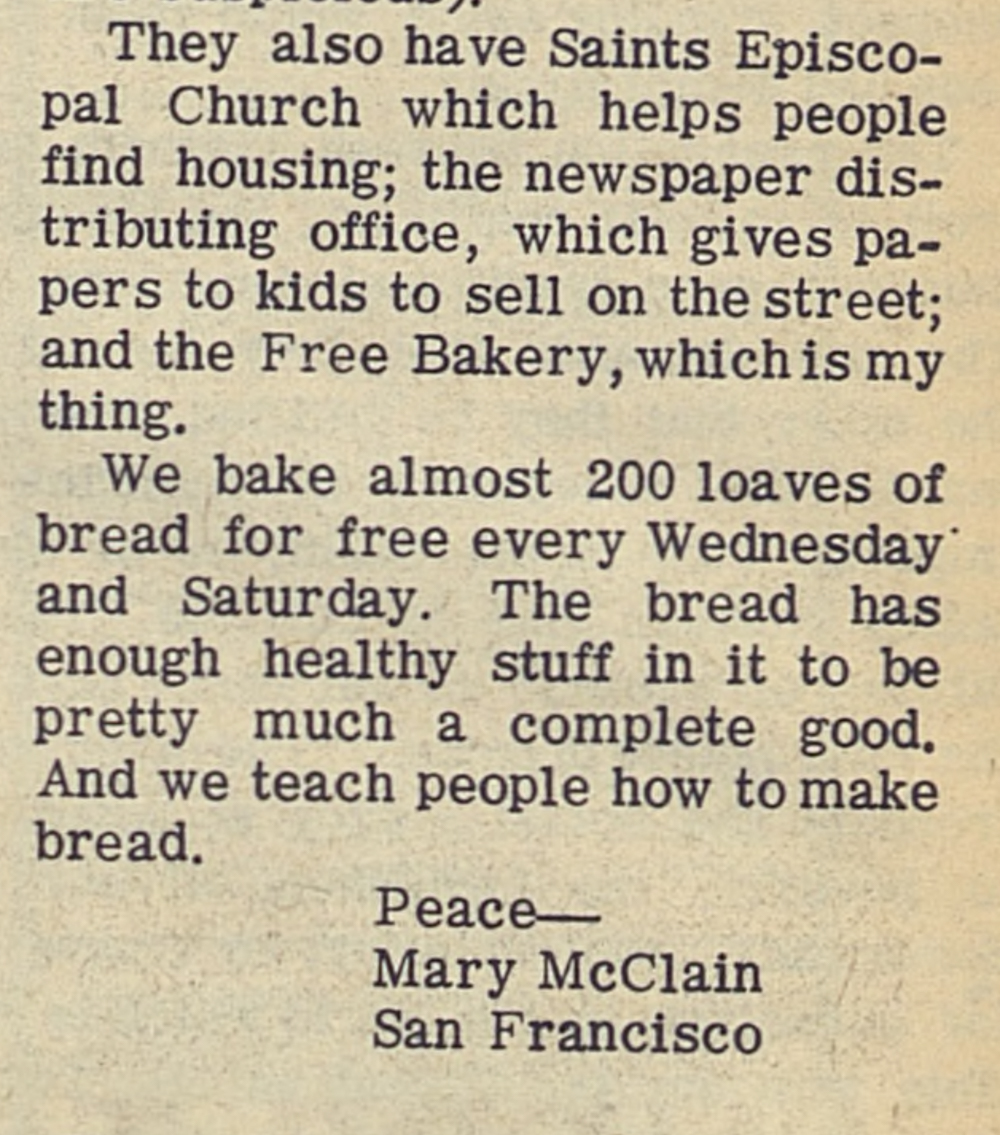
Excerpt from a letter to the Los Angeles Free Press (Sep 9 1967)
from Mary McClain, one of the Diggers at All Saints Church who took on
the weekly production of Digger Bread.
<<==>><<==>><<==>>
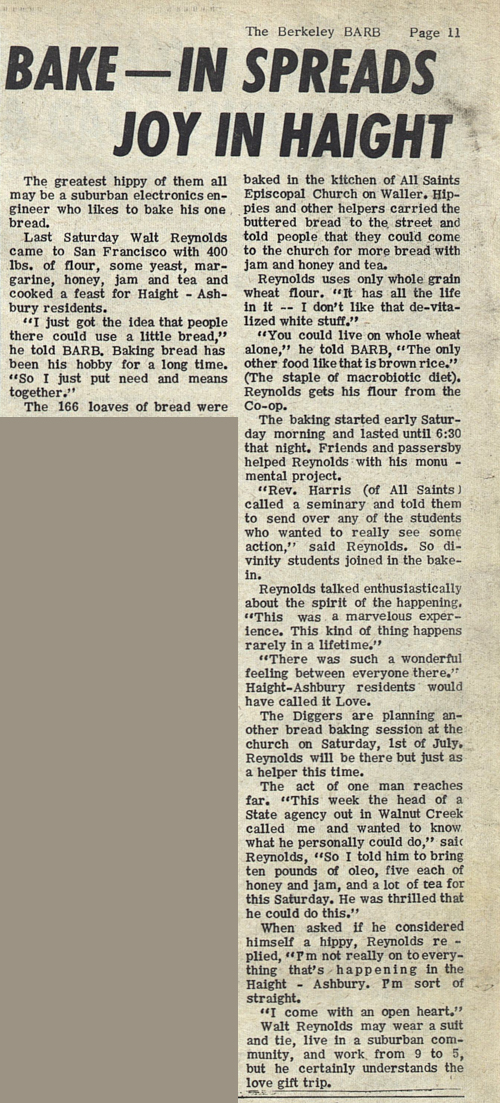
First mention of the Free Bakery in the Berkeley
Barb, June 30, 1967:
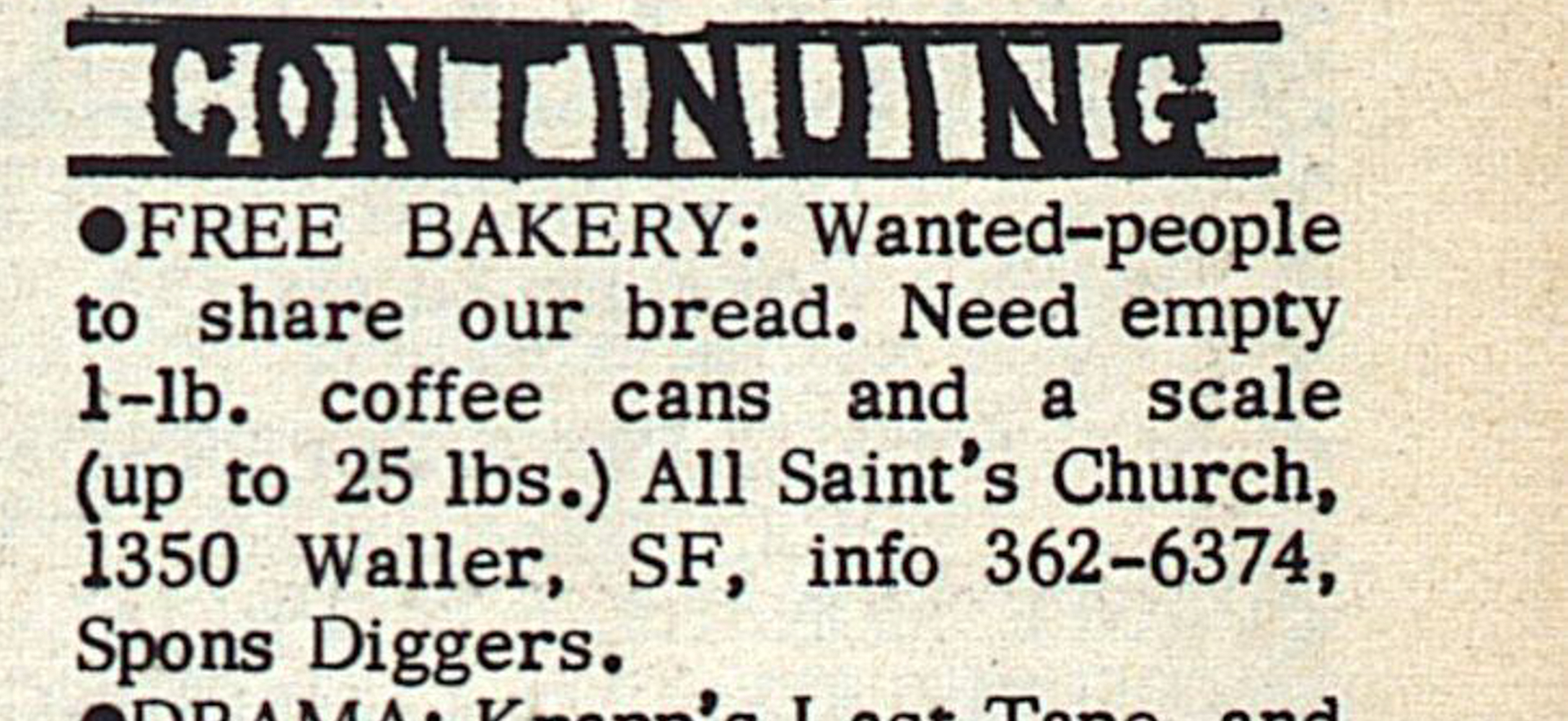
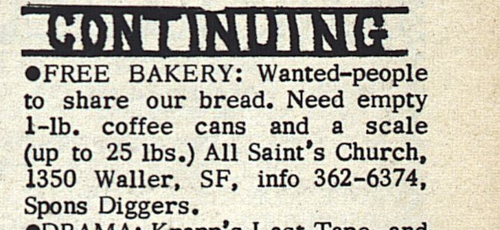
Typical ad that subsequently appeared weekly in the
Berkeley Barb (Aug 11, 1967):
|
Click on images for larger viewing.
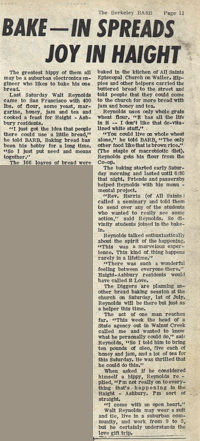
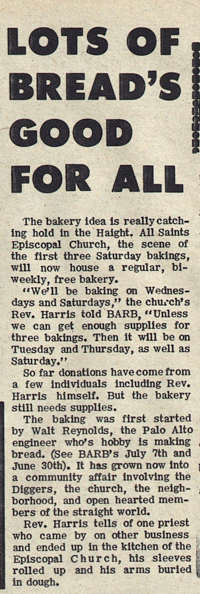
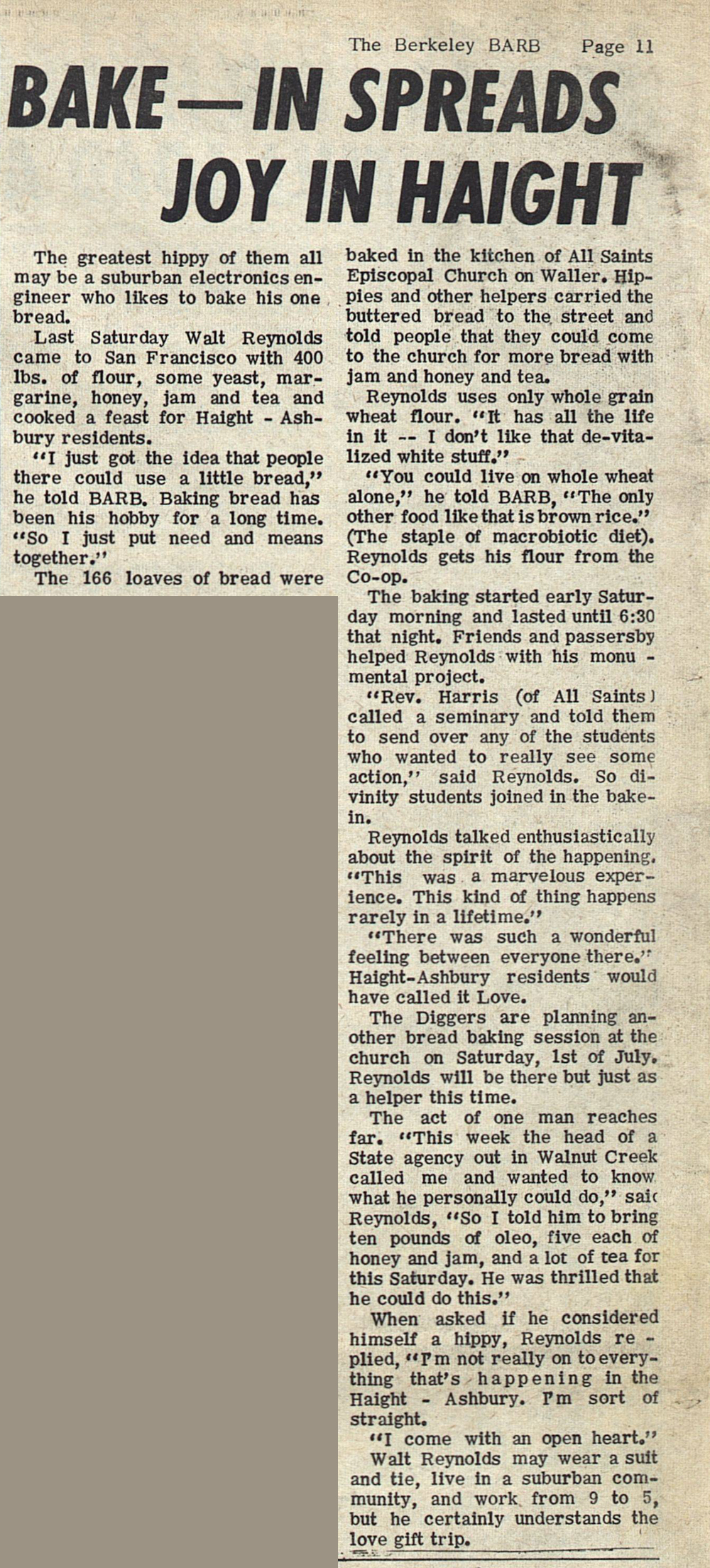
First articles (in two issues of the Berkeley Barb:
6/30/1967 and 7/14/1967) that mention the idea of a "free bakery" in the
Haight-Ashbury.
|
|
I asked Walt about the large oven that the Diggers used for baking
bread at Olompali. Walt told me that story. The baker who sold flour to
them was named Gray (last name), a young fellow who owned his own
equipment and had a one-man operation. One morning things weren't going
well. Gray was baking early—4:30am or
5:00am. He was only wearing pants. It was hot and as he was moving one
of the carts with jelly donuts and pies, it struck something and the
pastries fell all over him. The previous day's receipts (about $100)
somehow got knocked over too, mixed in with the pastries all over his
pants. So Gray took the pants off to clean them. His front door wasn't
locked and just then a woman customer came into the store. She walked
into the back and found Gray sitting on a table, naked, kicking things
in disgust. She demanded to be served and Gray replied, "I have enough
problems. Go on, get out of here." She left and called the police to
report a mad baker. The police came and took Gray to Agnew State
Hospital. He was single, didn't have any family, so no one knew where he
was. Walt came by a few days later and a neighbor merchant told him what
had happened. Walt went to Agnew and found Gray very happy, though a
little disgusted with the woman who had called the police. He stayed at
Agnew two or three months and eventually decided to quit his business.
Walt knew the people at Olompali ("one of the first communes") and he
suggested they ask for the equipment. They did and Gray said, "Sure,
clean the place out." So the Olompali people came down and took the oven
back with them and set it up on a concrete pad next to the swimming
pool.
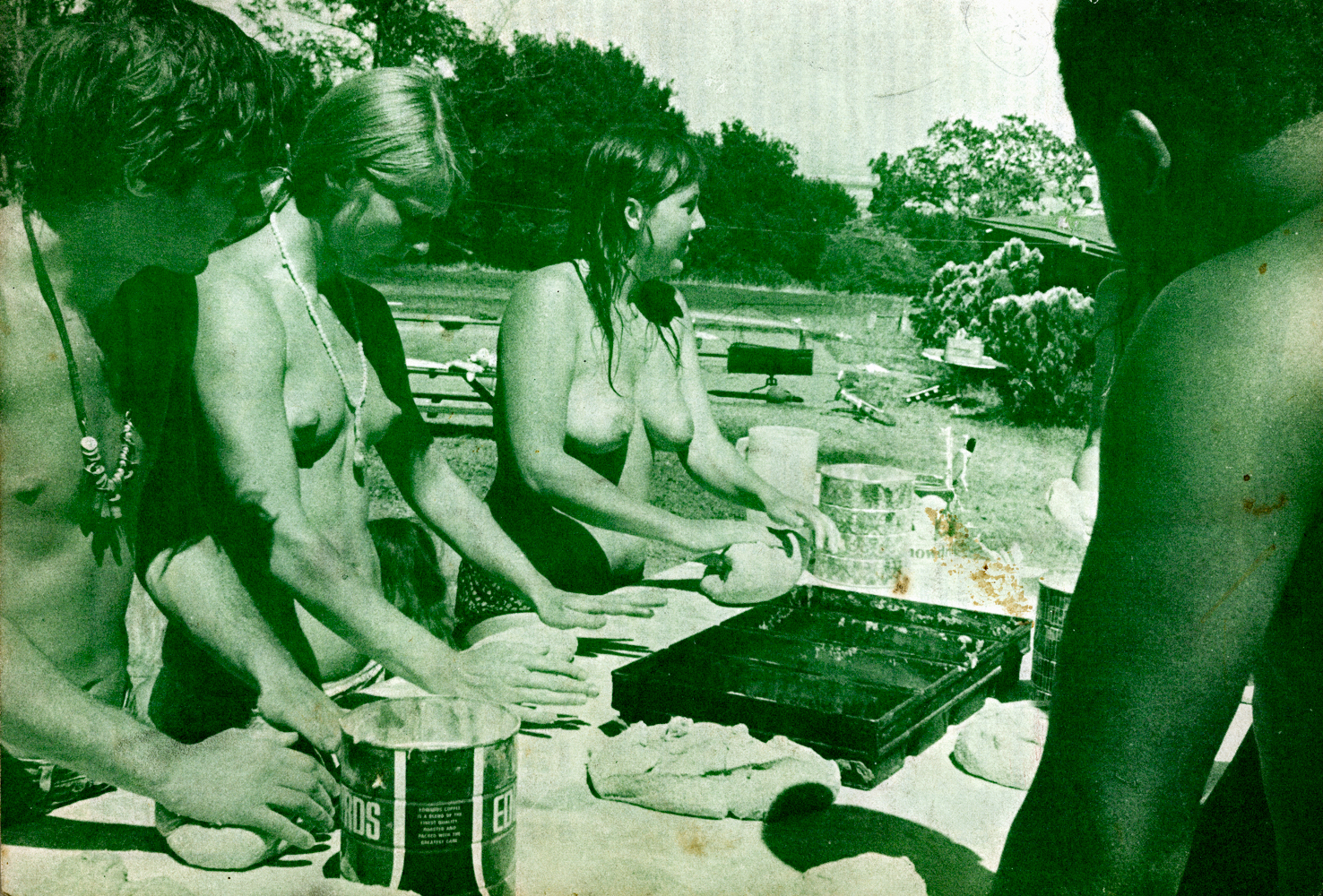
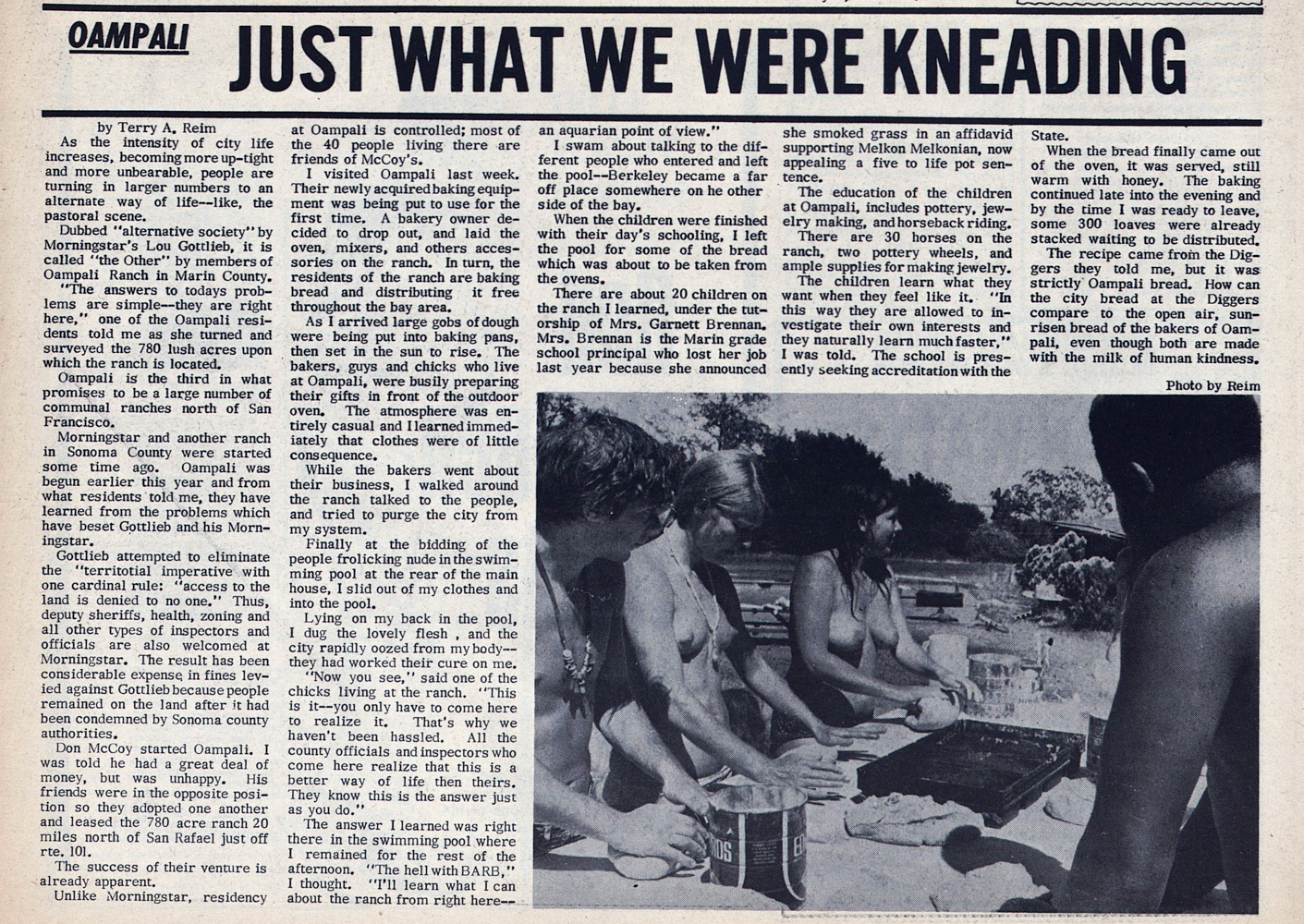
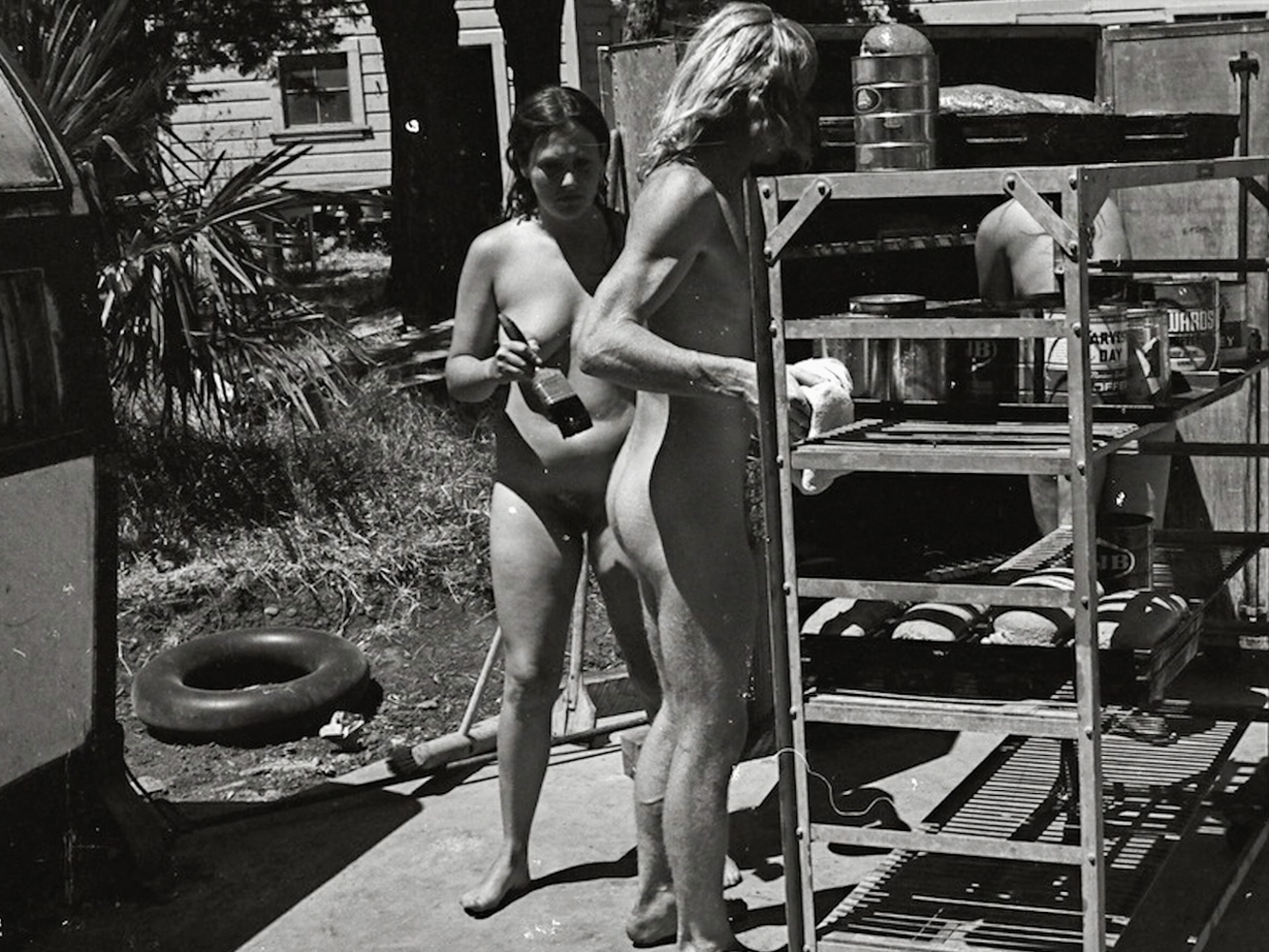
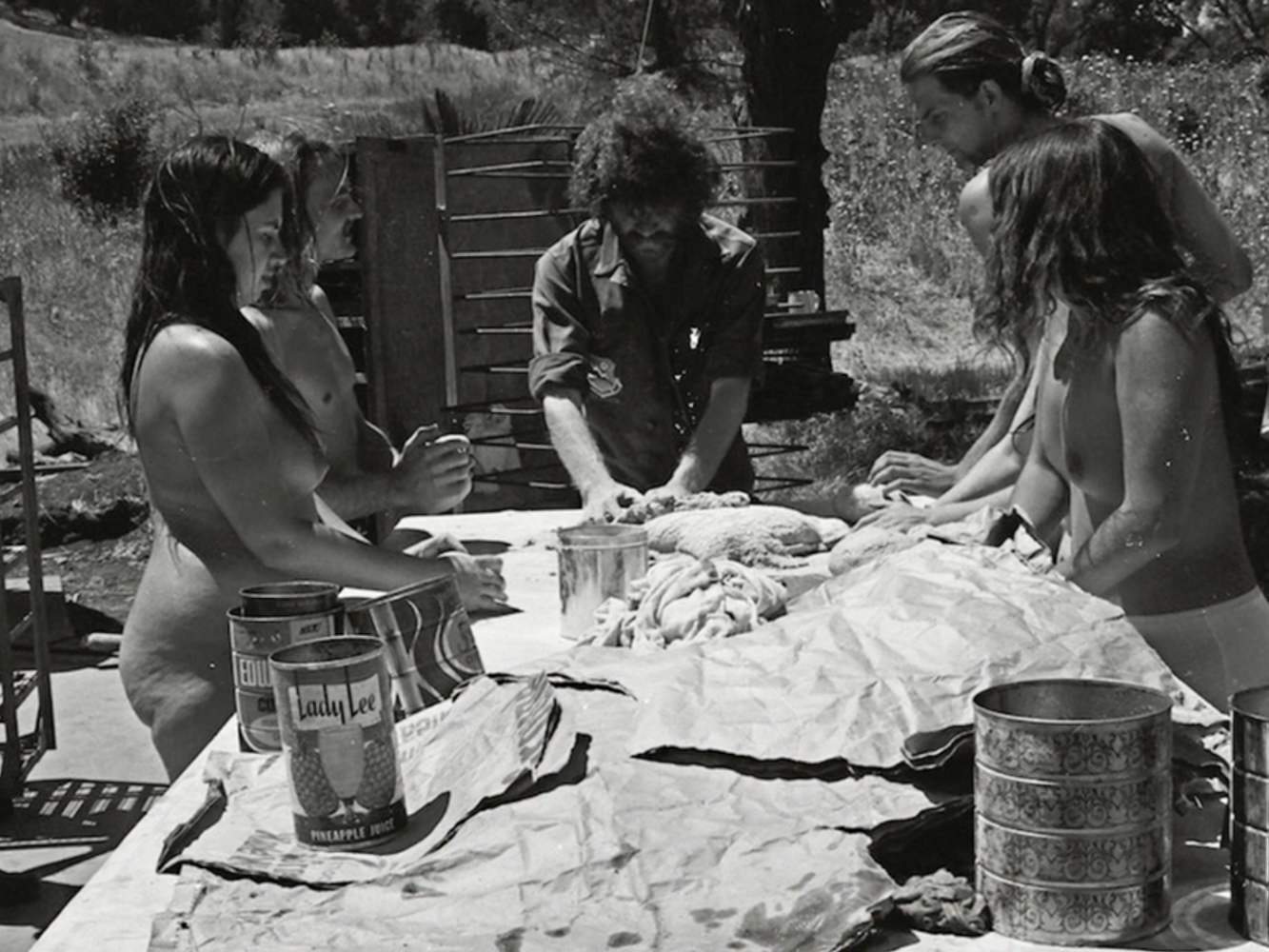
Walt recalled that, "Kneading bread at Olompali was a topless
affair." One day Father Leon Harris (from All Saints Church), his wife,
Walt, and his wife, went up to Olompali to dedicate the equipment. They
got there about 10:00am. One red-haired guy (who had always been rather
lazy around the Haight but had come into his own after the oven went to
Olompali) was busy baking bread with another guy, without any clothes.
Soon everyone got up. The women started kneading and took off their
tops. Father Harris gave the litany in Latin. "He's very straight but he
didn't even bat an eyelash," Walt recalled. He remembered that Father Harris never
spoke about religion unless asked to, but he was always a Christian in
his actions. Even though it cost him most of his congregation, Father
Harris
emphatically said it was his mission to serve the people in the
neighborhood meaning the new residents of the Haight-Ashbury.
See the remembrance of Olompali by David Simpson (below).
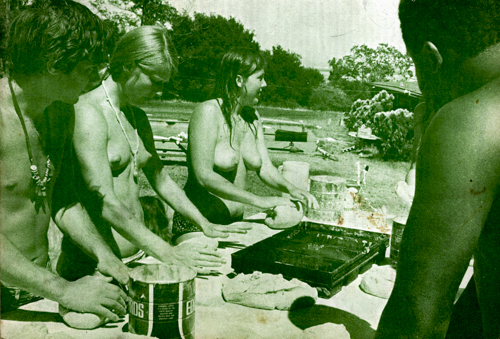
"The women started kneading and took off their tops.
Father Harris gave the litany in Latin. 'He's very straight but he
didn't even bat an eyelash,' Walt recalled."
|
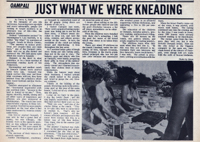
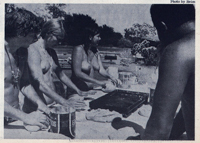
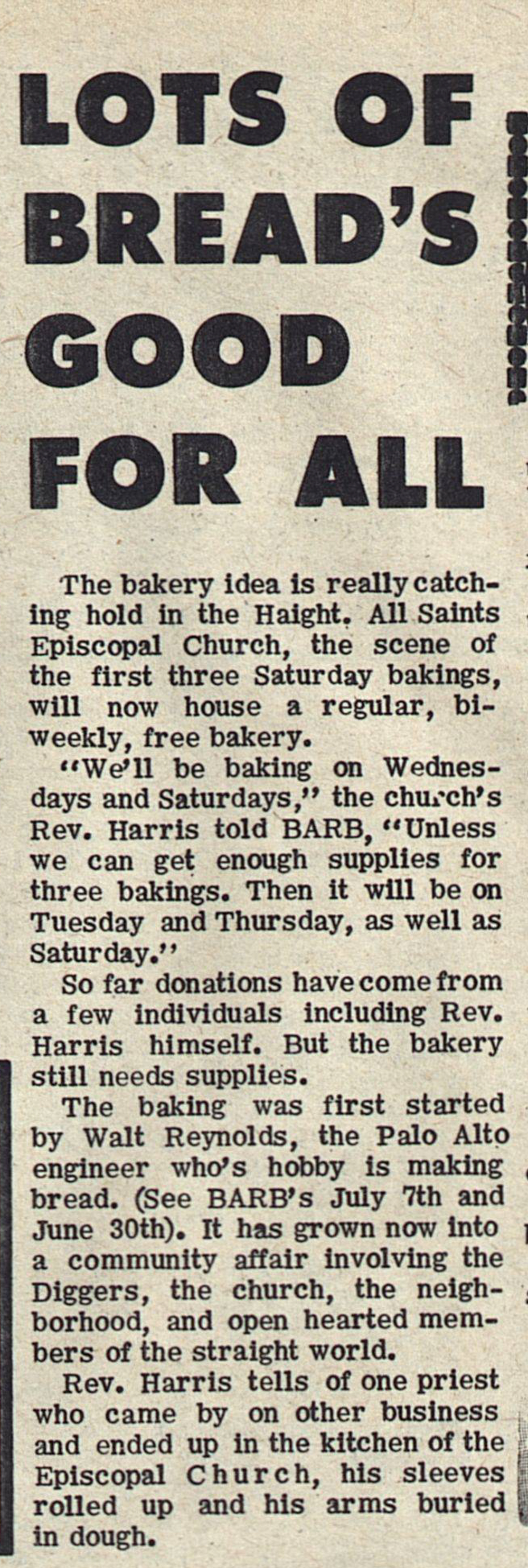
Article from Berkeley Barb, July 12, 1968.
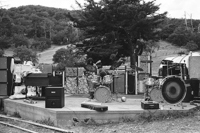
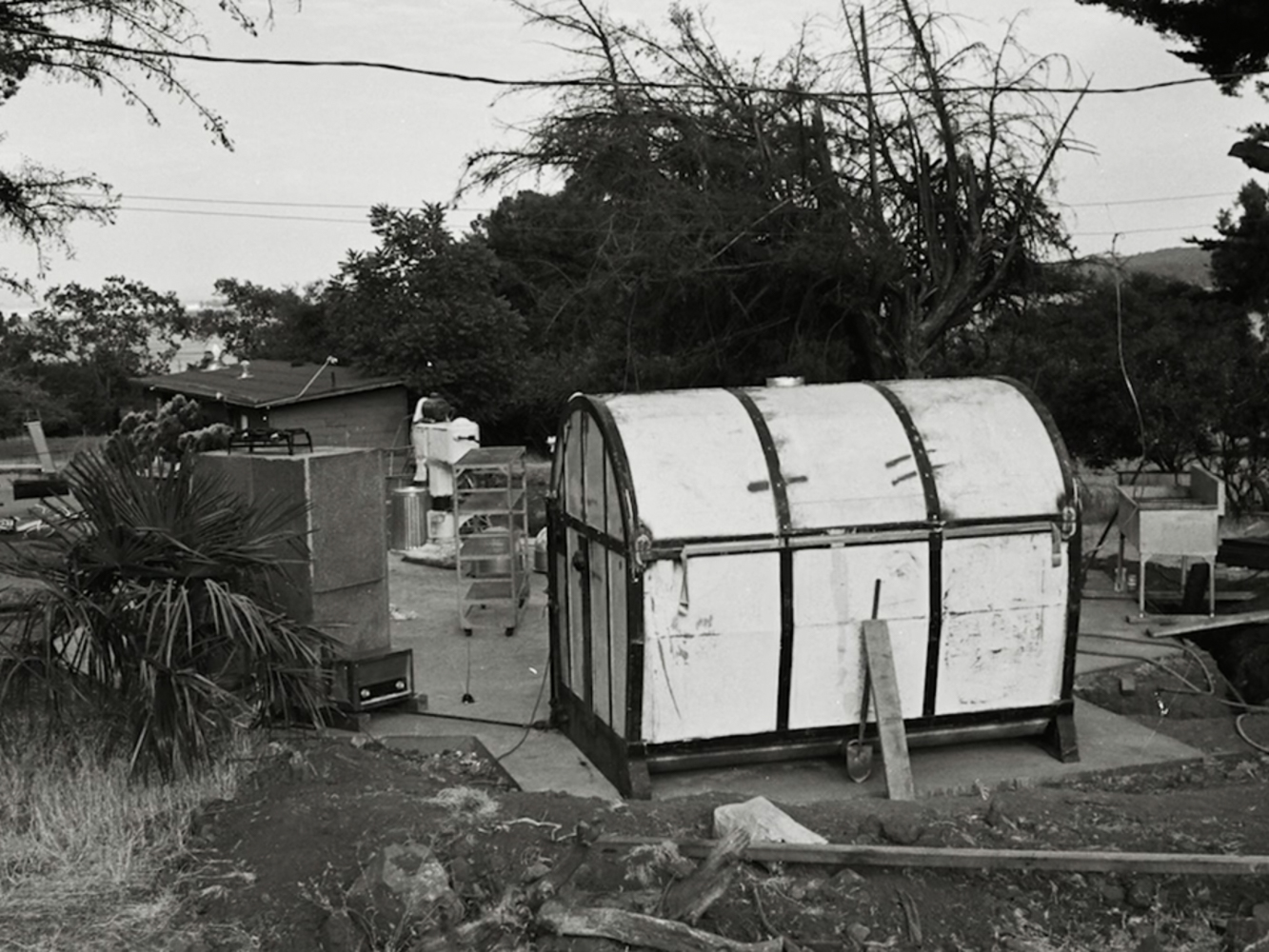
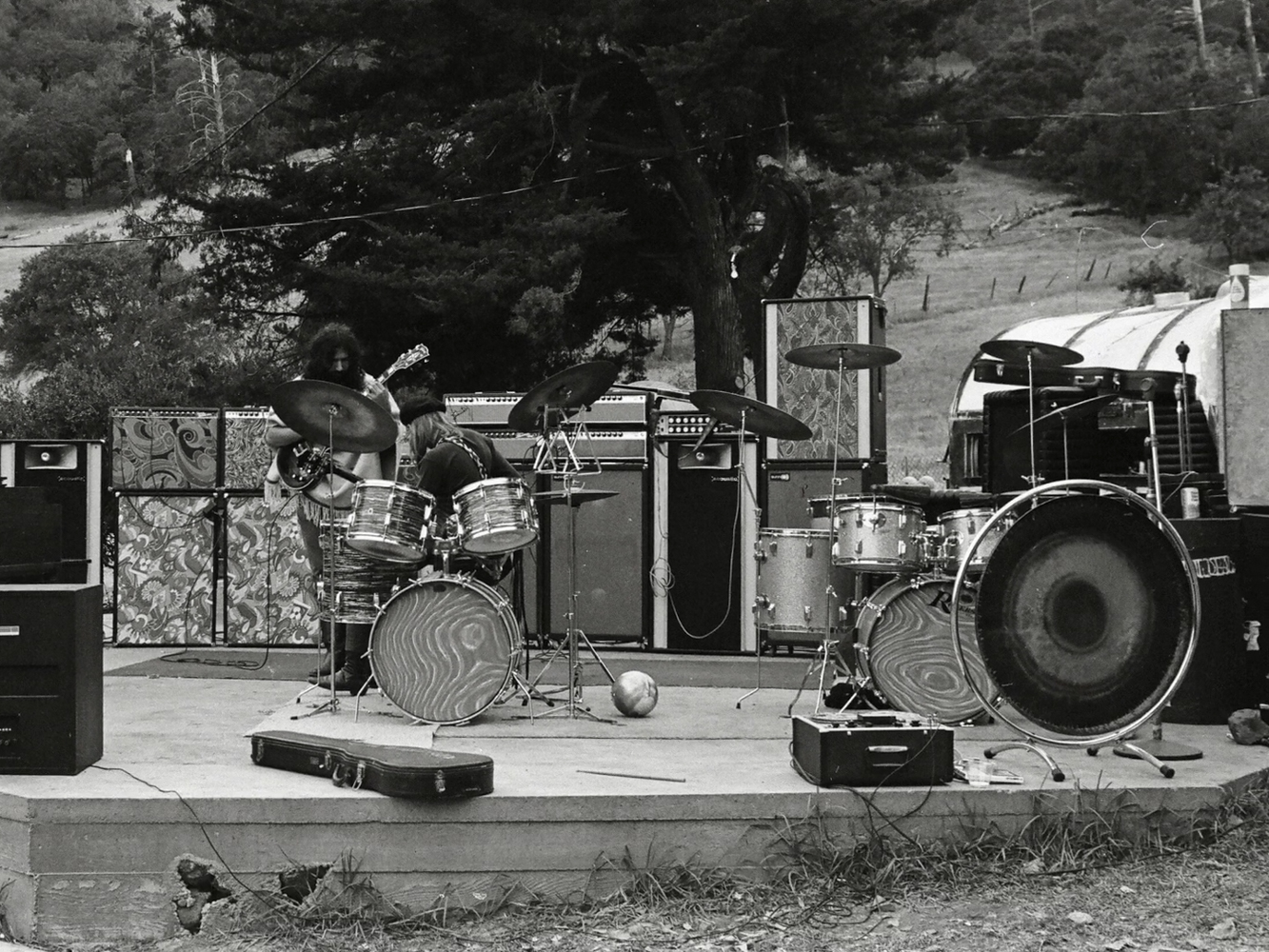
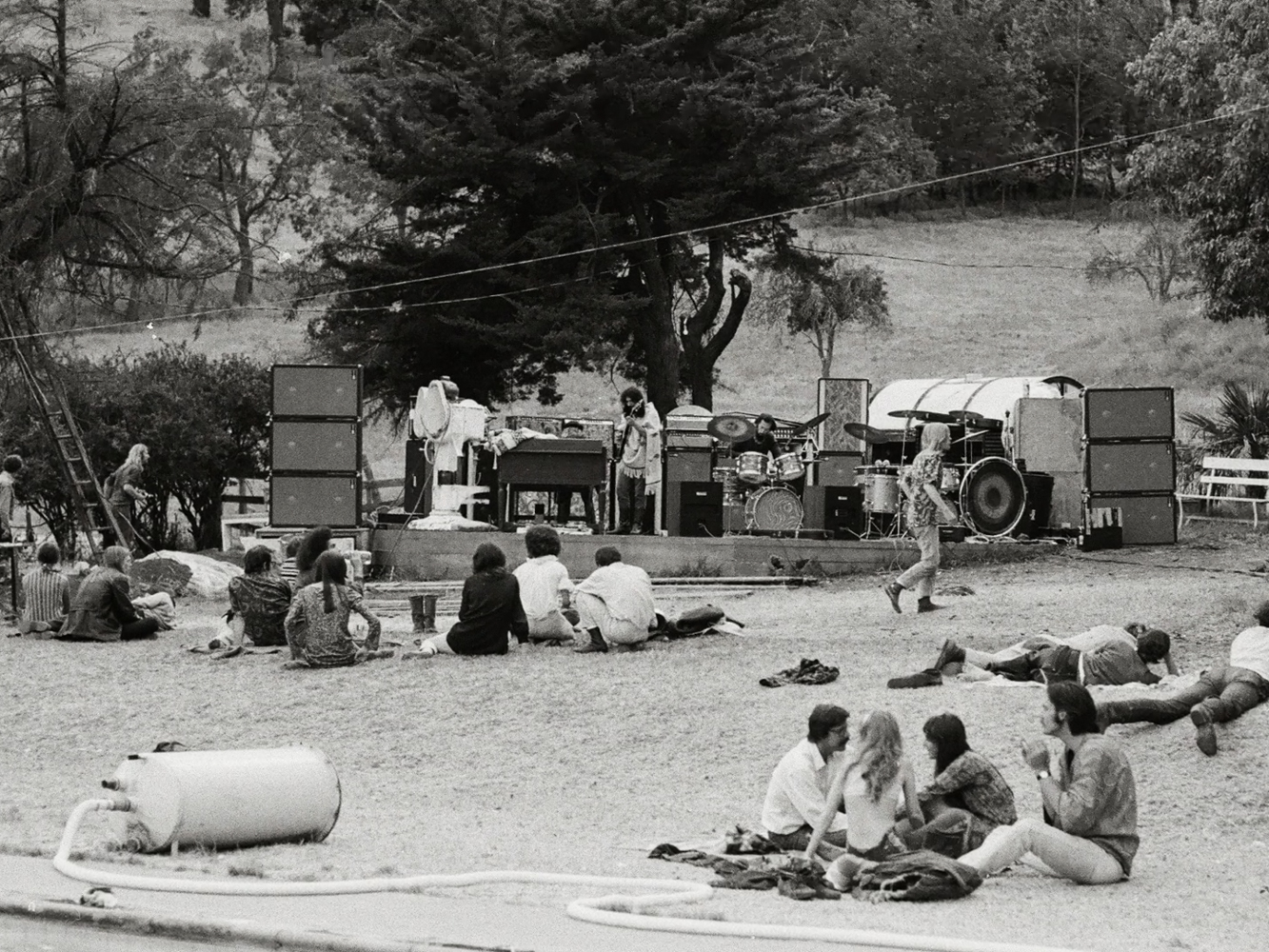
View of the concrete pad where the bread baking oven was located.
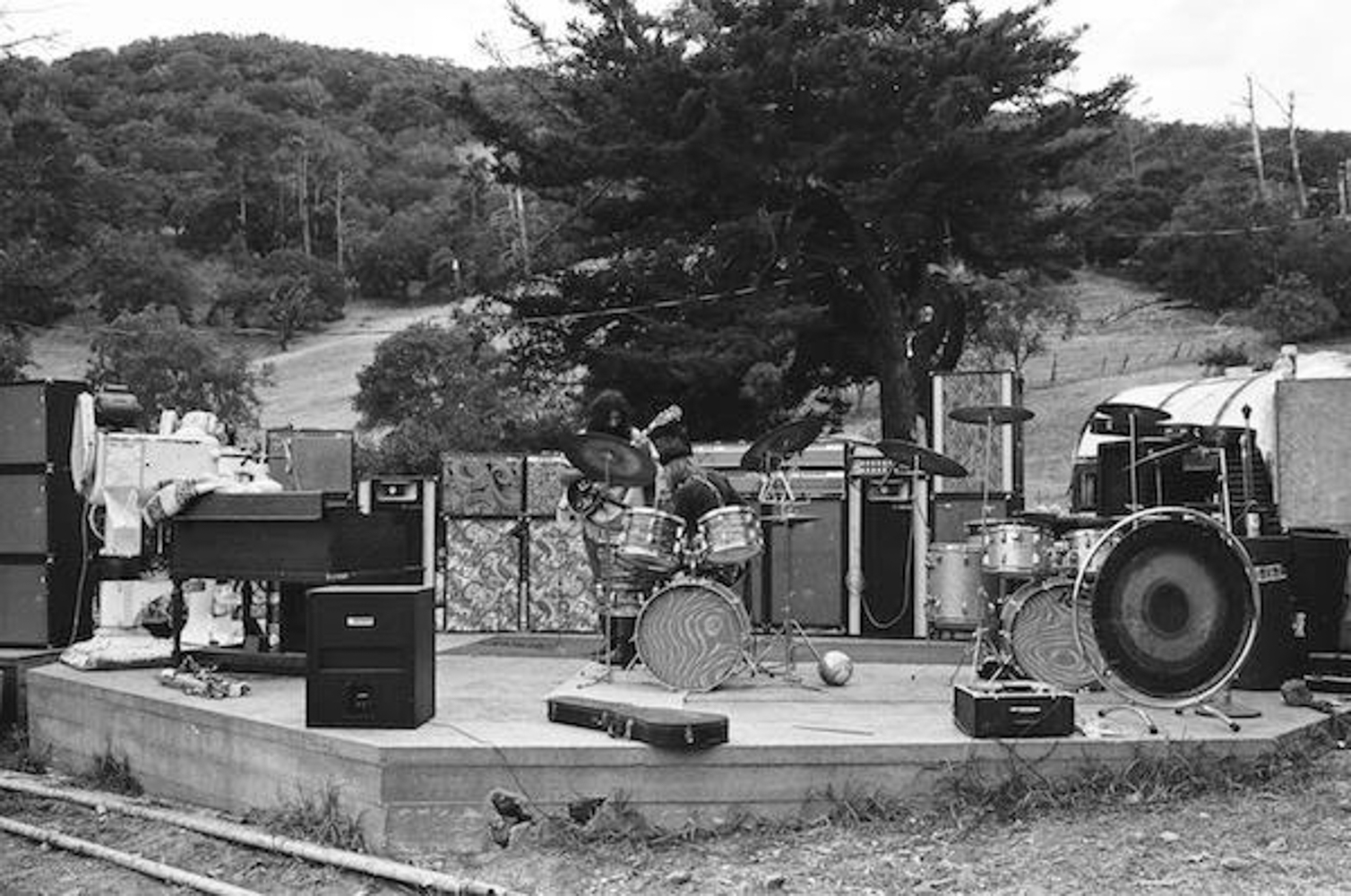
This photo shows the Grateful Dead getting ready to perform. The oven is
barely visible (right rear of photo).
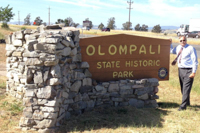
Today, the site of the Olompali Commune is now a California state
park.
|
Remembrance of Olompali
By David Simpson
[When I recently sent an email to the Digger listserve with an
attachment of the photo (above) of a baking session at Rancho Olompali
Commune in 1968, David Simpson was inspired to share the following
remembrance. David tells the story of how the large oven and other
equipment were brought to Olompali by the Diggers and installed in the
summer of 1968, and how the Diggers arranged weekly outings from the
Fillmore with neighborhood kids who tagged along and which resulted in
tons of baked loaves of whole wheat bread that were brought back and
distributed for free in San Francisco. Be sure to check out David and
Jane Lapiner's video of a
2011 reenactment of Digger Bread.—ed. 11/20]
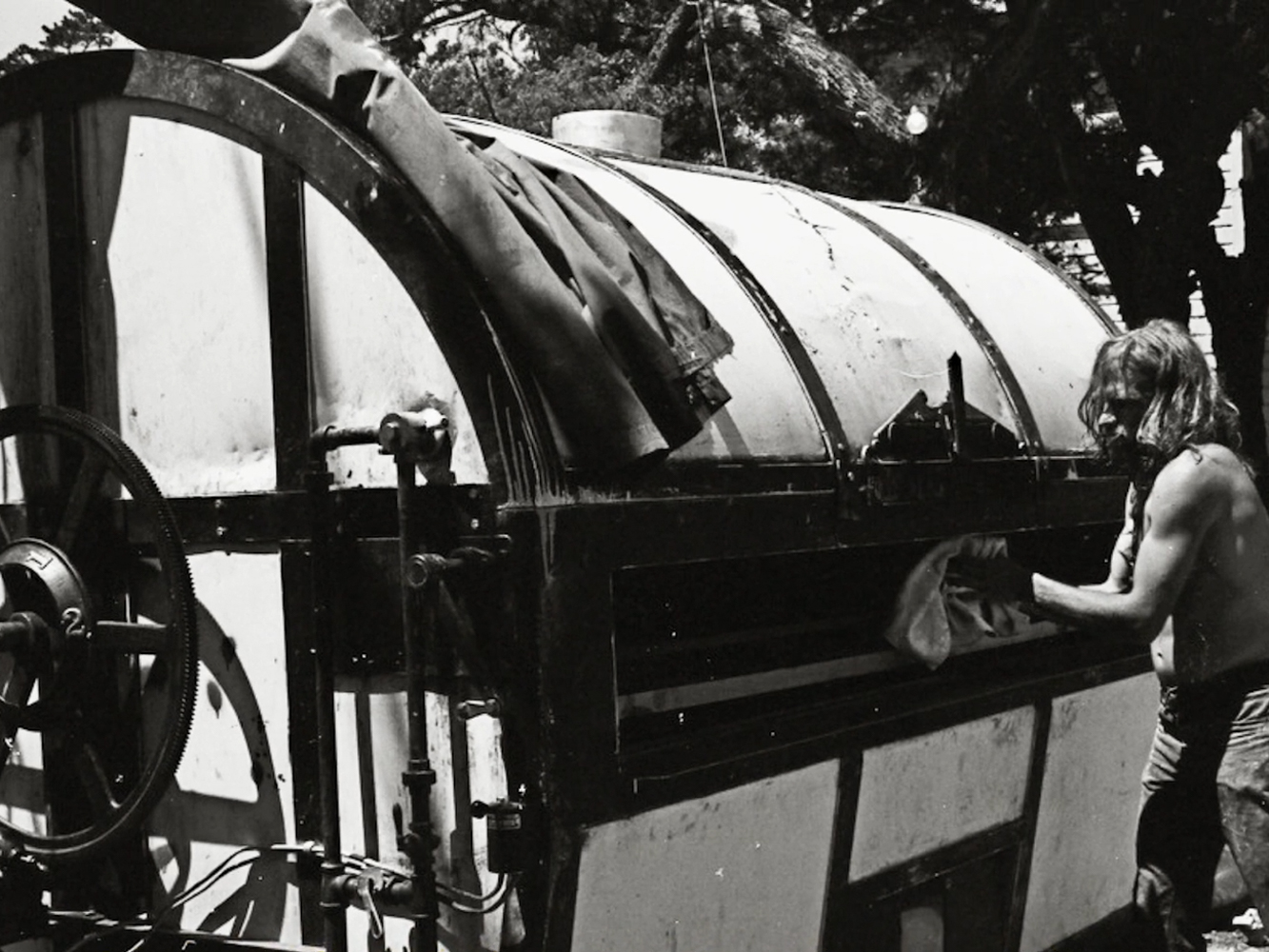
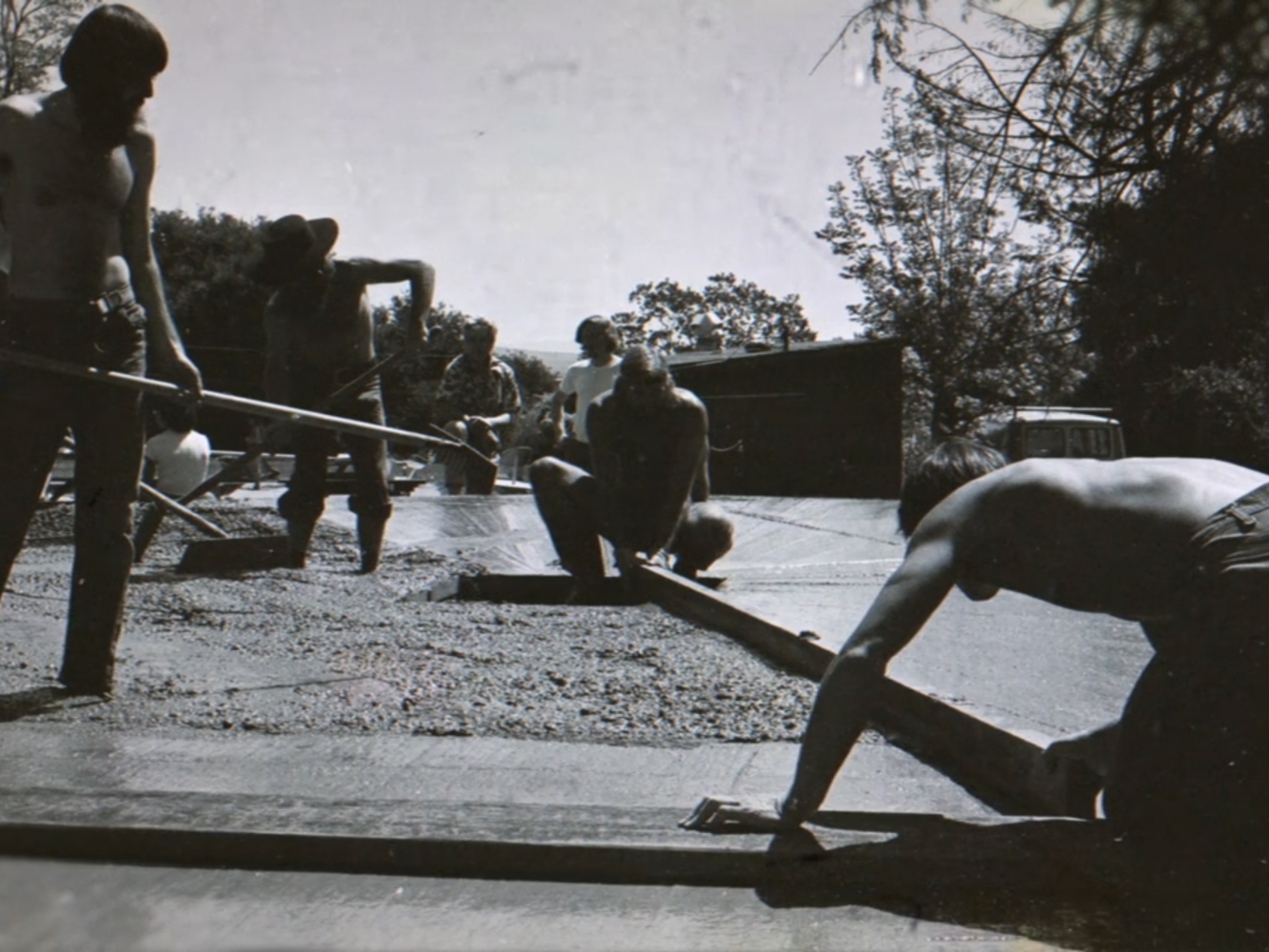
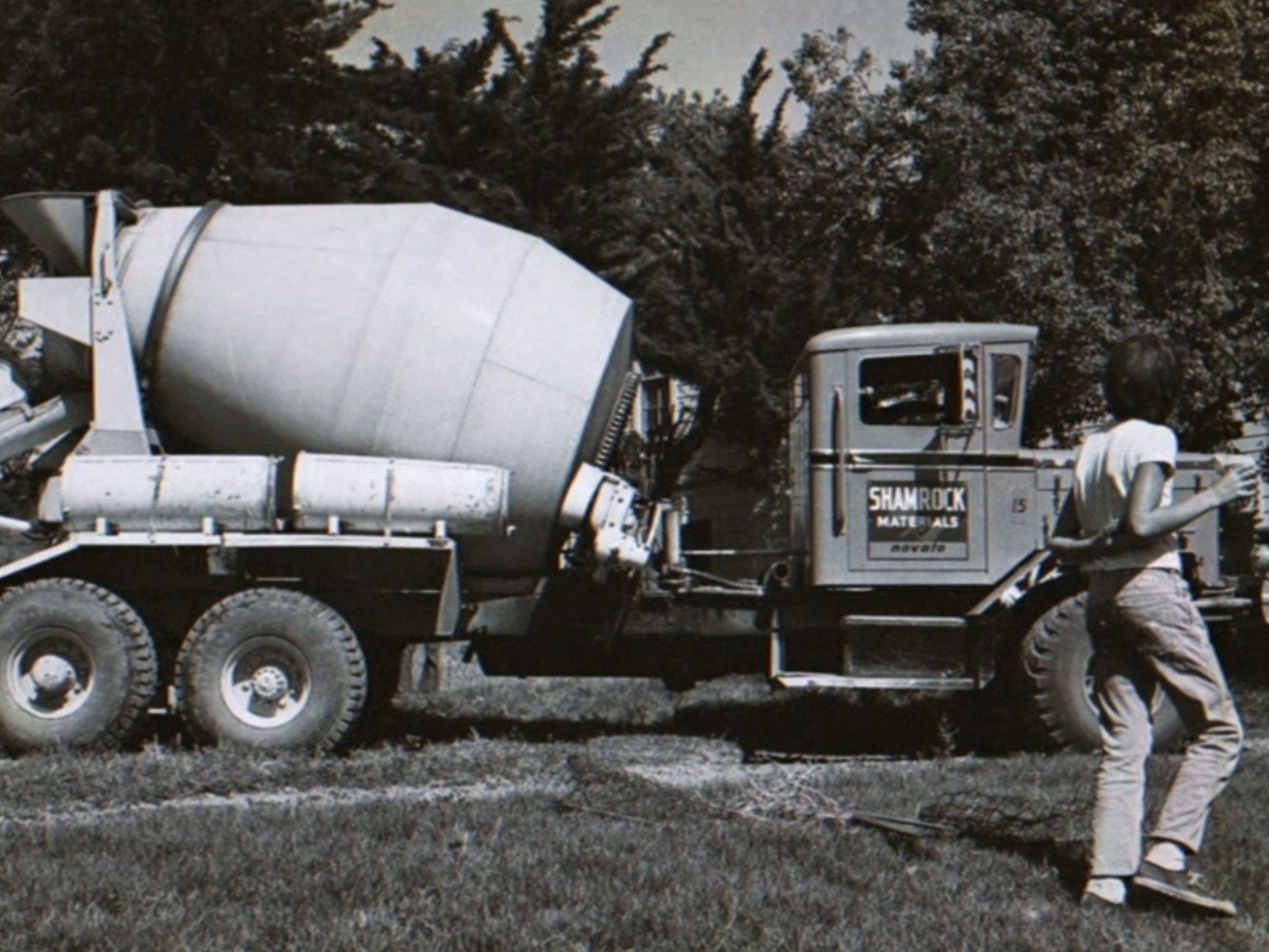
[Click on thumbnail images in side panel to view a full-size version
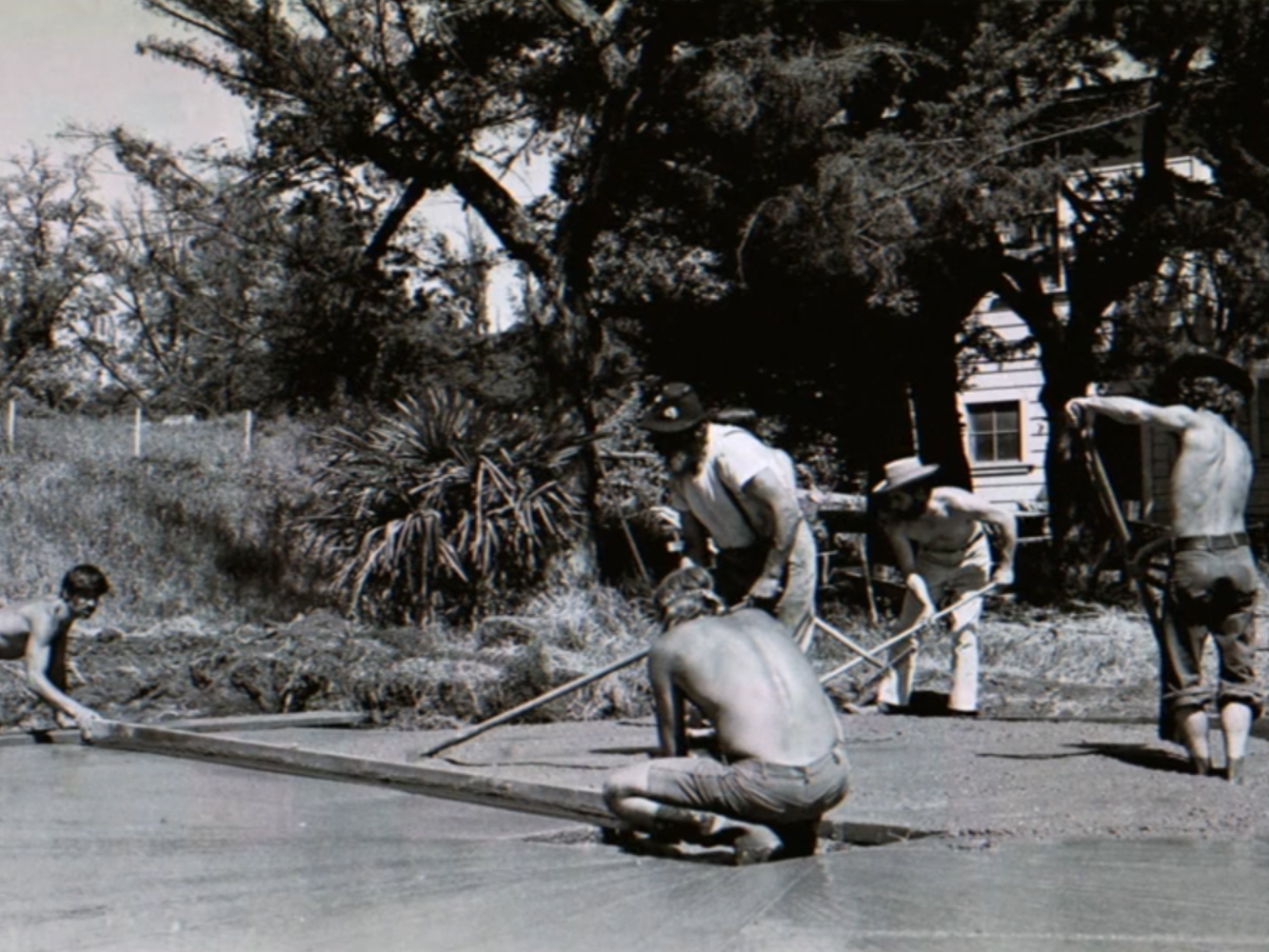
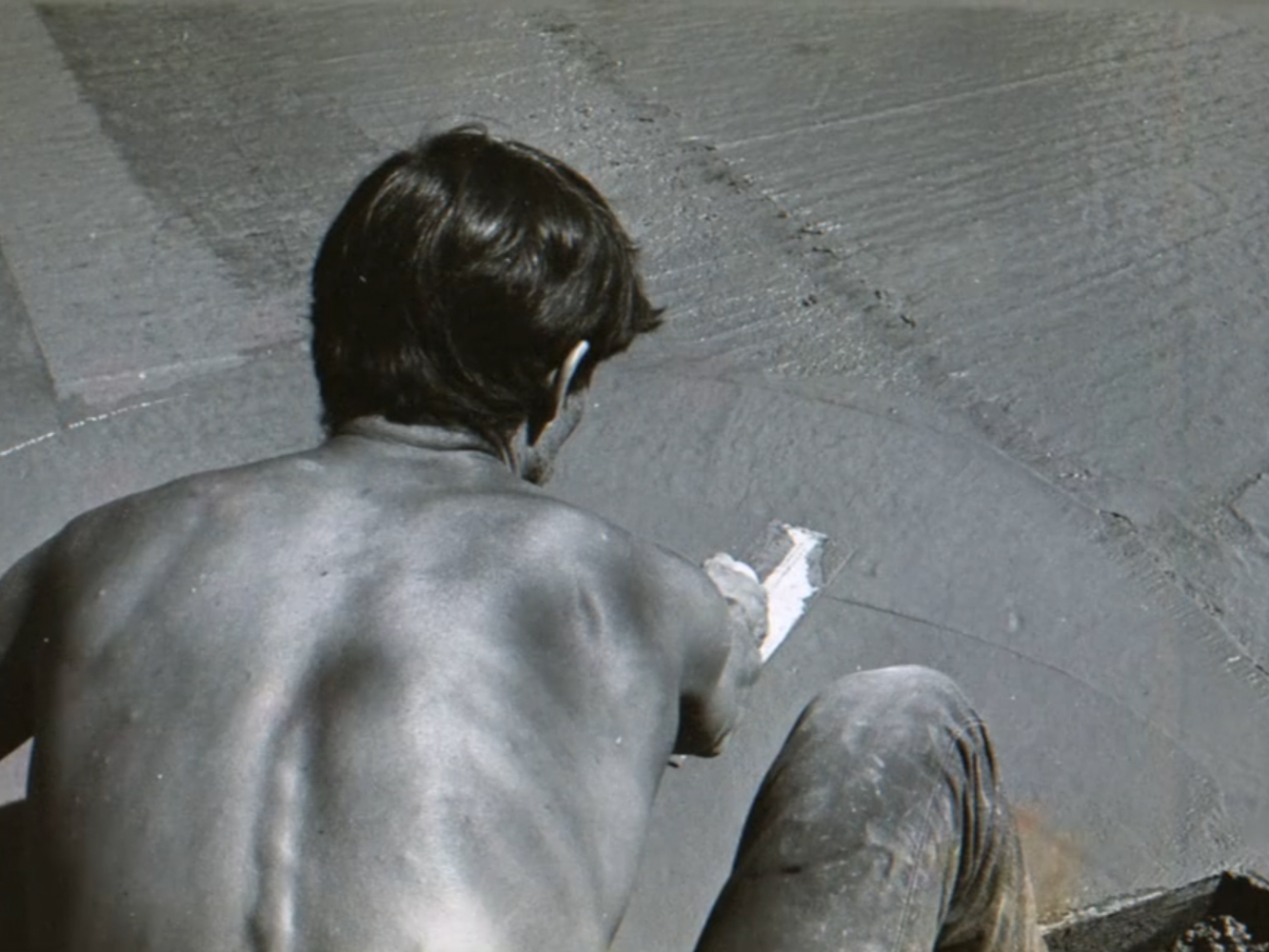
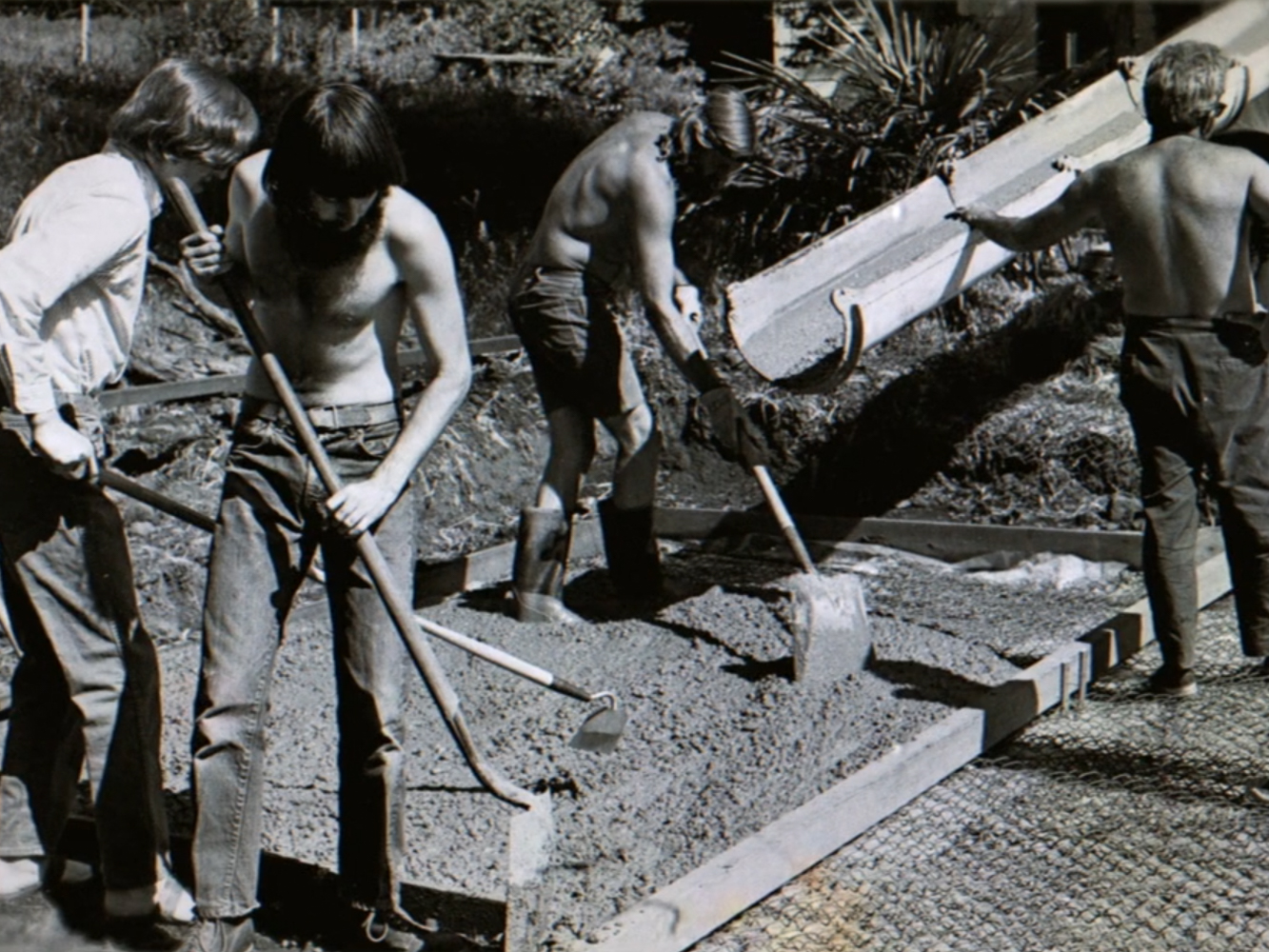
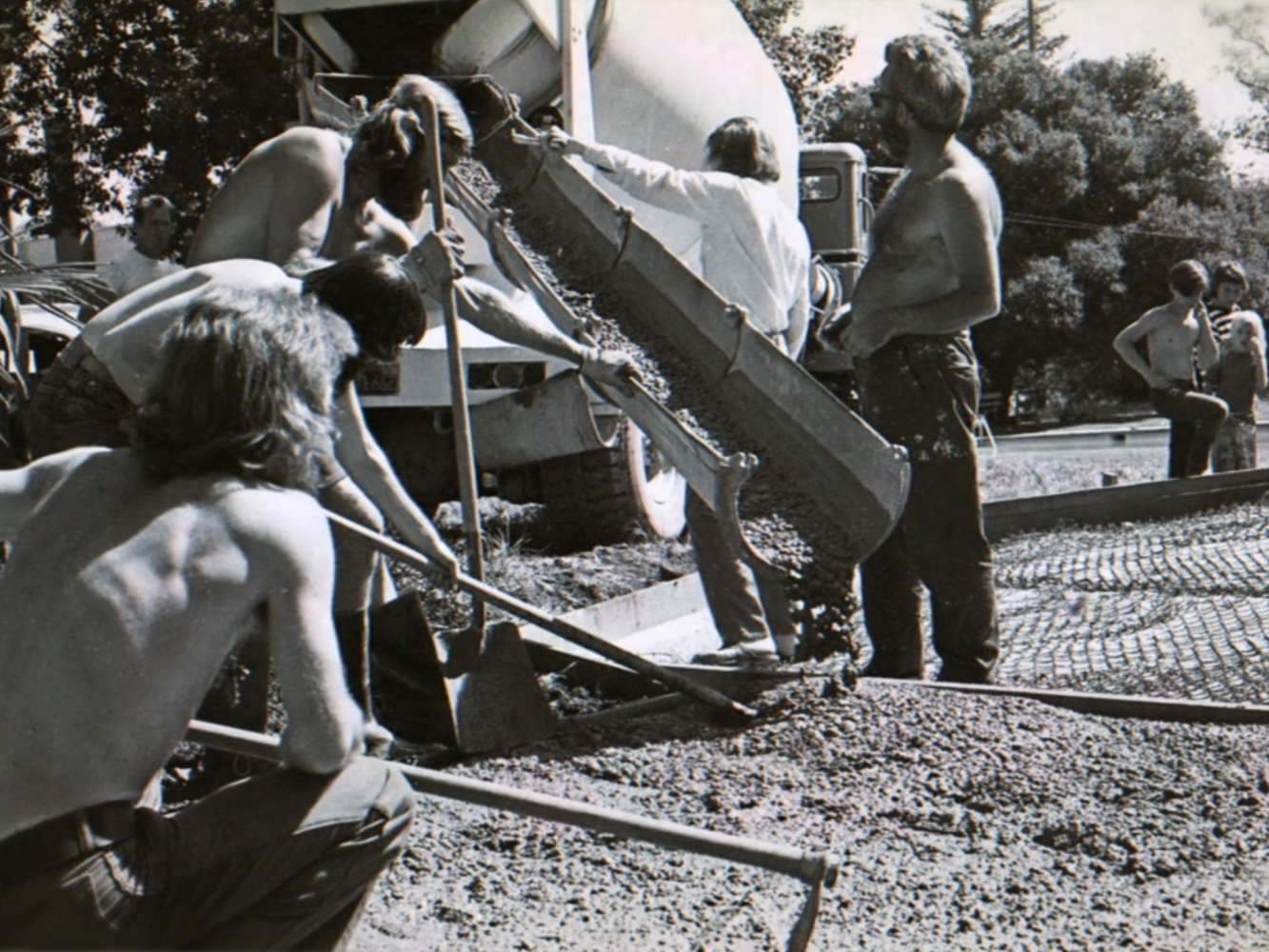
of each photograph. The images are screen shots of photographs by Noelle
Barton that appeared in the film Olompali: A Hippie Odyssey. All thanks
to Noelle for capturing this moment in time.]
Sorry to intrude but I just can’t let this one pass by without
comment. I am muddy on some aspects of the Digger Free Bread adventures
of the late ’60’s, but I recall the Olompali part of it pretty well.
Jane and I and a bunch of us were living in a seedy but very sweet old
mansion on Pierce Street a block over from Haight after us having moved
into the Fillmore proper. We had sort of inherited the place from the
Steve Miller band (via Harvey Kornspan) who were abandoning the city
just then for the greener climbs of Marin. There are, of course, long,
enduring stories connected to that house—stories of gorgeous groupies,
street altercations, Black Panthers, making
Nowsreal, and deeply
religious observations disguised as orgies—but who’s interested in that
kind of stuff anyways? In the name of something resembling brevity then,
I cut to the chase, gradually. Somewhere in this,
Kent
Minault, a buddy of Mime Troupe and Digger origins and his partner
at the time, our dear friend, Nina had employed their famous converted
flatbed known as ‘The Big Fucker’ in the middle of the night task of
moving a commercial bakery that had been abandoned by its owner
somewhere in Oakland (the move was just ahead of a Bank foreclosure) to
Rancho Olompali. That now famous (or infamous) locus a few miles north
of Novato was in the earlier stages of Free Family colonial
undevelopment under the tutelage of Chief Host, Don McCoy, also a friend
and first-rate Trooper. (Not ‘Mime” but ‘Soul’.)
We called Don that very night, as I remember, to see if he and his
crew had any room for us to store this potentially valuable set of
baking equipment. Don didn’t hesitate for a second. “Bring it!” he
proclaimed and we did. There was a rather large cement and tile
swimming pool already gracing the property back then and Don, taking
ambition for our bakery project to new height, gave us his permission
and support to set it up right alongside the pool. Which, over the
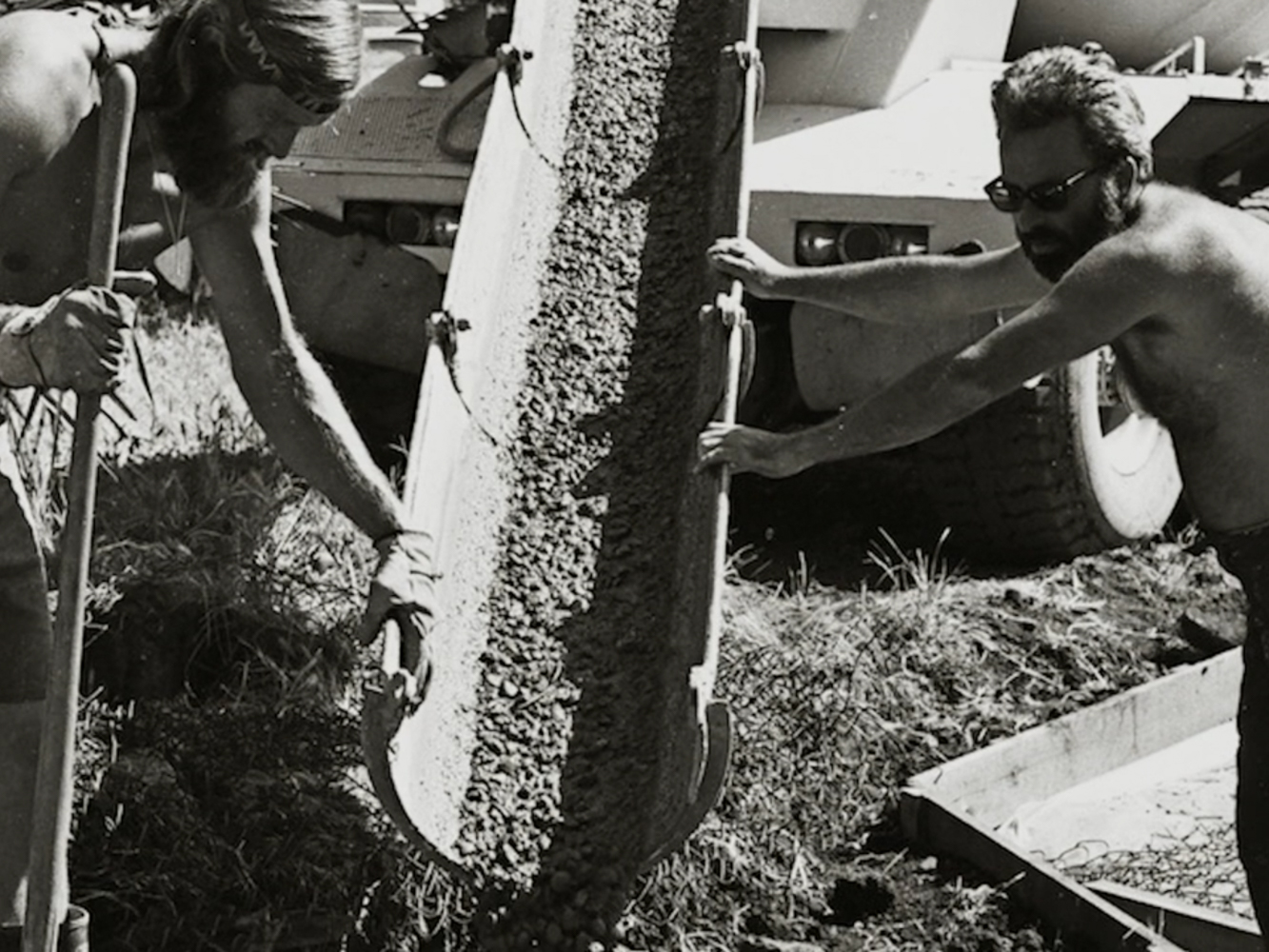
course of a couple of working days, we did—poured cement, plumbed the
water and gas piping, set up several ovens, mixers, bakery tables. All
of this strenuous activity was carried on by the pool under the piercing
sun and intense California early summer heat. This circumstance resulted
in a schedule of strenuous bakery installation work interspersed,
naturally, with dives into the pool almost all of which was done without
bathing suits.
One picture of that aspect that stands out in my mind was of Leo
Blasenheim, Nina’s father, who had showed up just then on a paternal
visit from his home in Astoria, Queens, NYC. Lucky for us, Leo had
gained access to some of the tools of his trade which was, believe it or
not, pipefitting. Imagine, a NYCity pipe fitter showing up at
Rancho Olompali in the Northern California countryside just in time to
plumb a full-on commercial grade bakery at the side of a deep blue
swimming pool surrounded by a bunch of naked Diggers, accompanied
subsequently by a pack of country-hungry children. Leo toiled all day in
the hot sun fully clothed and, like the decent, old-school kind of guy
he was, managed to keep his mind on the work mostly undistracted by the
dozens of naked young workers all around him several of whom I somehow
recall (who was looking just then?) were women of substantial
pulchritude. Leo did good and hopefully is reaping his reward along with
Don, both now ensconced firmly in the Great Beyond. We actually got
the job done, installing what may have been California’s one and only
poolside bakery and thereafter in the remaining months of that summer we
bombed up from Pierce Street in our old (l954) brown Dodge pickup two
days a week (Tuesday and Friday as I recall) after hustling flour and
other bread-making ingredients from very generous guys who worked at one
or another place in SF’s warehouse district (which was not far from the
produce district, home of much of the earlier Digger diet). And then up
to the Rancho. But only after Jane and I additionally encumbered each
trip only slightly by the addition of 6 or 7 kids from the Pierce Street
neighborhood that we loaded into the open bed of the pickup each
run—kids who had never been outside of the city. For them, country was
maybe “Oakland”? With this odd, noisy, highly visible load, we’d
stagger up 101 to the rolling oak savanna of northern Marin/southern
Sonoma. Before I could even turn off the truck, the kids would leap down
and literally disappear into the oaks and brush and be gone for the next
few hours as if they had always belonged there and knew where the hell
they were, until we corralled them for the trip home. For most of them,
it was as close to summer camp as they were likely to get and
miraculously surviving relatively unharmed their adventures into the
backcountry. The Gods were no doubt with us. How could they not be, I
ask in as much humility as I can muster now at his long past late date.
And we, these lunatic adults, would bake bread IN COFFEE CANS all the
rest of the day—maybe 6 or so hours—alternating with blissfully cooling
dives into the pool we shared with some of the regulars to the Ranch who
were slightly scared of us—these wild tribespeople, country cousins from
what was still left then of the Free City as the Summer of Love faded
into rear view mirrors of fleets of ancient trucks, many headed
consciously now though still at least indirectly Back to the Land.
We’d pack up then, gather that days’ contingent of kids and head home
into the the city now armed with maybe 250-300 per day coffee-can-shaped
loaves of bona-fide whole wheat bread. (Whole wheat bread was still
something of a novelty back then we learned decades later from Alice
Waters and the guy, Steve, who started ACME Bread who took us under his
wing for a day's tutorial once at the UC Berkeley historical
library—another story, thank you, Peter.) It was heavy stuff,
poundage-wise and sometimes hard as nails, but the single mothers of the
southern Fillmore/Haight Ashbury of the same now-well-recreated kids
were happy to see it, aware that it was healthier stuff than their usual
corner-store fare especially after we’d supplemented the bread with a
little of the stinkweed Mexico shake we also dropped off in a last paean
to true wholesomeness, all of it Deliciously, Deliriously, Dangerously
FREEEE! Goddam we slept well. 30 October 2020 [Photographs in the side
panel by Noelle Barton from the documentary film Olompali: A Hippie Odyssey
(2019). Directed by Gregg Gibbs. Produced by Maura McCoy. Edited by
Lucas Celler. Director of Photography Tyler C. Johnson. Narrated by
Peter Coyote. Surrey Lane Productions.]
|
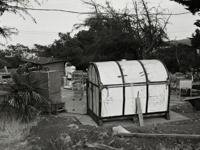
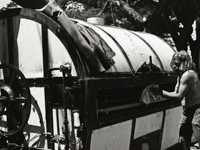
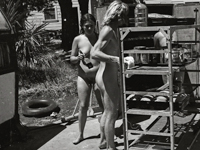
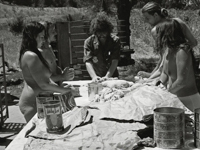
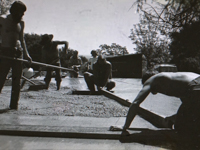
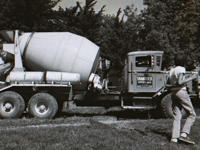
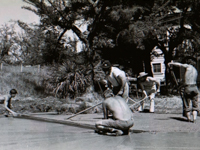
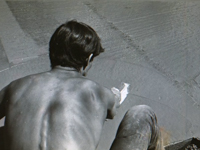
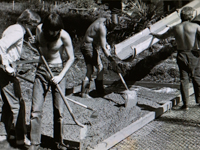
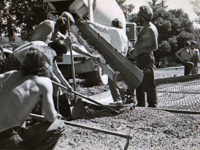
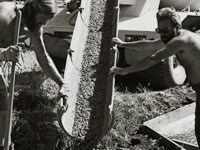
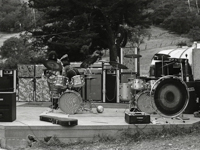
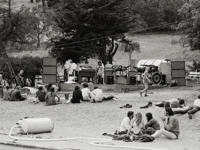
Photos by Noelle Barton. |
|
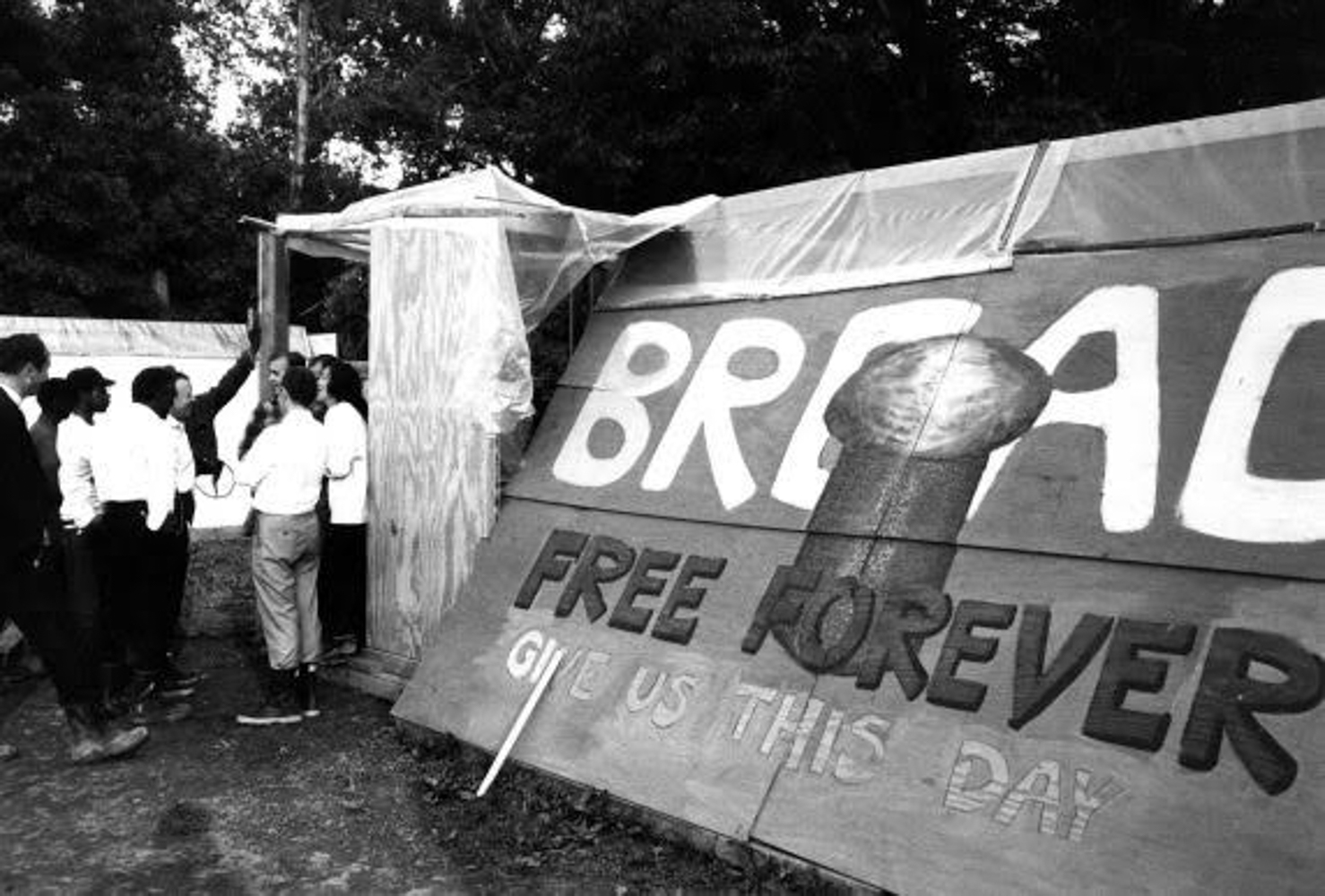
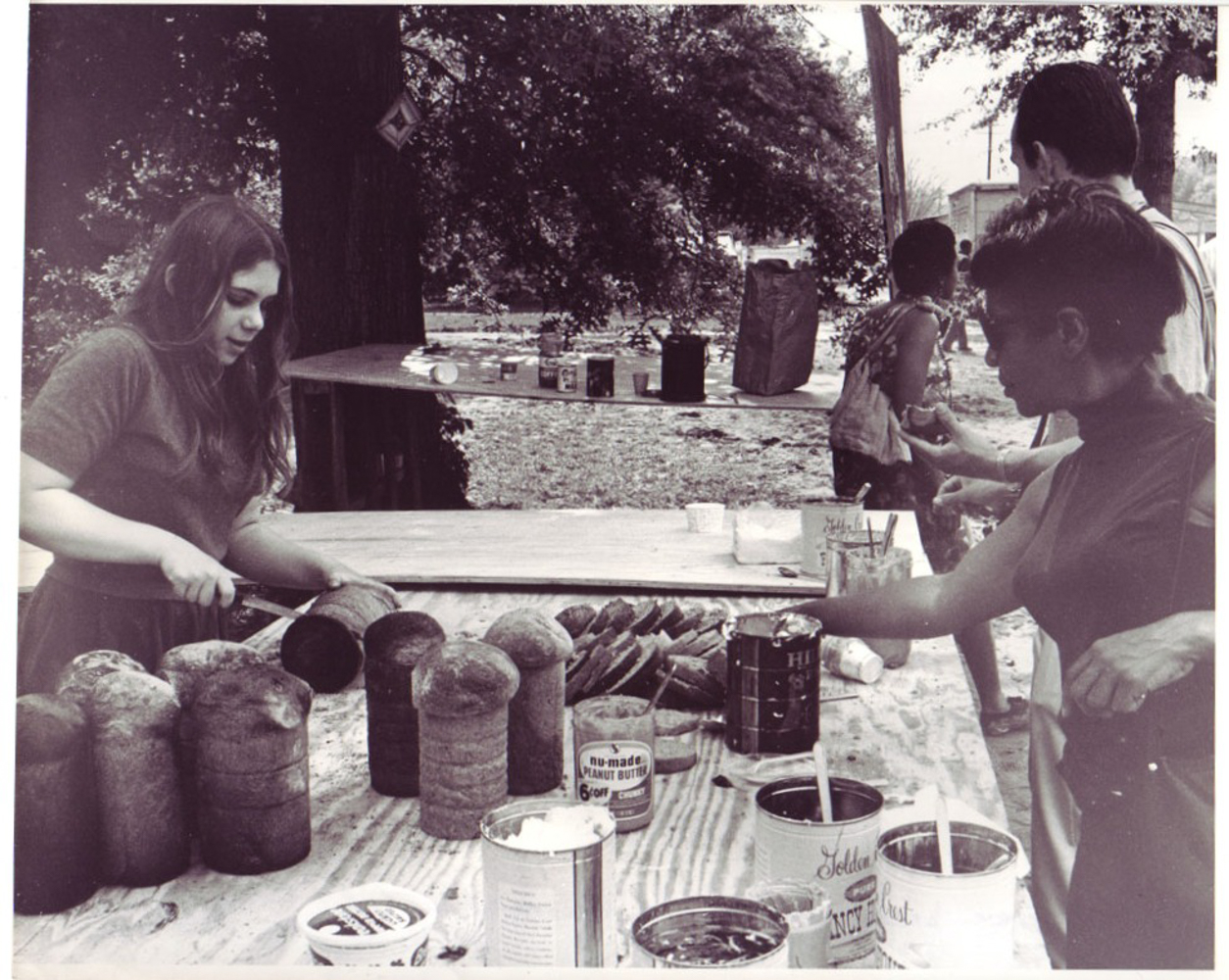
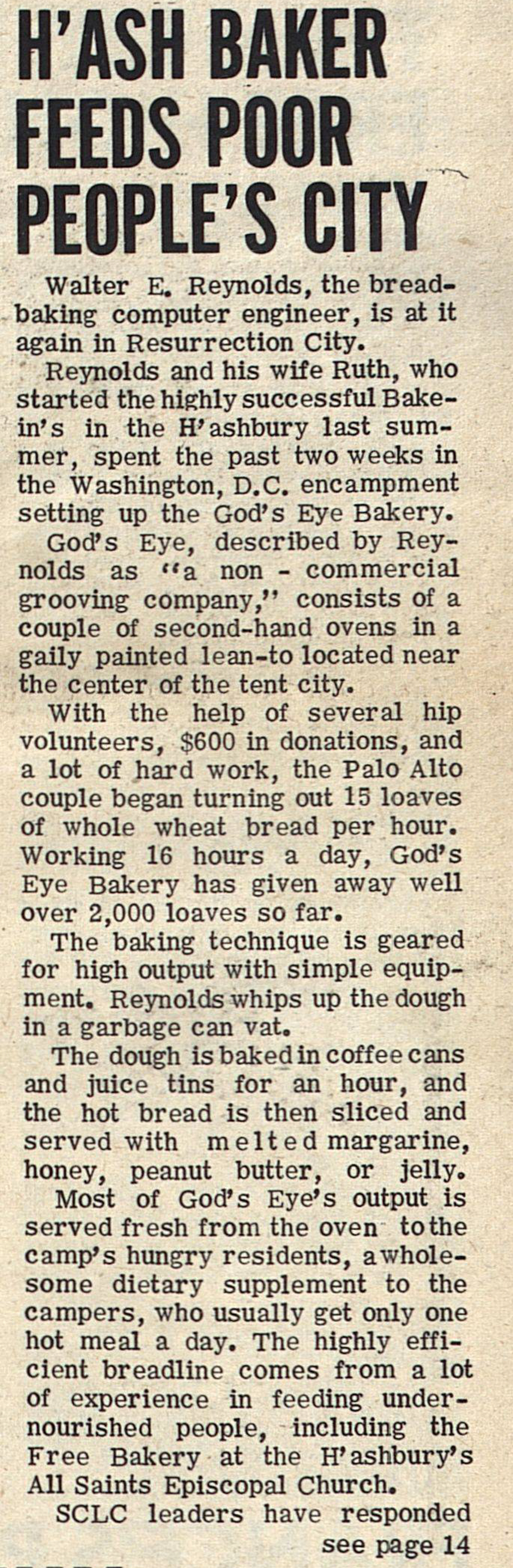
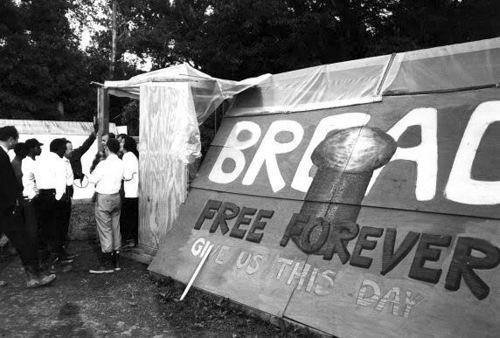
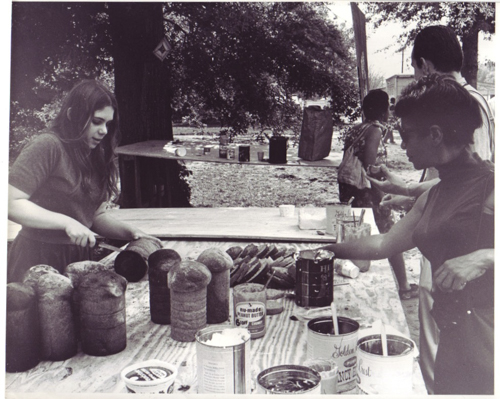
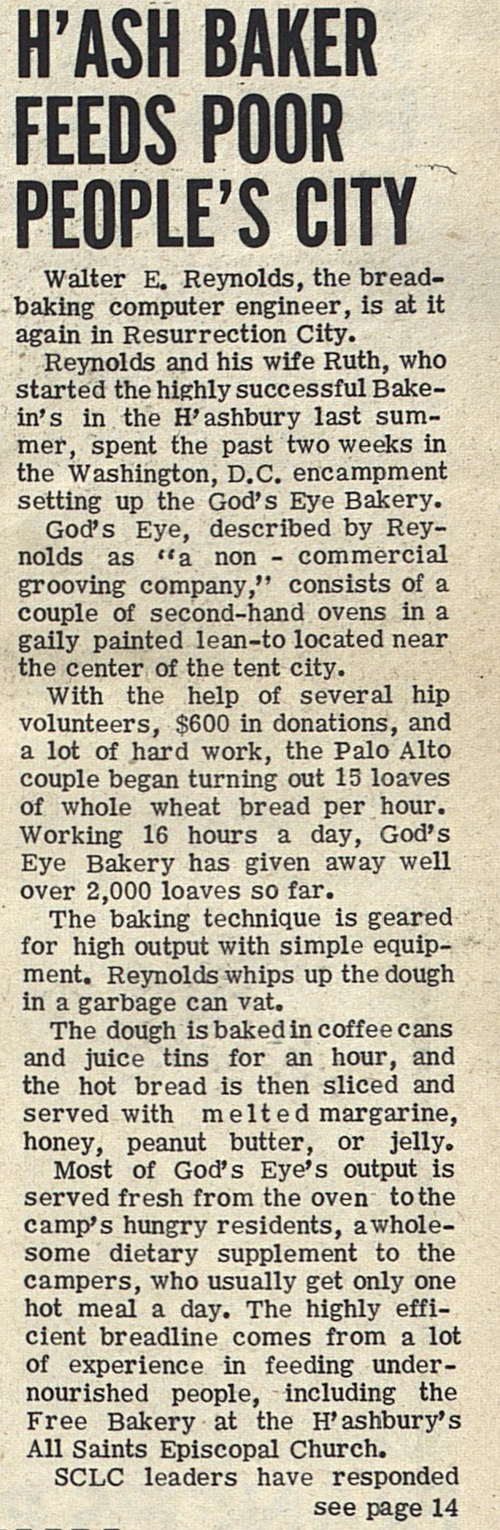
I had met Walt Reynolds in 1974 through my discussions with Fred
Moore who had known Walt at Resurrection City in 1968. This was the tent
city erected in Washington DC for the Poor Peoples Campaign that Martin
Luther King, Jr., had started before he was assassinated in April that
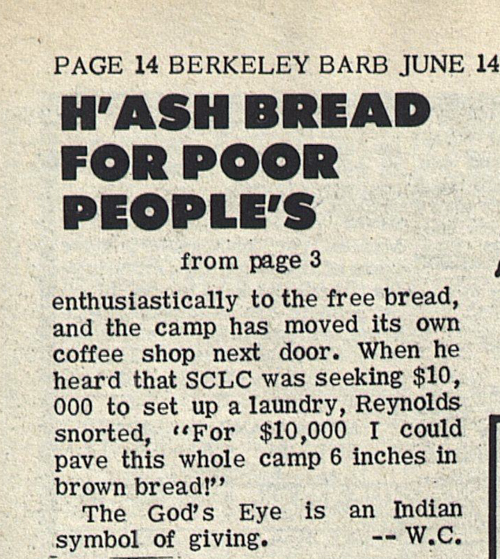
year. Fred remembered that Walt ran a Free Bakery at the tent city,
baking hundreds of loaves of whole wheat bread and giving them away.
Fred told me that he thought there was a special magic in the bread
loaves made in coffee cans. To the right, and below, are articles about
the "God's Eye Bakery" that Walt and others set up and ran in the spirit
of digger-do at Resurrection City.
[Update, March 2021] Ángel Martinez sent an
account of the God's Eye Bakery based
on the stories and memories of his father, Carlos Raúl Dufflar. Also
included is a series of photographs from Resurrection City in 1968.]
|
|
|
The fourth Free Bakery happened when the people at Olompali offered
the oven and equipment to the collective that was operating Jellyroll
Press in Oakland. For this part of the story, I quote from an account by
Thomas Morris, one of the consummate printers and designers at
Jellyroll.
Reminiscence by Thomas Morris
There was an oven and all the other machinery up in Novato (Olompali)
from a “first” rebirth of the equipment given up by a disenchanted
baker in the South Bay. In it’s brief shooting star of a lifespan, bread was baked, and
sent back to the City (I had no involvement in that chapter). However, it had soon sat in disrepair for some time (the energy
and resources required were exhausting) and … Ken came and picked me up in a big flatbed truck, and we went to
the Olompali location, and loaded all the equipment. We brought all of it back to an incredible storefront space we
had rented on old Grove Street between 45th and 47th Streets (don’t
remember how or who scammed together the lease). Downstairs was once a church, and was a huge space. Upstairs had at least 3 bedrooms, and soon every nook and cranny
had a loft or sleeping space, as that space, and another communal
house … In the Oakland ghetto … we scored as a huge but dilapidated
place with thin walls but lots of room. Plywood laid in the attic
allowed for more sleeping space, and often 15 – 20 or more folks
stayed there. Ken, myself and many others got all the bakery equipment into
that downstairs space and got it all working (gas lines, water and
big sinks). An amazing explosion of energy and inventiveness. Maybe some of the following is redundant for some, but great
stories all the same … They were dismantling old railroad cars at the train station in
Oakland, and we scored the huge floors – all 1” wide x 4” thick
laminated oak that we cut up and made into huge kneading tables. The stories on how we came to get the whole wheat and other
supplies for special baking session – are all quite special and
should be retold at some time. But one in particular … as I recall Adele Davis (the health food
author), gave us enough money to organize a trek to a wheat farm in
the South West. It took months to get an old flat bed truck up and
running, and then even more time for the adventurous round trip. Who
was that sweet, soft-spoken long blonde haired fellow that took on
that trip and brought back all the wheat?
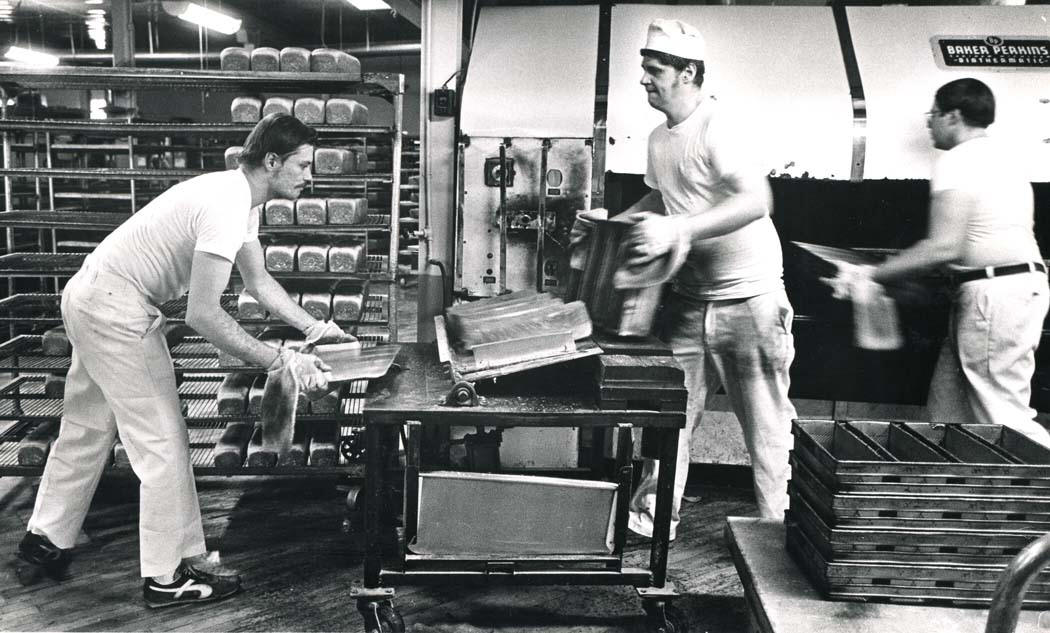
I tried to find a photo that would do justice to my memory of
the large oven that we rescued from Grove Street (who had rescued it from
Olompali, who in turn had rescued it from the "mad baker of Palo Alto"). But to
no avail. The photo, above, was the best I could do. It depicts a Baker Perkins
oven in back. But this photo does a good job showing the type of activity in any
large bread baking operation whether Free or not.
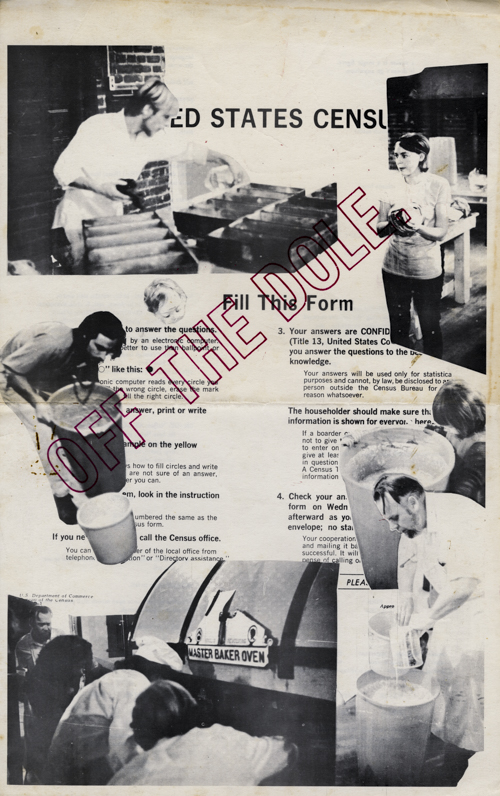
UPDATE 2017: I found a photo of the big oven. It appears on the
poster (below) that was printed by Jellyroll
Press. Included in the poster design are snapshots of the Free Bakery on Grove
Street in Oakland ca. 1973, including the Master Baker Oven we all came
to love:
|
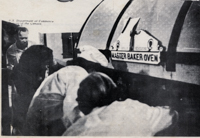
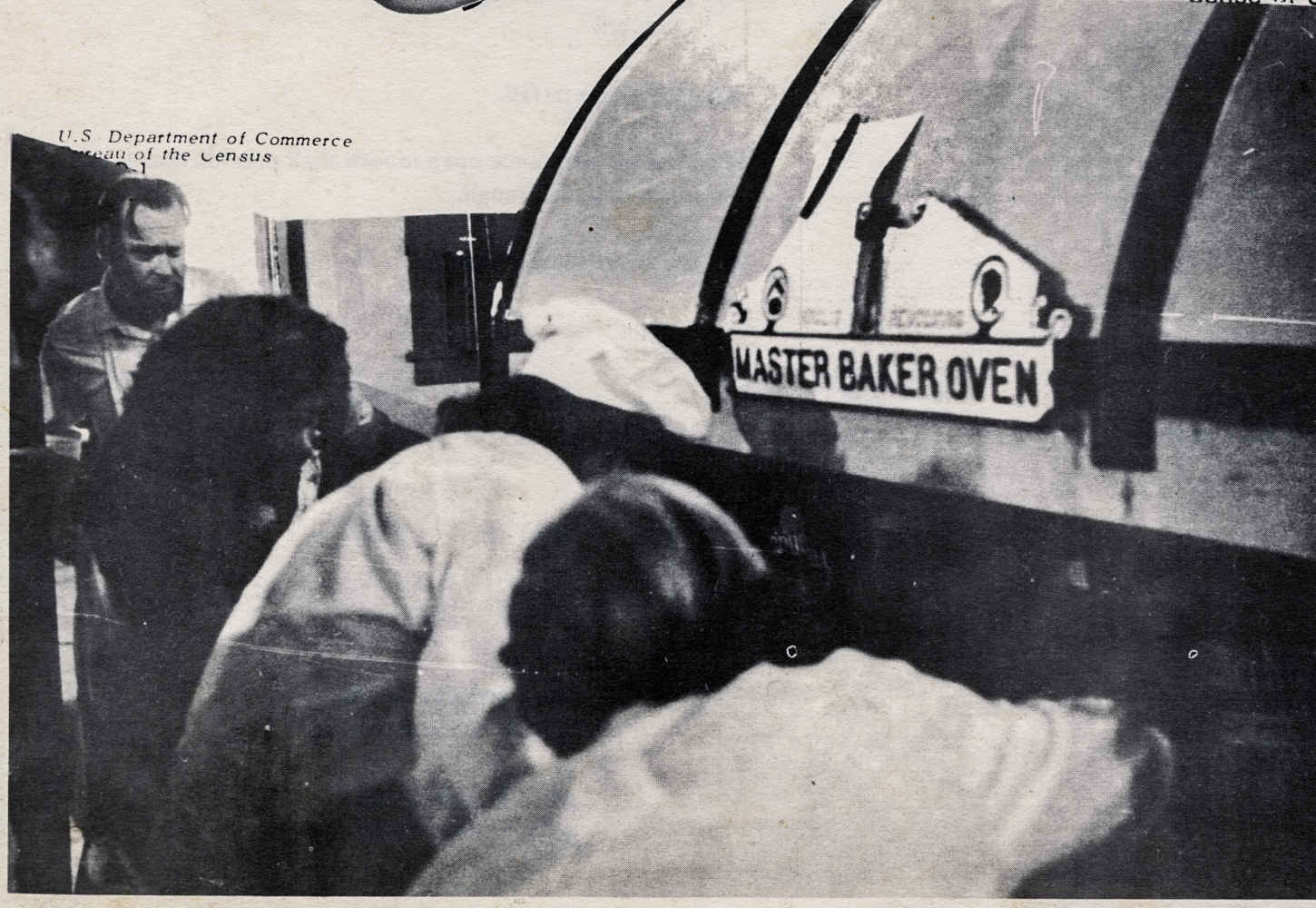
Snapshots of the Free Bakery at Grove Street, ca. 1970. Note the
image of the Master Baker Oven (which had come from the Olompali
Commune).
|
|
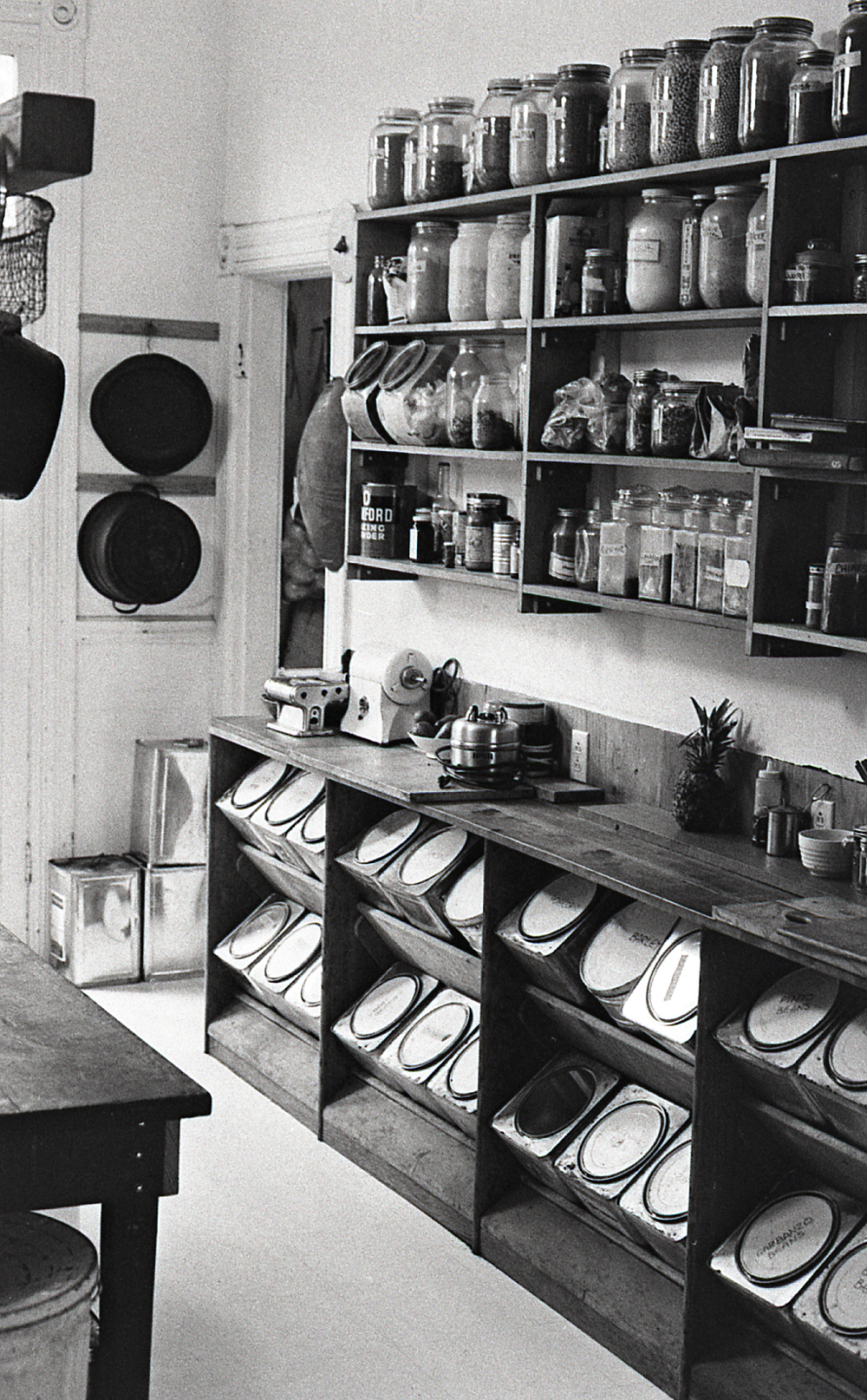
At some point in 1973, the folks at the Grove Street Free Bakery
contacted our commune (Kaliflower) and we brought the big rotating oven
over to Scott Street. By that point, we had extended our tentacles into
the Victorian next door, and to the abandoned gas station at the corner
of Eddy Street. We put the big oven into the gas station temporarily and turned one
of the flats in the Victorian into a new Free Bakery. The One Mind
Temple group used to come over and bake bread in smaller ovens that we
had installed in the Victorian flat. One Mind Temple gave away the whole
wheat bread to
their congregation on Divisadero Street (to the tune of John Coltrane's
A Love Supreme.)
There is some haziness and fog of memory at this
point in the story. Some of us remember a second large oven which we
offered to Huey Newton and brought to the Black Panthers in Oakland. We
also gave the original large rotating oven (which was yellow with black
enamel trim which Thomas Morris remembers painting) to the One Mind
Temple after they had created a space large enough for it to fit behind
their storefront church. I
would love to nail down some of these fuzzy recollections. Perhaps the time
may come when the commune meeting minutes will be available to research
the details of this story further.
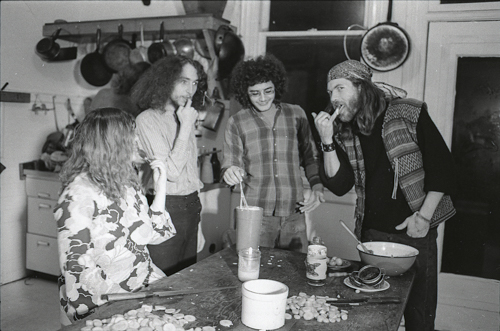
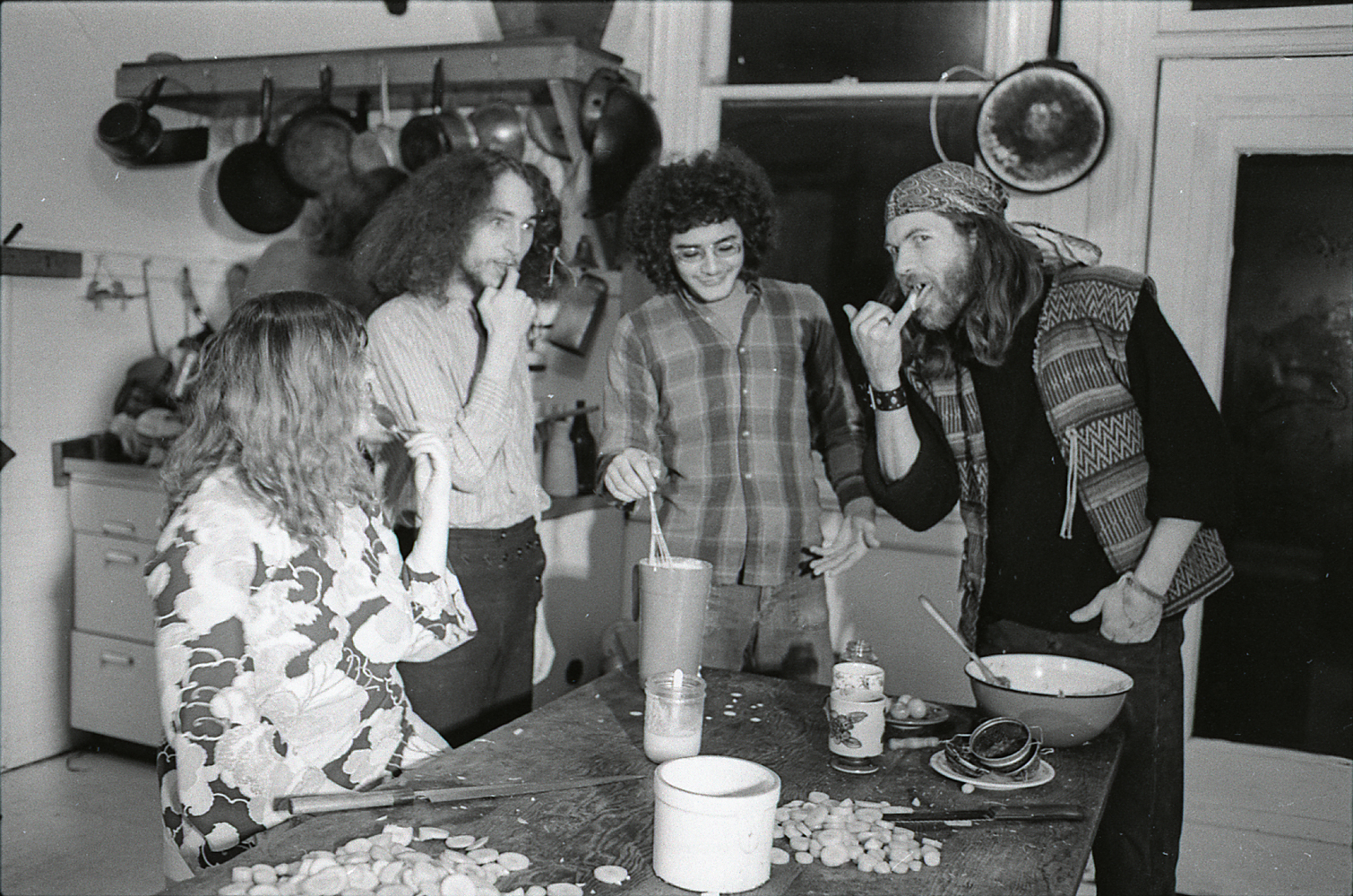
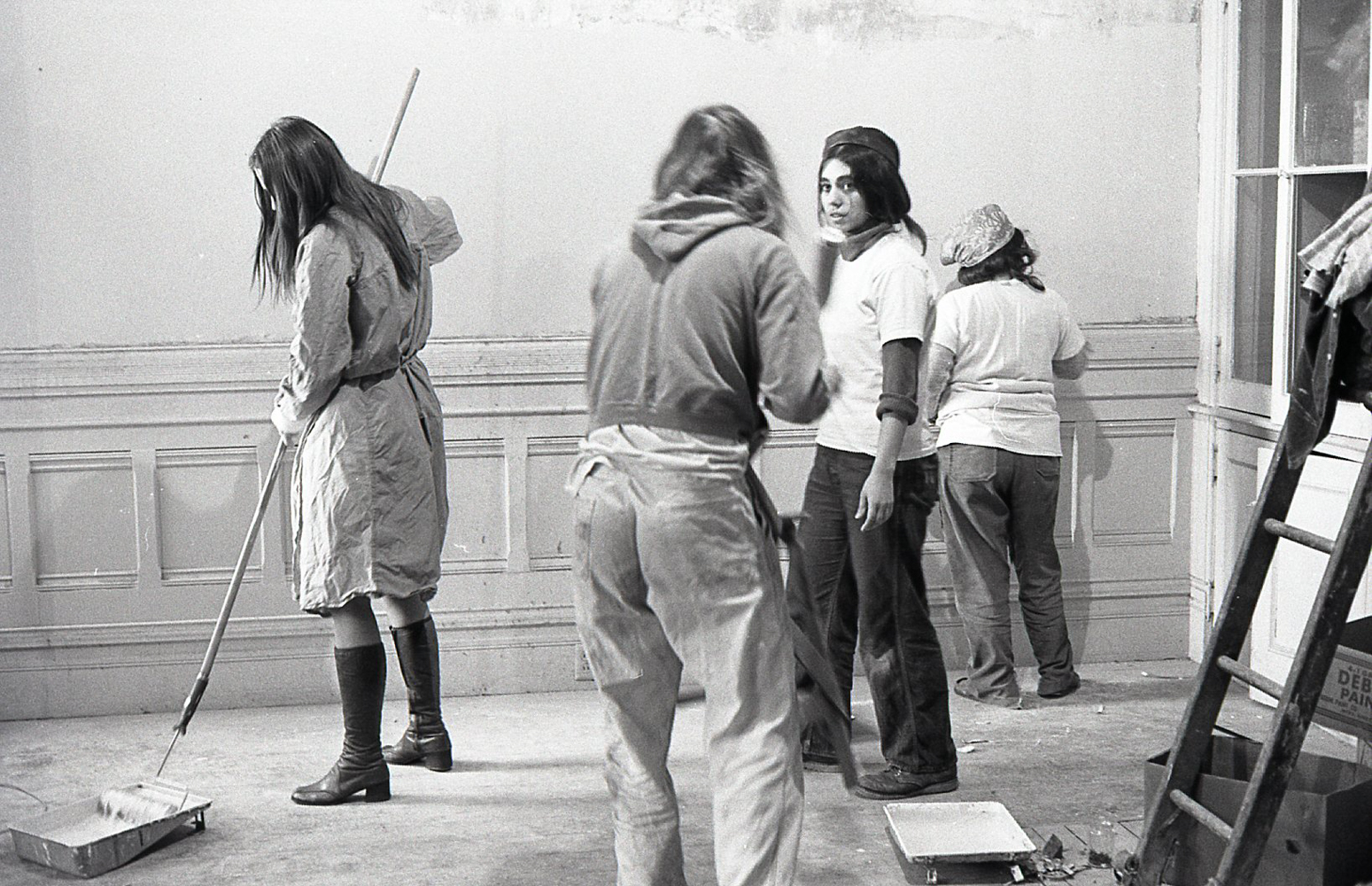
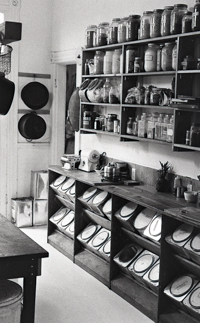
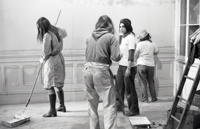
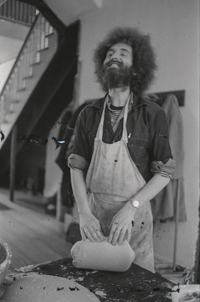
Photographs of the Scott Street Commune (ca. 1972) which brought the
Grove Street equipment to San Francisco and set up the fifth Free
Bakery. (Above and top right) the communal kitchen; (middle right) work
crew constructing the space for the Free Bakery; (bottom right) Jocko
kneading bread dough. The Free Bakery was located in the
Redevelopment-owned building next-door (1211 Scott Street). The
Commune's carpenters opened a doorway into the space that connected the
proposed Free Bakery to the communal kitchen/dining area in 1209.
|
|
|
The video below was shot in 2011 when Jane Lapiner and David Simpson
retold the story of Digger Bread before a large crowd in San Francisco's
Mission District who learned the finer art of coffee can bread baking
and ultimately enjoyed the results of their labors of love.
An afternoon baking Digger Bread; stories of the Free Bakery.
|
|
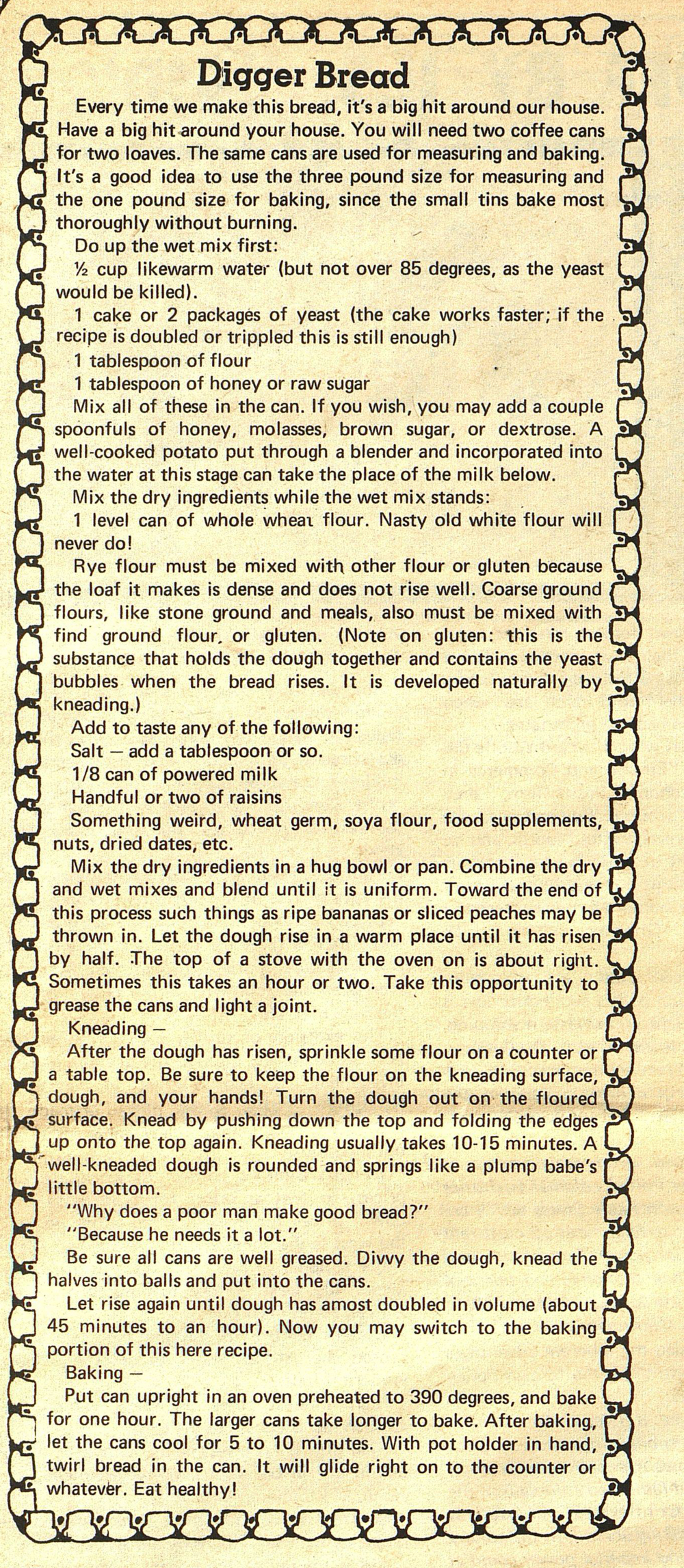
(a Digger broadsheet)
[This leaflet was two-sided, 8-1/2" by 11". I found it in my collection after
Ramon Sender sent me an email message requesting any information about recipes for digger
bread. I had remembered seeing at least this leaflet (and perhaps others) so went
searching. This leaflet was in one of my un-cataloged folders, with a date that indicated
when I acquired it but not where. One of these days, I must ask "I" to see that collection
I put together and left behind so precipitously when I moved out of the commune. Until
then, I have to use the Xerox copies that are fading after twenty years. Enjoy this leaflet, which is just as current today as 25 years ago. If someone was
interested in setting up a Free Bakery, here are the instructions. The only things you'd
need to change would be the wholesalers who aren't around anymore (Oh's only closed in the
past few years — I know because I live two blocks from Mission Street.) Most inspiring quote from this leaflet:
"Please take this recipe home and start making bread. The only stipulation is that you
always give it away."]
This is the recipe for the bread that is made in coffee cans at the Free Bakery. The
Bakery is at All Saints Episcopal Church, 1350 Waller, on Tuesdays and Fridays from 9 a.m.
on. For information or to make donations, call Mary McClain, 362-6374, or Father Harris at
the Church, 621-1862. Contributions can be mailed to Father Harris at 1350 Waller.
We get our flour in 100-lb sacks from several sources. The first we try is Whitman's
Salvage, 1350 Egbert, Hunter's Point. They sell flour from damaged sacks, very cheaply.
Then, if they don't have the whole-wheat flour we use, we go to two wholesale places:
Fisher's Flouring Mills, 1566 Carroll, and Coast-Dakota, 1588 Carroll (two blocks from
Whitman's). Another place that sells flour in 100-lb sacks, but retail, and open on
Saturday's, is Oh's (California Direct Importing Co.), 2651 Mission at 23rd. Finally, many
whole grains and special mixes are available at the Food Mill, 3033 MacArthur,
Oakland (near Fruitvale). Some grains can be found at health food stores such as
Far Fetched Foods (1915 Page, SF) and Sunset Health Foods (9th Avenue, SF.) We also use quantities of dry
milk, brown sugar, honey, molasses, margarine, jam, and tea. These things can be bought
cheaply at Whitman's, Big Bonus (Howard St. near 7th or Potrero Hill)), or Co-op on Third
St. near Paul Ave.
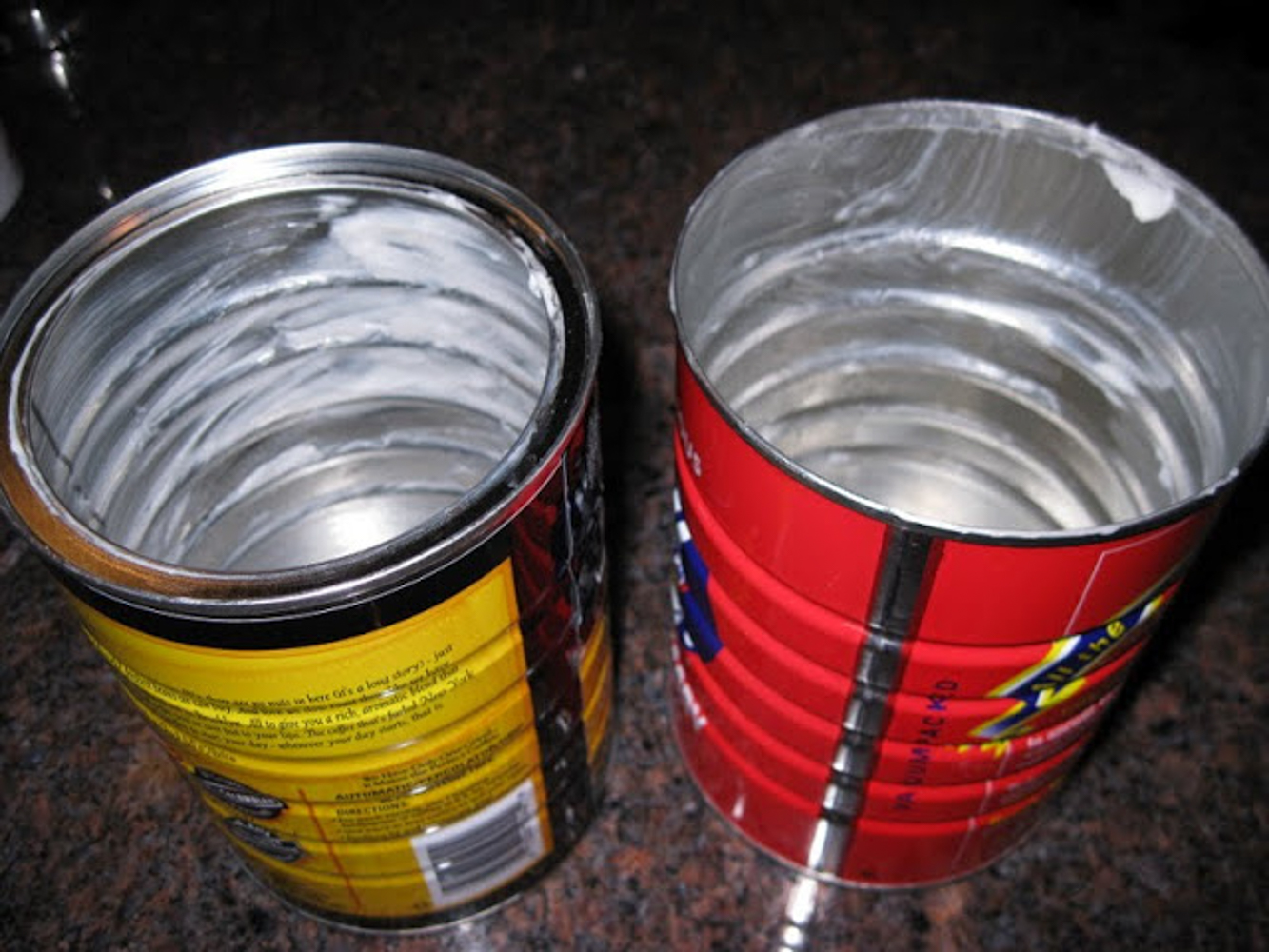
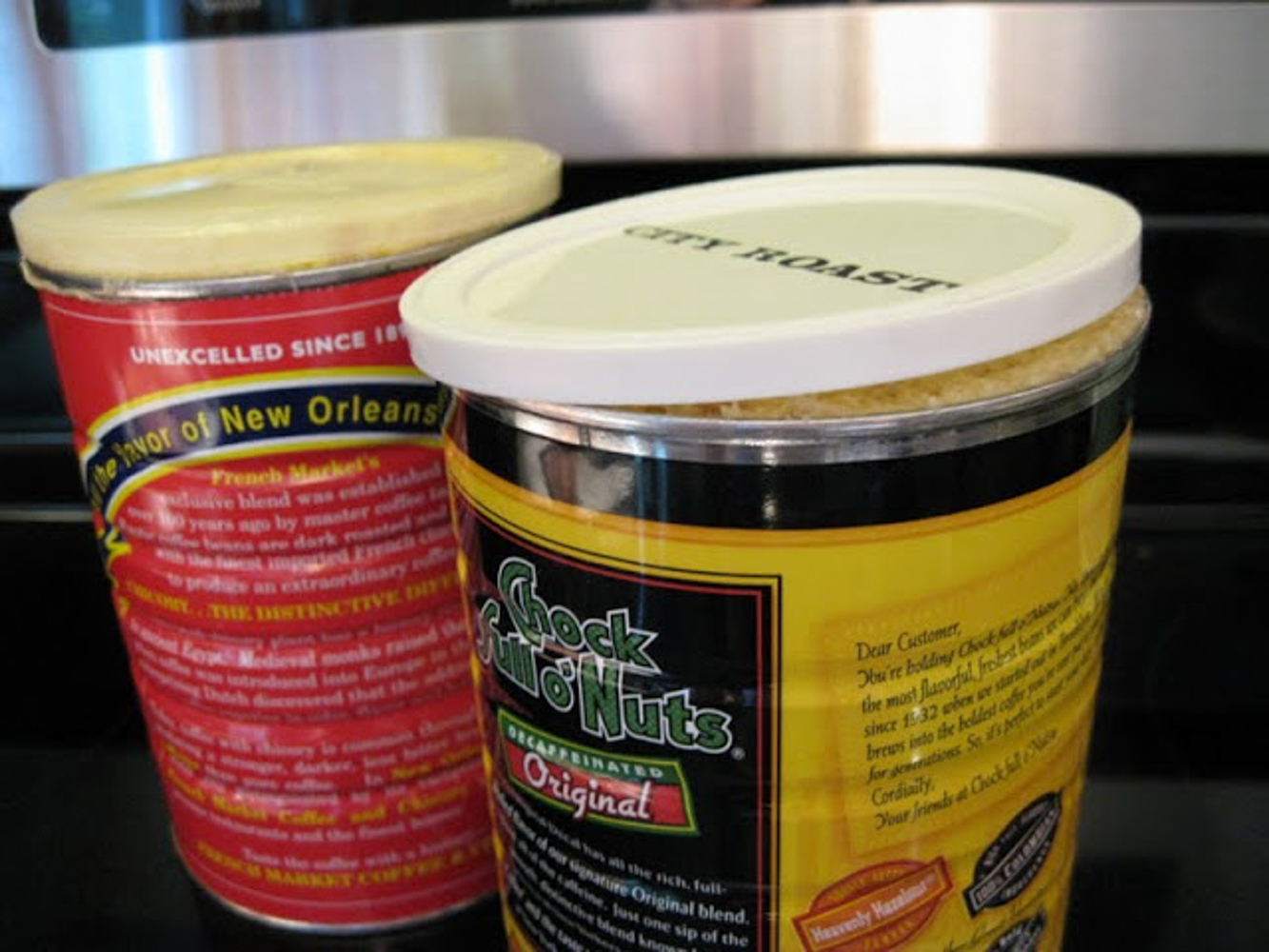
We bake in 2-lb coffee cans and sometimes 1-lb cans. This recipe makes one loaf in the
2-lb can and two in the 1-lb cans.
WET MIXTURE:
2-1/2 cups warm water (not over 85 degrees—if it's too hot it will kill the
yeast, which can survive at freezing but not at high temperatures)
1 cake or package of yeast (this is still enough if recipe is doubled, tripled)
1 tablespoon flour
1 tablespoon sugar, honey, molasses (more may be added,
or some of each—we like to use molasses because it's so rich in minerals and vitamins)
This can be mixed in your 1-lb coffee can—2 cups water fills it to the middle line.
Let the wet mix stand while preparing the dry ingredients.
DRY MIXTURE:
1 level 1-lb coffee can whole-wheat flour, or 4 cups
2 teaspoons salt, or to taste
1/4 to 1/2 cup dry milk
MIXING THE TWO: In a large bowl mix the wet mixture into the dry mixture. Let
the dough stand in the bowl until it rises by half, about two hours. The bowl should be
put in a warm place, such as over the pilot light on top of your stove, and it should be
covered. Again, too much heat will kill the yeast, but at about 80 degrees it is at peak
activity.
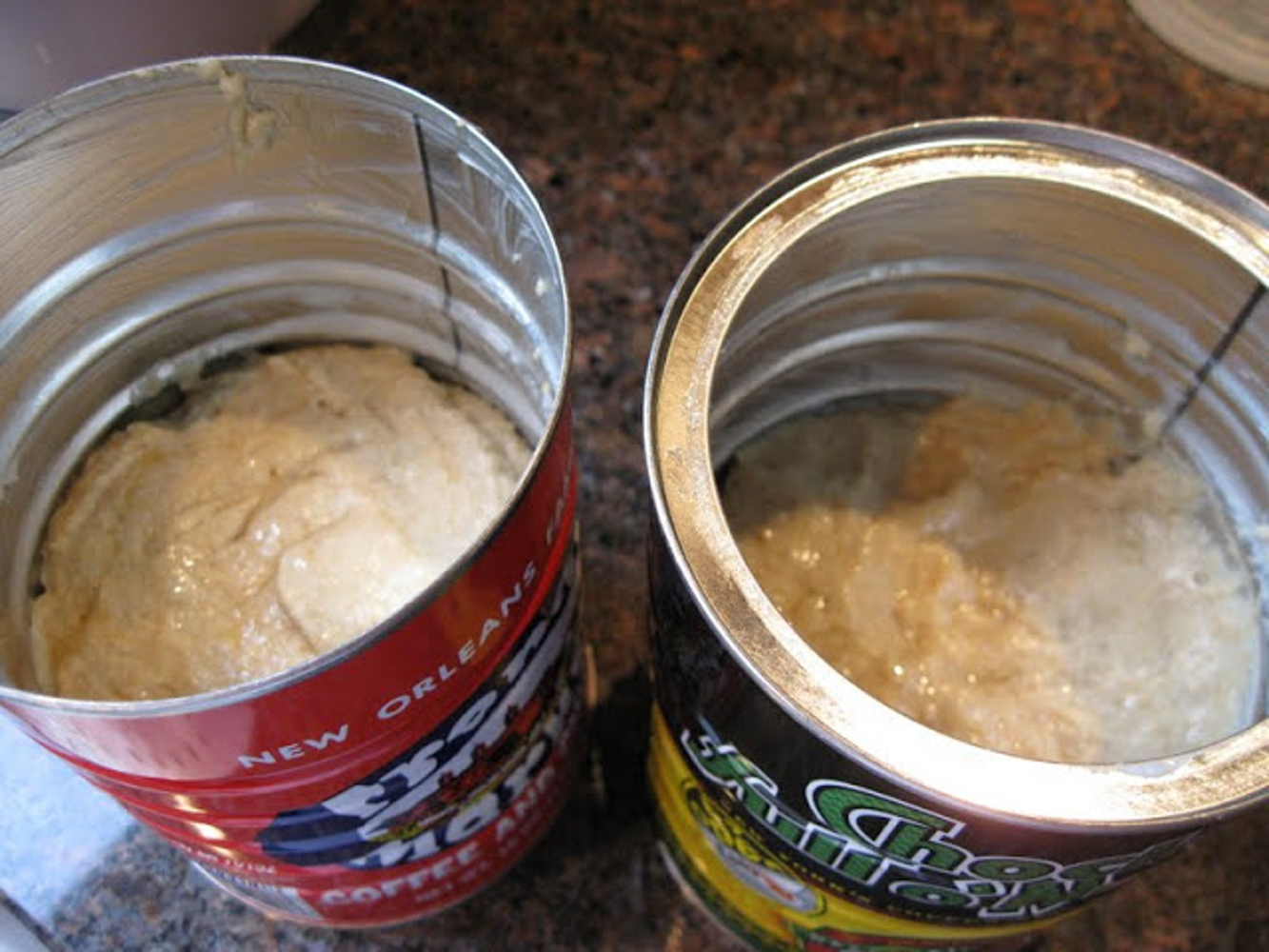
THEN KNEAD (see below), drop into a greased coffee can - the 2-lb can takes
2-1/2 lbs dough, the 1-lb can about 1-1/4 lbs—after shaping the dough into a ball making
sure no flour is on the surface. Let rise again until it's just getting to the top of the
can, about 45 min.
BAKE at 390 degrees for the 1-lb can, 55 minutes; or 400 degrees for the 2-lb
can for 60 minutes. Oven should be preheated.
KNEADING AND GLUTEN: This is what bread is all about. Yeast is not necessary for
bread (macrobiotic and many other kinds of bread, especially Middle Eastern and Indian, do
not contain yeast) but kneading, which causes gluten to develop, is. Gluten is a protein
substance contained in the grain and released by milling and increased by kneading. It is
elastic (same root as glue) and makes the fibers of dough able to stretch without
breaking; these stretched fibers make little pockets to hold in bubbles of gas formed by
the action of the yeast, and thus the bread rises. If yeast is not used, you still notice
that kneading changes the character of the dough, makes it "breadlike" and not
crumbly.
HOW TO KNEAD: Turn out the dough after it has risen two hours in the bowl onto a
floured surface. Work it with the heels of your hands, pushing and stretching it. Keep
just enough flour on the board and your hands to prevent sticking. Push at it until it
begins to push back—in other words until it has developed gluten and gets elastic. Keep
on until it doesn't stick any more, looks shiny, stretches without breaking when you pull
it apart, holds the indentation made when you poke your finger in, instead of closing up
on it. Caution: several of these tests can be passed by dough that has had too much flour
added. Keep the dough soft, adding only enough flour to prevent sticking. But it may take
another 3/4 cup of flour in the kneading, depending on the kind of flour you used, etc.
The whole thing should take 10 to 15 minutes.
NOTE ON FLOUR: The freshest flour makes the best bread. Besides tasting best, it
has more gluten. You can mill the grain yourself if you have an electric coffee grinder.
It comes out slightly coarse, with all the wheat germ in it (commercial flour has the oily
wheat germ removed because it can go rancid if it is stored for a long time) and needs
very little kneading because of the high gluten content.
Whole wheat flour will make a loaf of bread without any additions. Coarsely-ground
flours, such as stone ground, can be used for all the flour in a loaf but unless they are
very fresh they don't develop quite as much gluten and so are often mixed with a
fine-ground wheat flour. Rye flour hardly has any gluten at all, so must be mixed in order
to rise. White flour, or bleached whole-wheat, is not allowed for Free Bread.
We generally put in one or two of several additions: wheat germ, soy flour (high in
protein), various kinds of meals. You can experiment, starting out with perhaps 1/4 to 1/3
by weight of germ, other flours, meals. And then there are raisins, other kinds of fruit,
honey, and so on.
Milk: If you use regular milk, scald it first (bring it to a boil) to kill
bacteria, then cool to lukewarm (so it won't kill the yeast). Be sure to change it to a wet
ingredient and adjust proportions accordingly.
Please take this recipe home and start making bread. The only stipulation is that you
always give it away.
If you wish to start your own bakery, here is the recipe for twelve loaves. At the
Bakery we mix up about ten or twelve of these batches during the day, keeping two ovens
going with loads of twelve loaves coming out every half hour.
WET MIX:
6 quarts water (80 degrees)
1/5 pound yeast
1/2 cup flour
1/2 cup sugar
Molasses, if you have it, is added to wet mix.
Alternative for at least 5 batches: Mix 1 pound yeast with 10 quarts water, 1 cup
flour, 1 cup sugar. Take 2 quarts of this yeast water for every batch, adding 4 quarts
lukewarm water.
DRY MIX:
15 lbs flour (5 2-lb coffee cans or 3 Co-op 5-lb sacks)
1 lb sugar (3-1/2 cups)
1 lb dry milk (3 cups)
6 heaping T salt
Substitute other flours, meals here. Brown sugar works fine. Wheat germ too. 2 cans of
substitutions for the flour is about right.
Let rise in the mixing container (we use plastic garbage pails) for two hours (same as
for small recipe), then get in 5 or 6 friends to help knead. We use a scale to weigh the
finished balls of dough (2-1/2 or 1-1/4 lbs) to be dropped in the cans. Rising and baking
times the same as for small recipe.
[Document uploaded May 18, 1996]
|
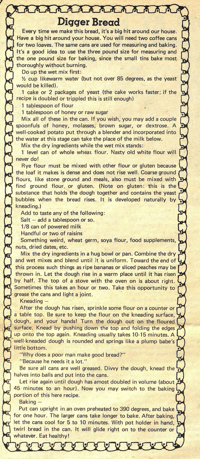
A later recipe for Digger Bread that appeared in Northwest Passage, an underground
newspaper from Bellingham, WA, dated Mar 17, 1969.
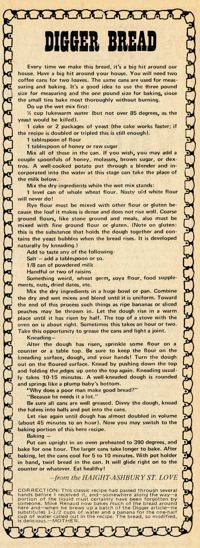
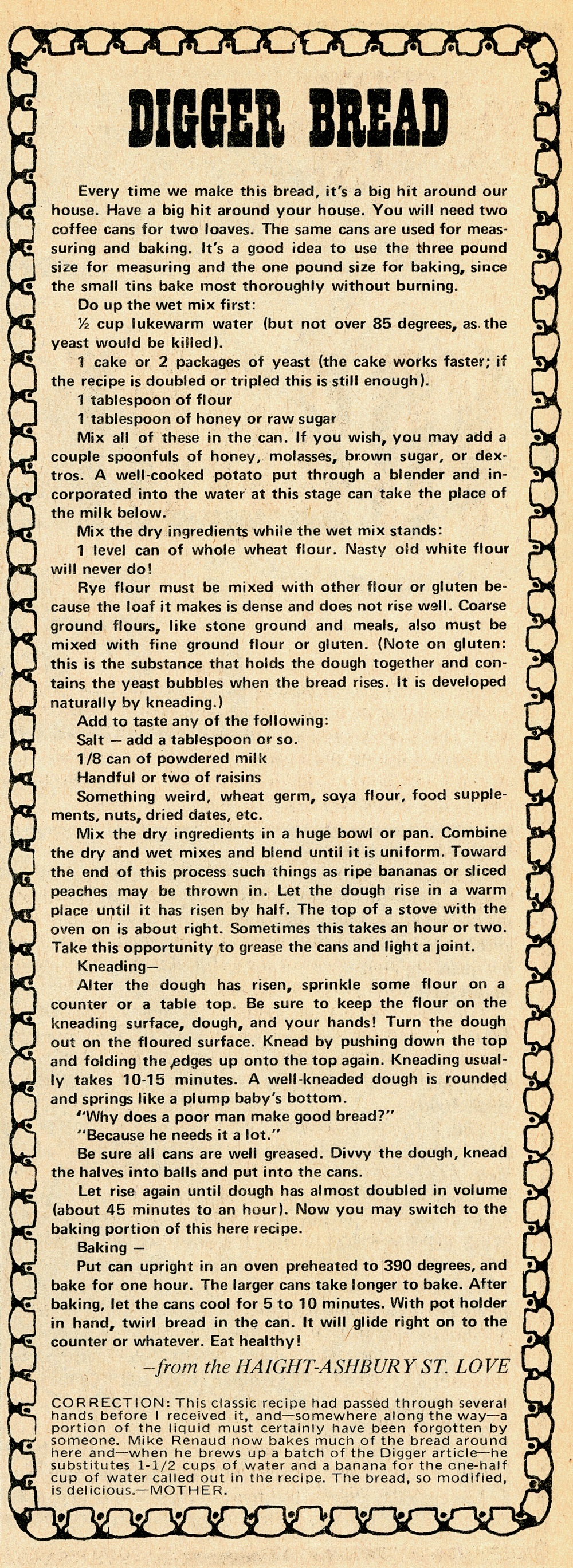
The above recipe was published in the premier issue of The Mother Earth News,
Vol 1, No. 1, January 1970. Note the "correction" by the editors of TMEN.
|
|
As with all the Digger innovations, the Free Bakery concept spread throughout
the Sixties Counterculture, as is evident from the following sampling of
clippings from underground newspapers.
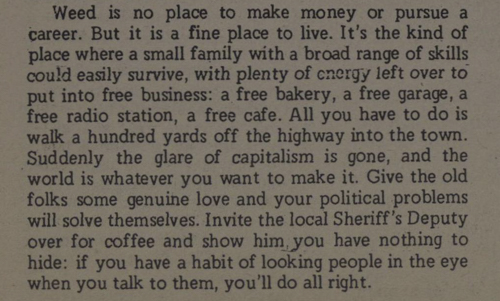
An article from the Berkeley Barb (Jan 15, 1971)
extolling the virtues of small-town living in Weed, California mentions that
"it's the kind of place where a small family with a broad range of skills could
easily survive, with plenty of energy left over to put into free business: a
free bakery, a free garage, a free radio station, a free cafe."
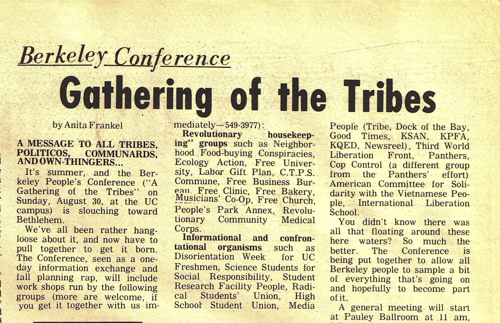
An article in the Berkeley Tribe (Aug 22, 1969)
announces an upcoming People's Conference to include a wide range of
revolutionary groups including the local Free Bakery.
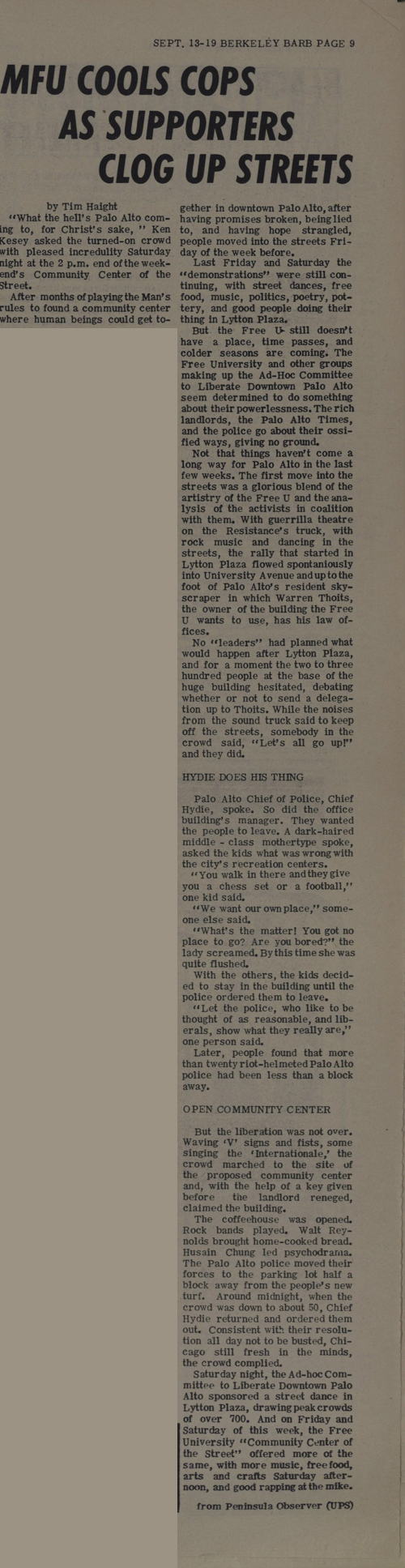
Walt Reynolds continued to proselytize whole wheat bread
wherever his path led. Here he is noted bringing fresh baked bread to a
gathering of Free University activists. (Berkeley Barb, Sep 13, 1968)
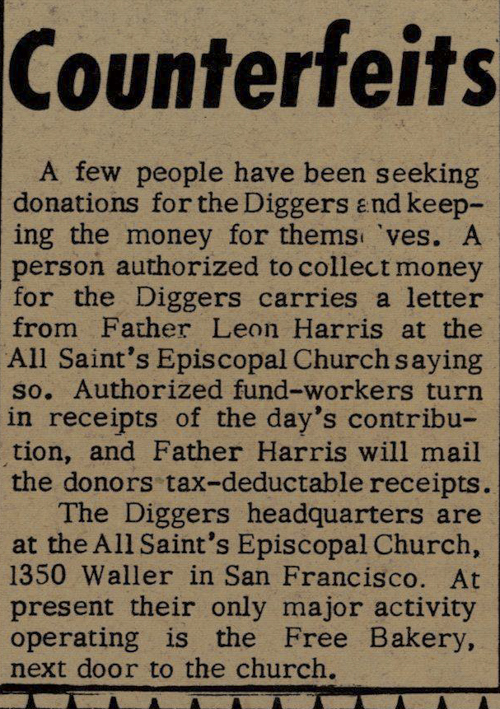
Troubles in the Counterculture, as reported here in an
article from the Berkeley Barb, Sep 19, 1969.
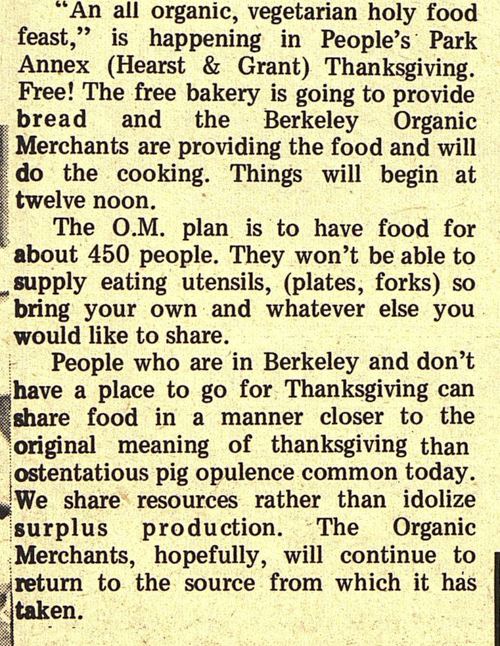
An article in the Berkeley Tribe (Nov 30 1970) announces a
free Thanksgiving dinner with bread supplied by the Free Bakery.
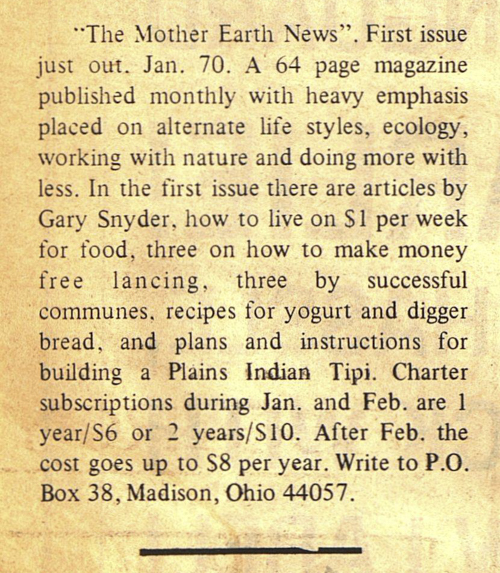
An announcement for the Mother Earth News (January 1970)
mentions that a recipe for "digger bread" will be included in the first issue.
[Update, 18 Jan 2019. See the image above
from a scan of that issue.]
|
|
![High-Res Image]()
|