Including Ephemera, Broadsides, Posters, Street Sheets, Collections, etc. for the
San Francisco Diggers, Communication Company, Free City Collective,
Kaliflower Intercommunal Network, Free Print Shop, Planetedge Manifestation,
Earth/Life Defense Commune, &c.
Category = | Keyword = ALL | Group = ALL | Issue = ALL | New = ALL | Followup = ALL | Order = DATE | Search = EMPTY | Records = 1309 | Page = 14 of 53 [Browsing category-filtered records]
Click thumbnail for large size. Click again to return.
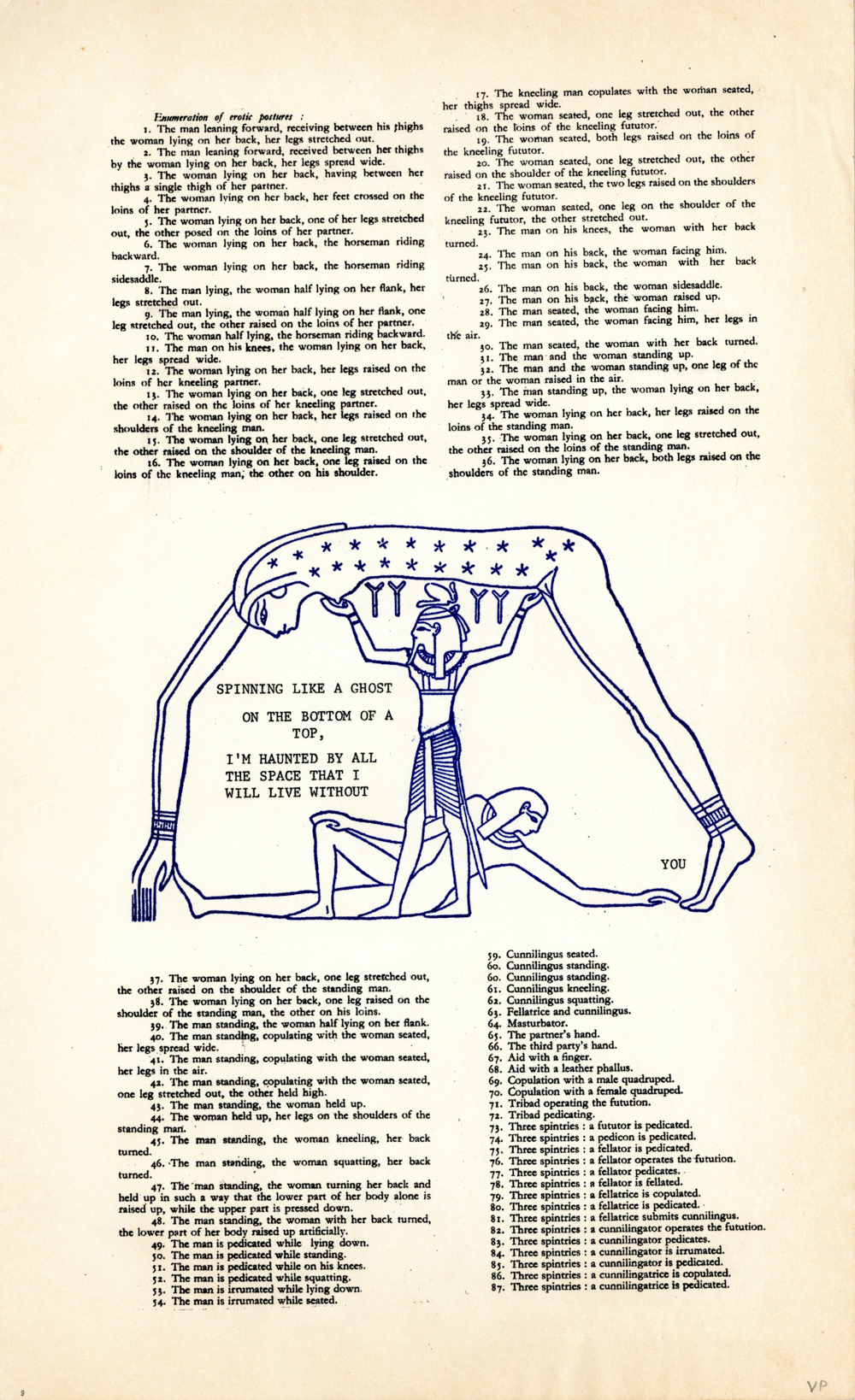
Cat. No.: FC-1-008 Full record BibCit: n.d., ca. 10/1/1967. San Francisco: Free City Collective. Collection: SOLA-o; SS-o (MH). Abstract: This striking Free City page juxtaposes a dry, encyclopedic list of sexual positions with an Egyptianizing central image and a brief lyric meditation on absence, desire, and haunted space. The effect is neither pornographic nor purely comic; rather, it turns erotic taxonomy into collage material, setting clinical enumeration against mythic imagery and poetic interiority. In the context of the Free City project, the piece reads as part of a broader effort to break down conventional boundaries between the sacred and the profane, information and art, body knowledge and visionary play.
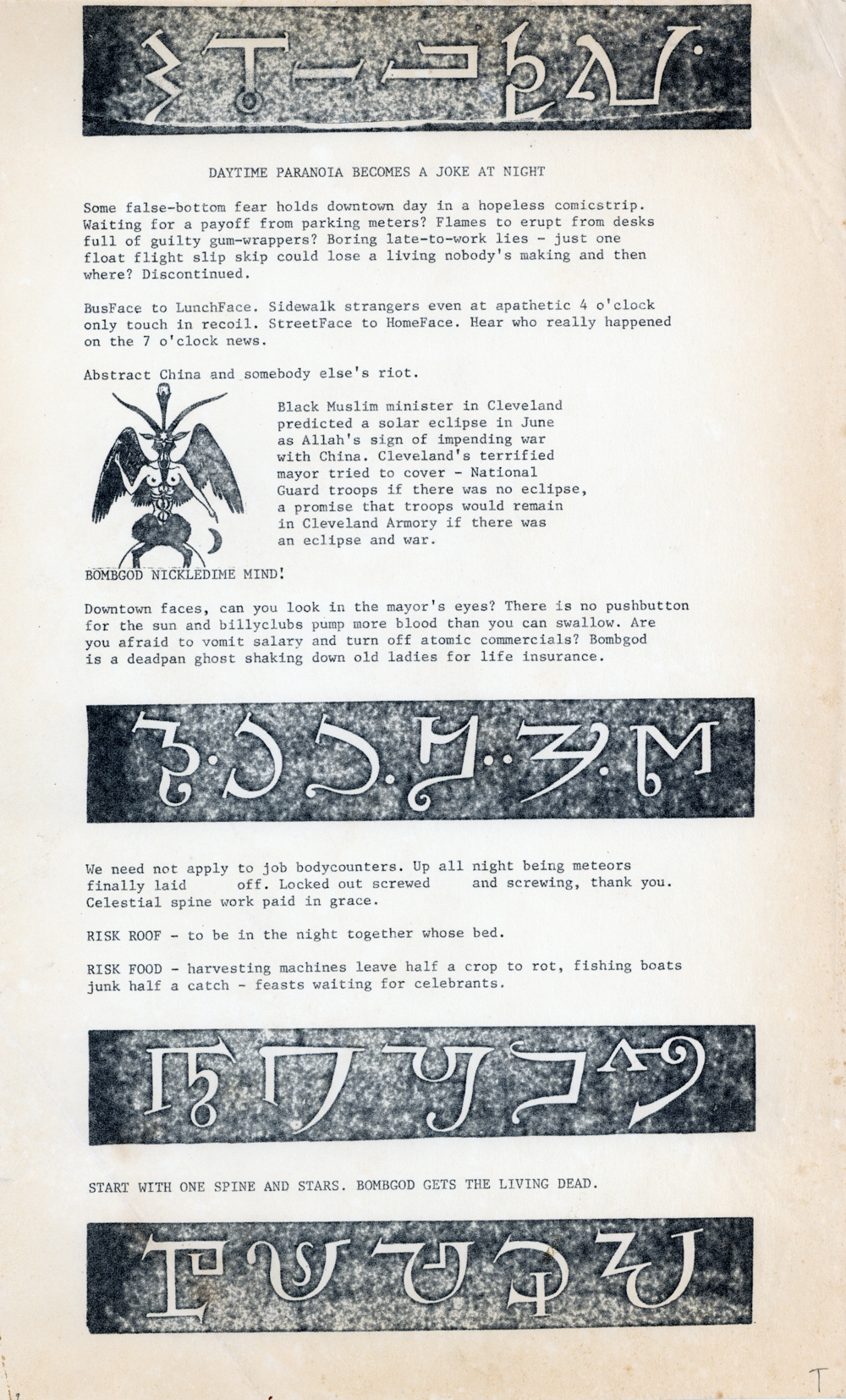
Cat. No.: FC-1-009 Full record BibCit: n.d., ca. 10/1/1967. Broadside. San Francisco: Free City Collective. Collection: SOLA-o; SS-o (MH). Abstract: Reads as a fevered prose poem of urban dread and countercultural refusal, contrasting the deadened routines of downtown work, media fear, and official paranoia with a visionary language of night, risk, grace, and collective release. Its jagged shifts—from Cleveland race panic and atomic dread to “Risk Food” and “Risk Roof”—suggest a world in which the administered realities of wage labor, news, and authority are already collapsing into absurdity. The mysterious letterforms and occult-like graphic framing deepen the page’s prophetic tone, as though the sheet were proposing an alternate script for those trying to escape the living death of ordinary America.
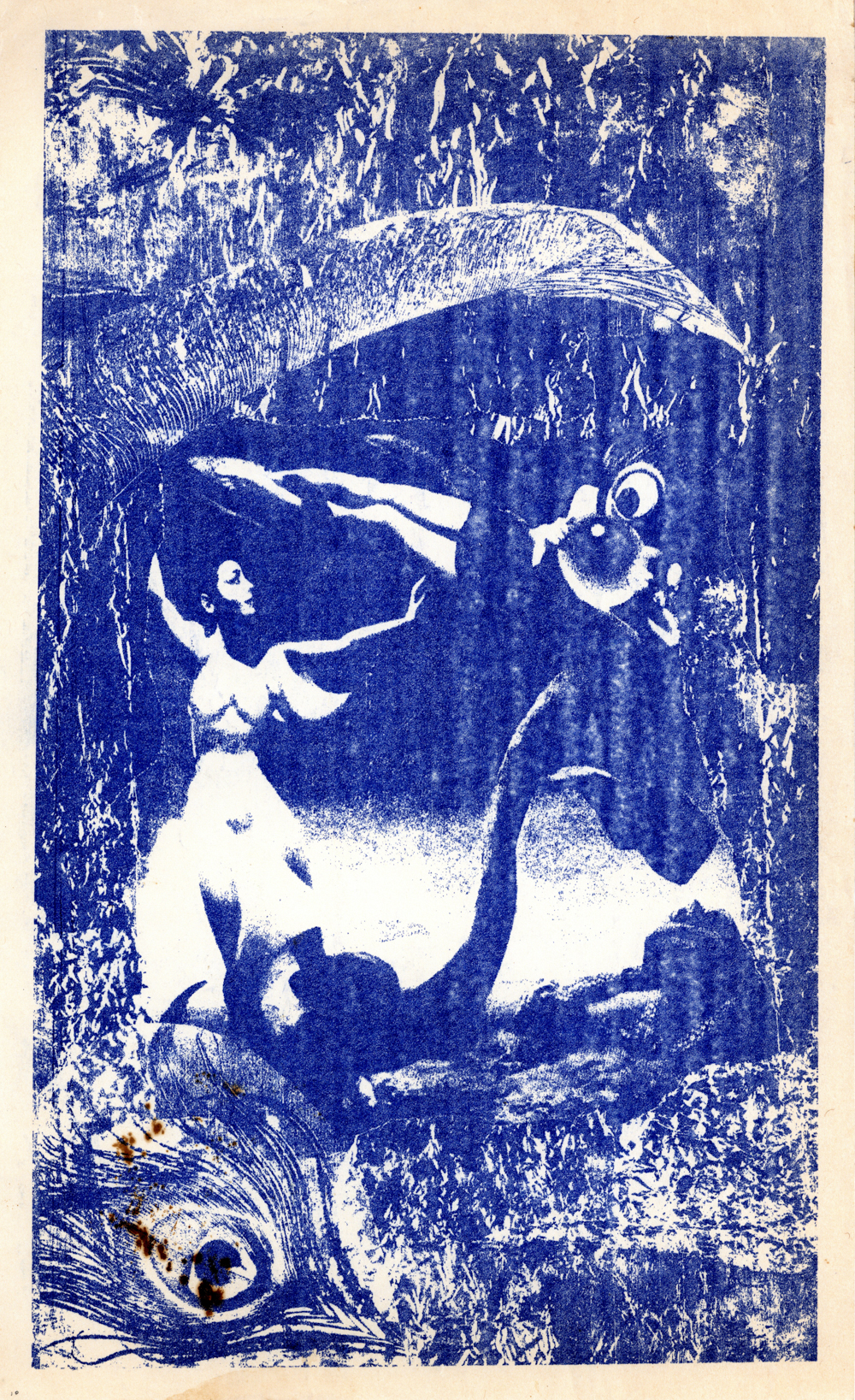
Cat. No.: FC-1-010 Full record BibCit: n.d., ca. 10/1/1967. Broadside. San Francisco: Free City Collective. Collection: SOLA-o; SS-o (MH). Abstract: This piece reads as a dream image or mythic interlude within the Free City sequence: a nude female figure stands beside or confronts a bird-headed, serpent-bodied creature in a lush, peacock-haunted environment. Printed in a dense monochrome blue, the image has the soft, degraded texture of a reproduced collage or altered illustration, which gives it an oneiric, half-submerged quality. In the context of Free City, it seems less like an argument than an atmosphere piece, bringing together eroticism, metamorphosis, fantasy, and the decorative excess that runs through much of the project’s visual language.
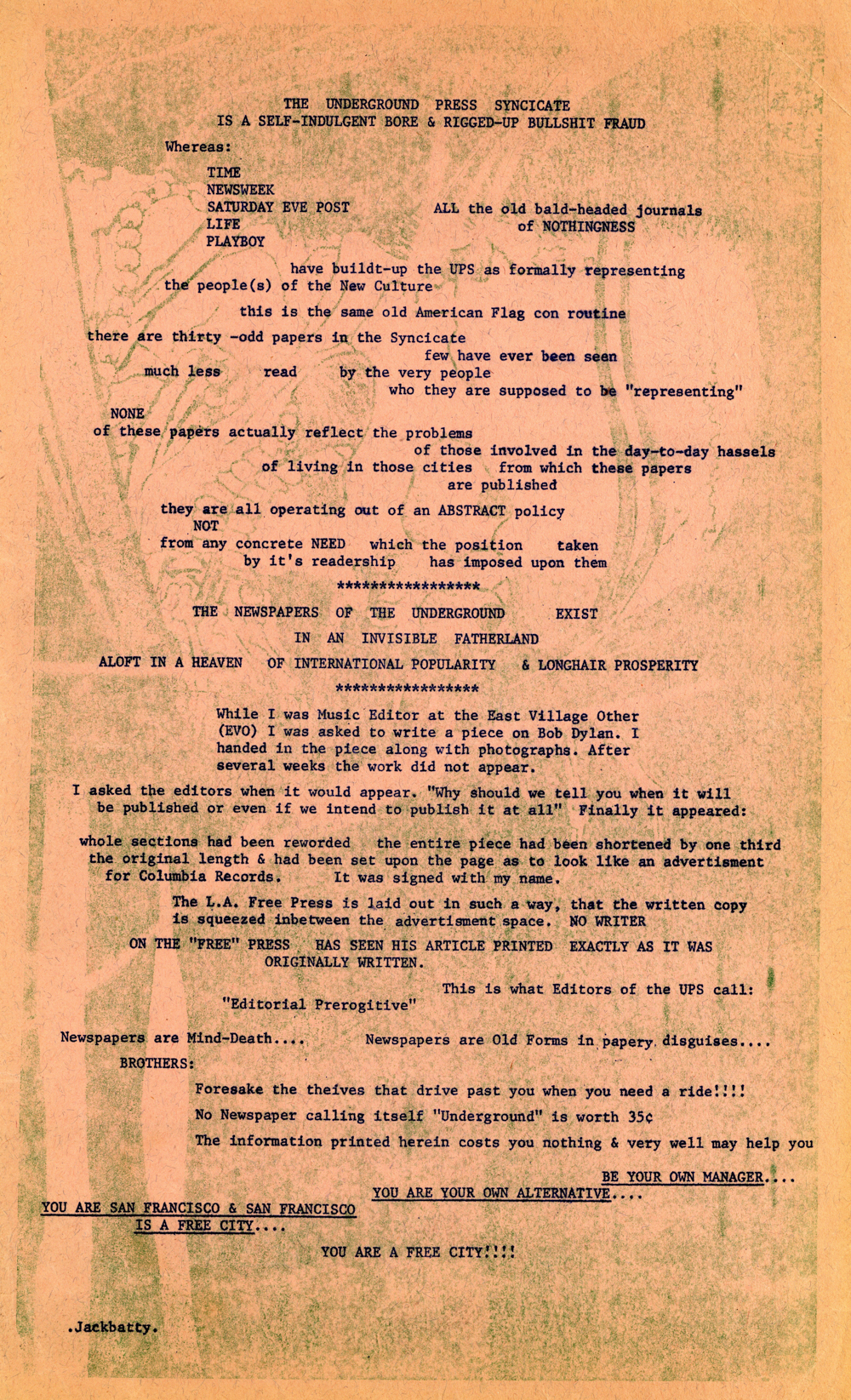
Cat. No.: FC-1-011a Full record BibCit: n.d., ca. 10/1/1967. Broadsheet. San Francisco: Free City Collective. Collection: SOLA-o; SS-o (MH). Abstract: A blistering attack on the Underground Press Syndicate, accusing the alternative press of reproducing the same hollow structures of mediation, editorial control, and false representation as the mainstream media it claimed to oppose. Mixing polemic with firsthand grievance, the text argues that underground papers do not arise from the concrete needs of their readers but from an abstract, self-important culture of editors, popularity, and packaged dissent. Its answer is the characteristic Free City reversal: do not look to newspapers, managers, or cultural intermediaries to speak for you—“you are your own alternative,” and San Francisco itself must become a free city through direct action and self-organization.
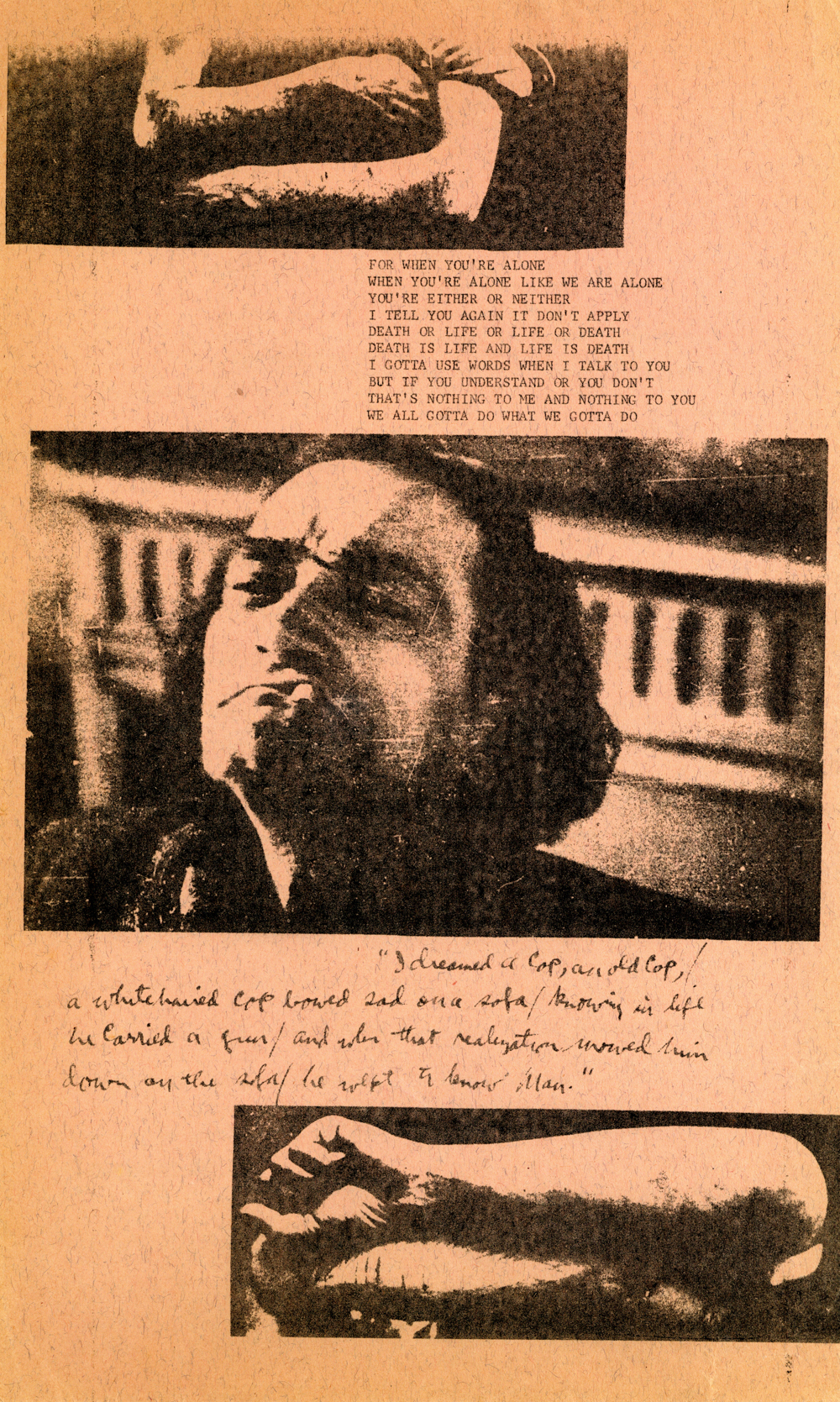
Cat. No.: FC-1-011b Full record BibCit: n.d., ca. 10/1/1967. Broadsheet. San Francisco: Free City Collective. Collection: SOLA-o; SS-o (MH). Abstract: Combines blurred photographic images, typed verse, and a handwritten dream fragment to create an atmosphere of solitude, mortality, and psychic unease. The repeated reclining figure, the stark portrait, and the lines about being alone and the interchangeability of life and death give the piece the feel of a dream document or private visionary notebook rather than a polemical broadside. In the context of Free City, it suggests the extent to which the project could also make room for intimate, haunted, inward material alongside its more public calls to action.
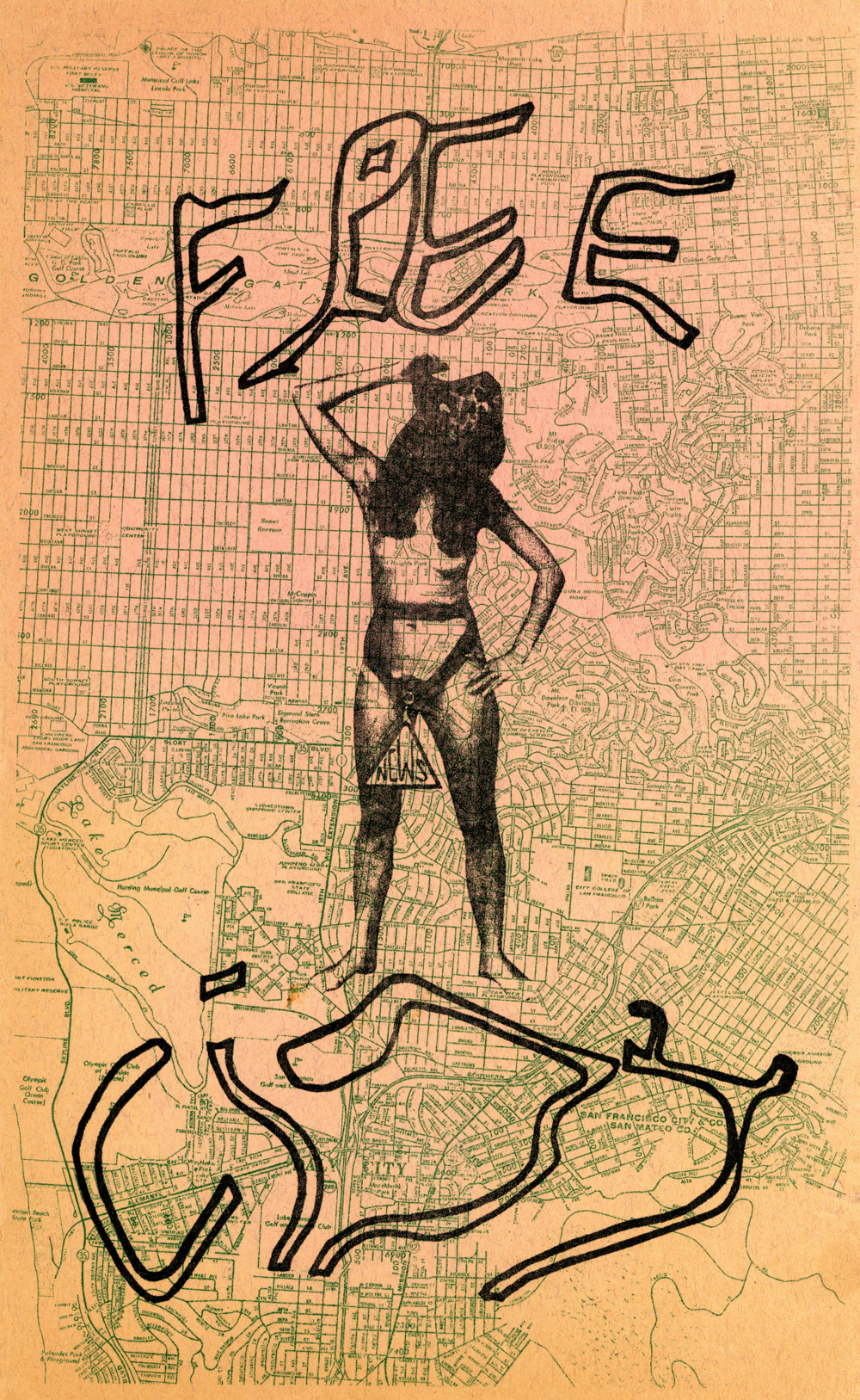
Cat. No.: FC-1-012 Full record BibCit: n.d., ca. 10/1/1967. Broadside. San Francisco: Free City Collective. Collection: SOLA-o; SS-o (MH). Abstract: As the parting image in Free City Set #1, this sheet recasts San Francisco itself as the terrain of a Free City imaginary, overlaying a street map with the large hand-drawn words FREE CITY and a central female figure poised like an emblem, muse, or tutelary spirit of the place. The belt or banner at her waist, bearing the word “NEWS” links that figure directly to the project of Free City as an alternative mode of communication, suggesting that the liberated city is not only inhabited but spoken, circulated, and imagined into being. The effect is both declarative and visionary: the existing grid of official geography is overlaid by a counter-map of freedom, desire, and collective possibility.
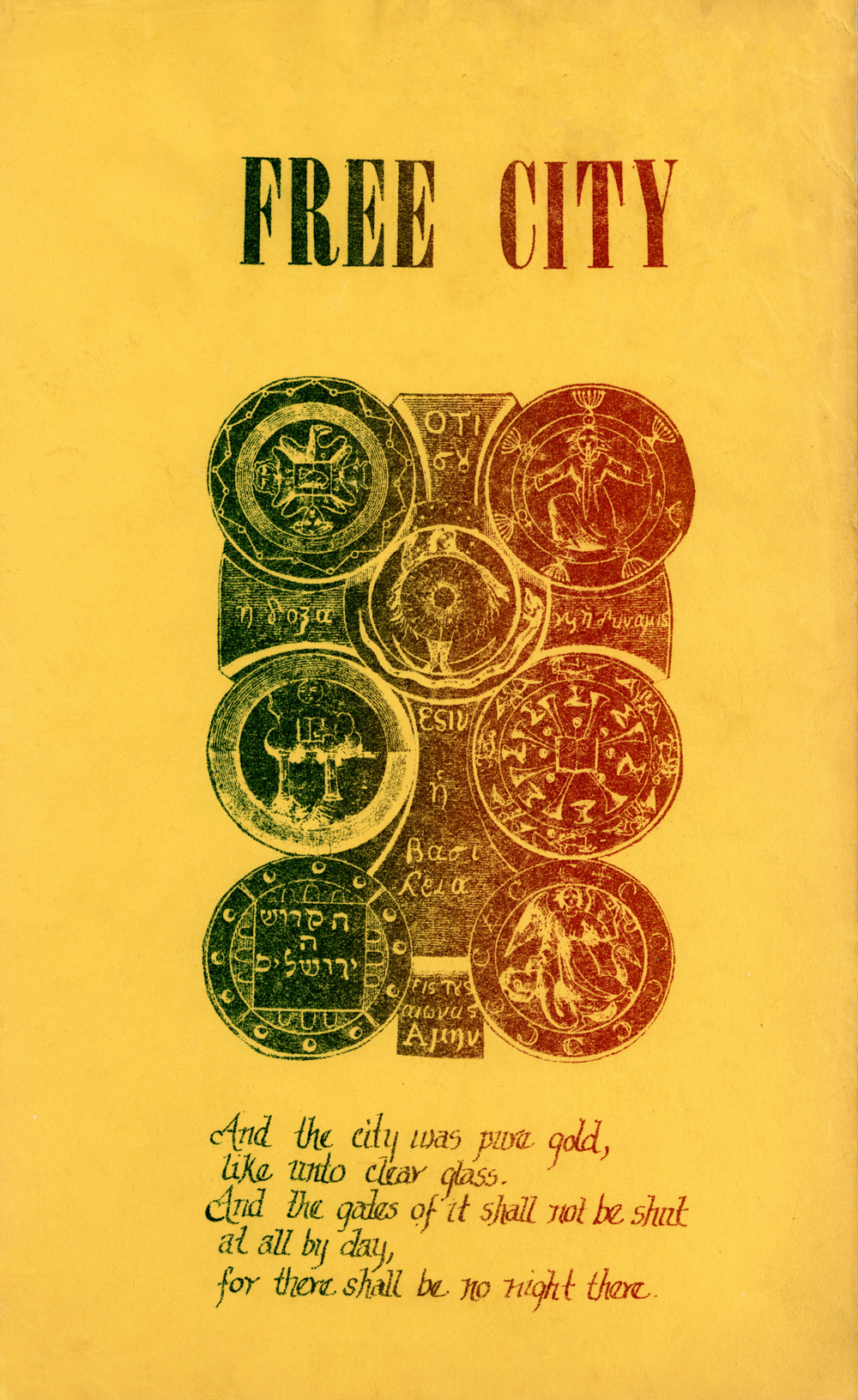
Cat. No.: FC-2-001 Full record BibCit: n.d., ca. 11/1/1967. Broadside. San Francisco: Free City Collective. Collection: SOLA-o; SS-o (MH). Abstract: This opening sheet of the second Free City set marks both a conceptual and technical leap. The occult seals, the passage from Revelation, and the split-fountain mimeograph printing on the Gestetner inherited from the Communication Company cast the Free City as more than a social experiment: it appears here as a visionary commonwealth, at once mystical and communal. For David Simpson and Freeman House to pull off this effect on that machine must have been a first.
Note: The passage from Revelation referencing the New Jerusalem is found at 21:18 and 21:25.
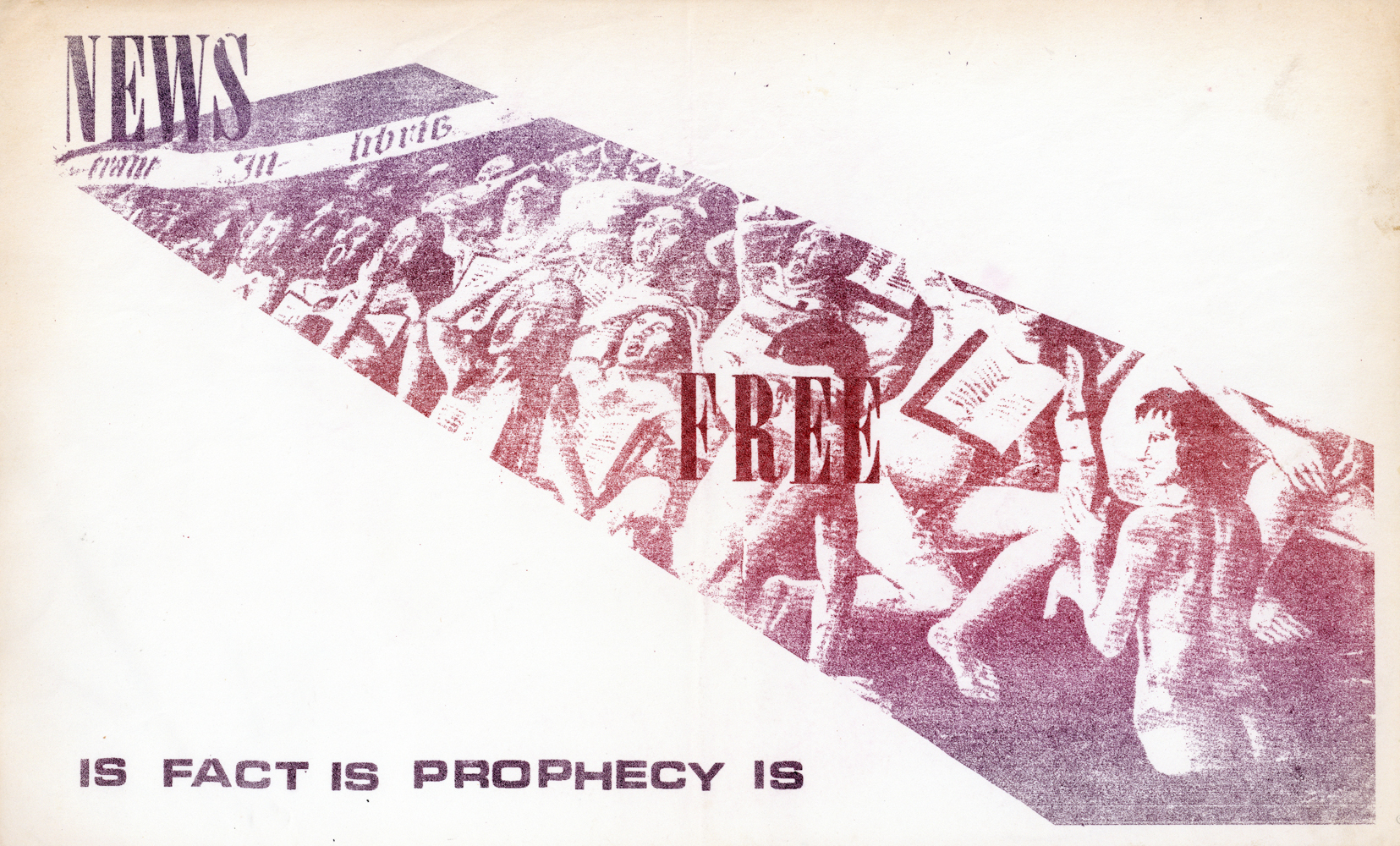
Cat. No.: FC-2-002 Full record BibCit: n.d., ca. 11/1/1967. Broadside. San Francisco: Free City Collective. Collection: SOLA-o; SS-o (MH). Abstract: This piece collapses the usual boundary between reporting and revelation. By declaring that news is “fact” and “prophecy” at once, the sheet presents itself not as neutral chronicle but as an active force within the making of the new social body it depicts. The angled crowd scene—apparently drawn from the world of Bruegel, or at least evocative of that dense, collective peasant tumult—reinforces the sense of history in motion, as though the paper itself were both witness to and instrument of the Free City.
Note: The idea of this sheet predates the first Free City News sheets by several weeks. (I have never been able to figure out the dating of this set of Free City, except that it was the second set published by the Free City Collective.)
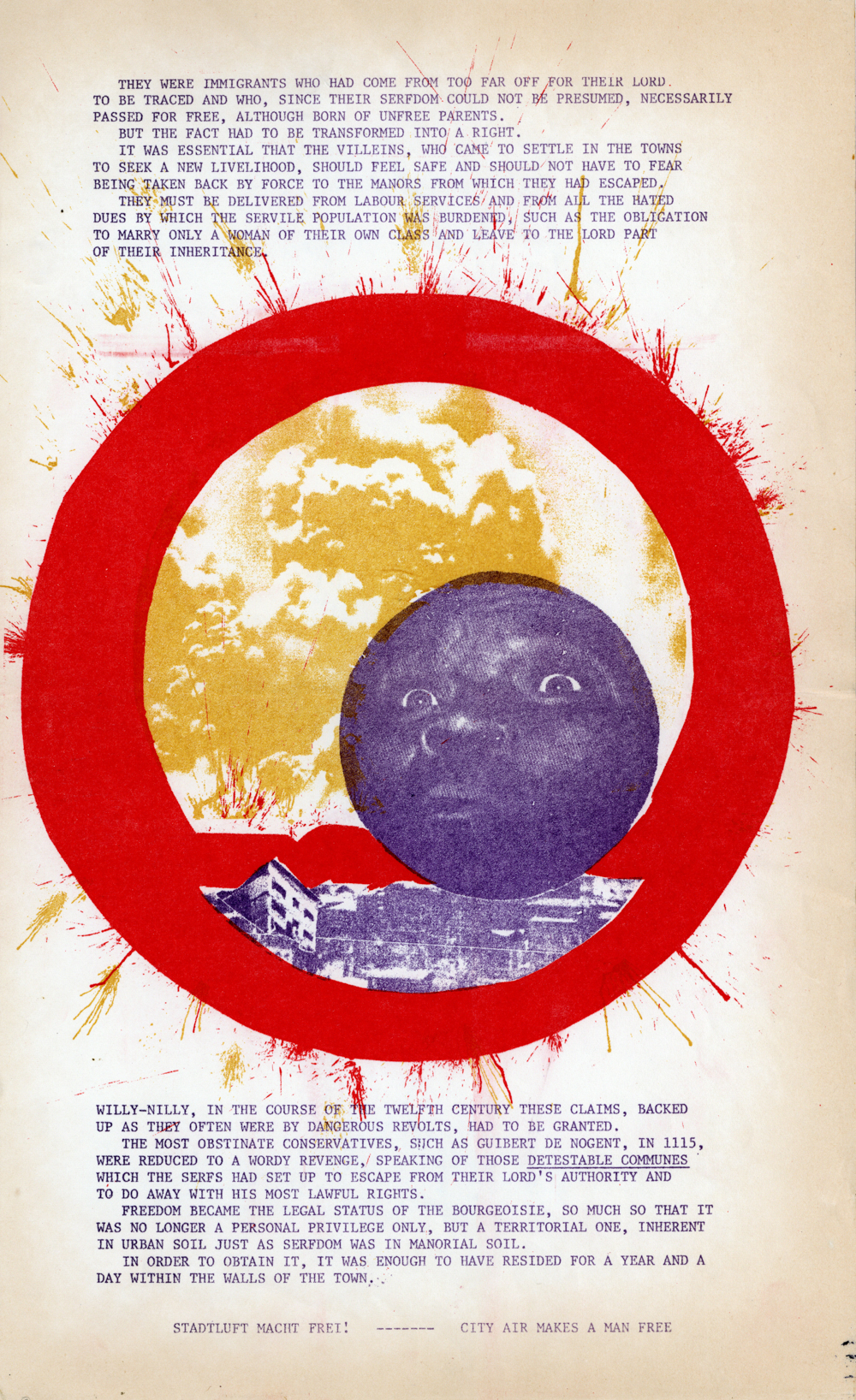
Cat. No.: FC-2-003 Full record BibCit: n.d., ca. 11/1/1967. Broadside. Legal size. San Francisco: Free City Collective. Collection: SOLA-o; SS-o (MH). Abstract: This sheet places the Free City in a much longer historical arc, linking the medieval town’s promise of refuge from feudal bondage to the countercultural hope of urban liberation in the present. The great red ring, the unsettling Black face, and the fragments of cityscape turn the page into an emblem of passage: a crossing into civic freedom that is at once communal and apocalyptic. “City air makes a man free” is invoked here not as quaint historical motto but as a charged proposition, suggesting that the city—if truly remade—might become a zone of release from inherited servitude.
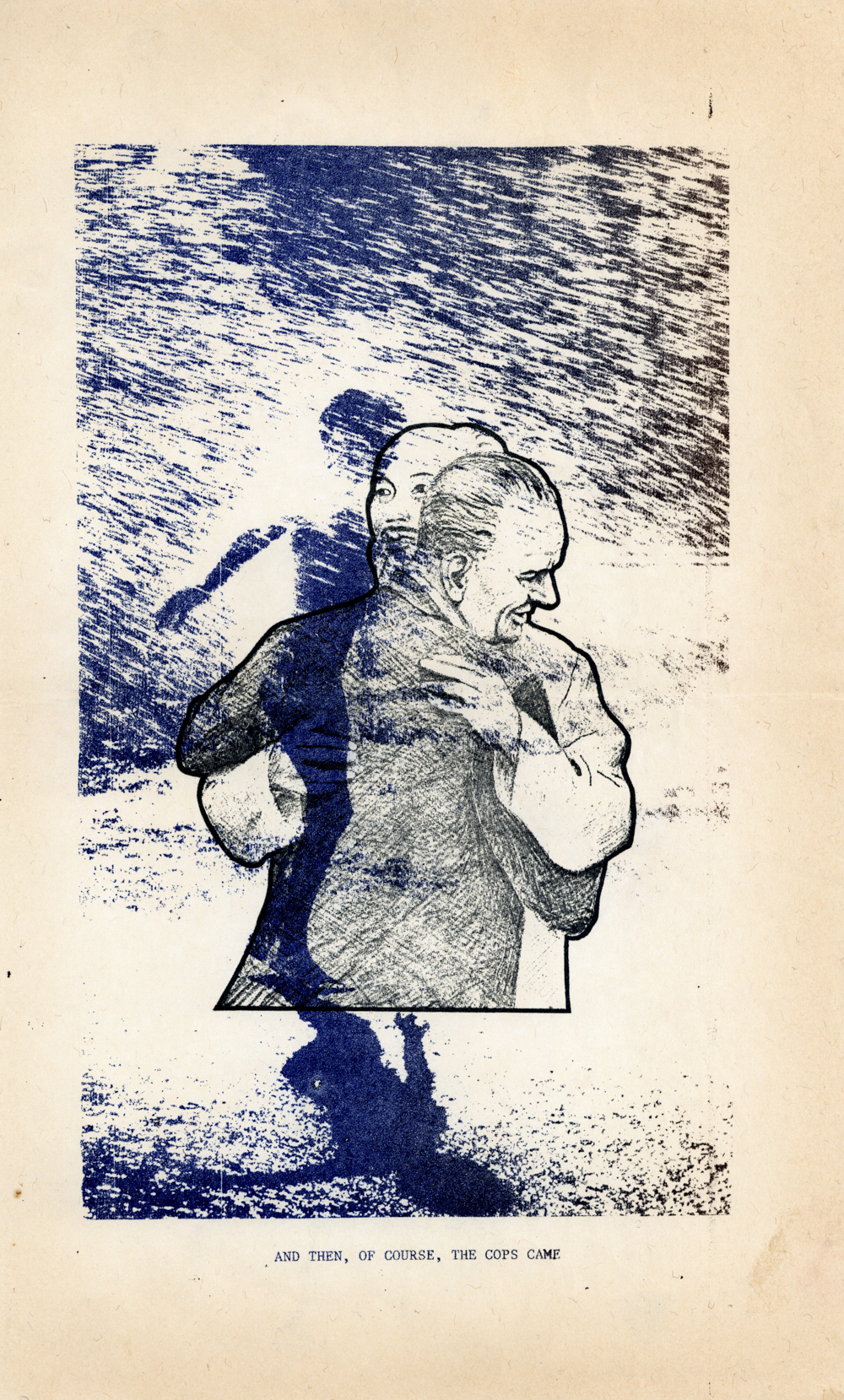
Cat. No.: FC-2-004 Full record BibCit: n.d., ca. 11/1/1967. Broadside. Legal size. San Francisco: Free City Collective. Collection: SOLA-o; SS-o (MH). Abstract: This sheet turns on the improbable image of Ho Chi Minh and Lyndon Johnson locked in an embrace, an image that works at once as political satire and as queer provocation. Read from a queer perspective, the piece becomes more than an absurd reconciliation of enemies: it stages forbidden male intimacy across one of the most militarized and hypermasculine divides of the era. The deadpan caption, “And then, of course, the cops came,” pulls that embrace back into the familiar machinery of repression, where geopolitics, sexual anxiety, and the policing of the body converge.
Note: For those unfamiliar with the context, Ho Chi Minh and Lyndon Johnson were, in 1967, the respective leaders of the two countries at war in Vietnam.
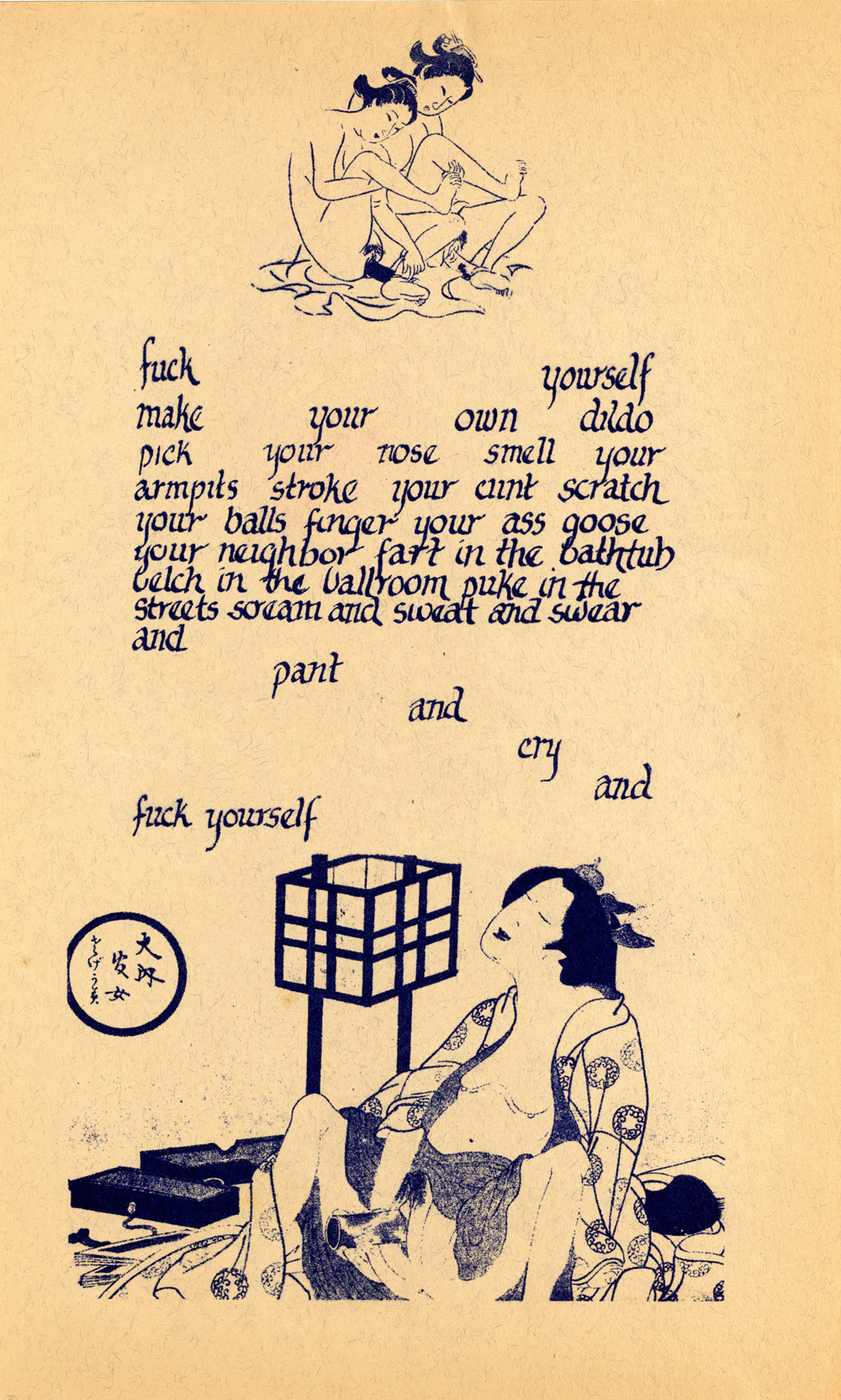
Cat. No.: FC-2-005 Full record BibCit: n.d., ca. 11/1/1967. Broadside. Legal size. San Francisco: Free City Collective. Collection: SOLA-o; SS-o (MH). Abstract: This sheet is a gleefully abrasive assault on decorum, self-importance, and the hypocrisies of polite society. Its litany of bodily acts and sensations, paired with appropriated Japanese erotic imagery, collapses the distance between obscenity, comedy, and liberation, insisting that the body in all its appetites and indignities must be brought back into view. In the context of Free City, it reads as a deliberately offensive manifesto of anti-refinement, aimed at shattering the managed sensibility of both straight respectability and hip pretension.
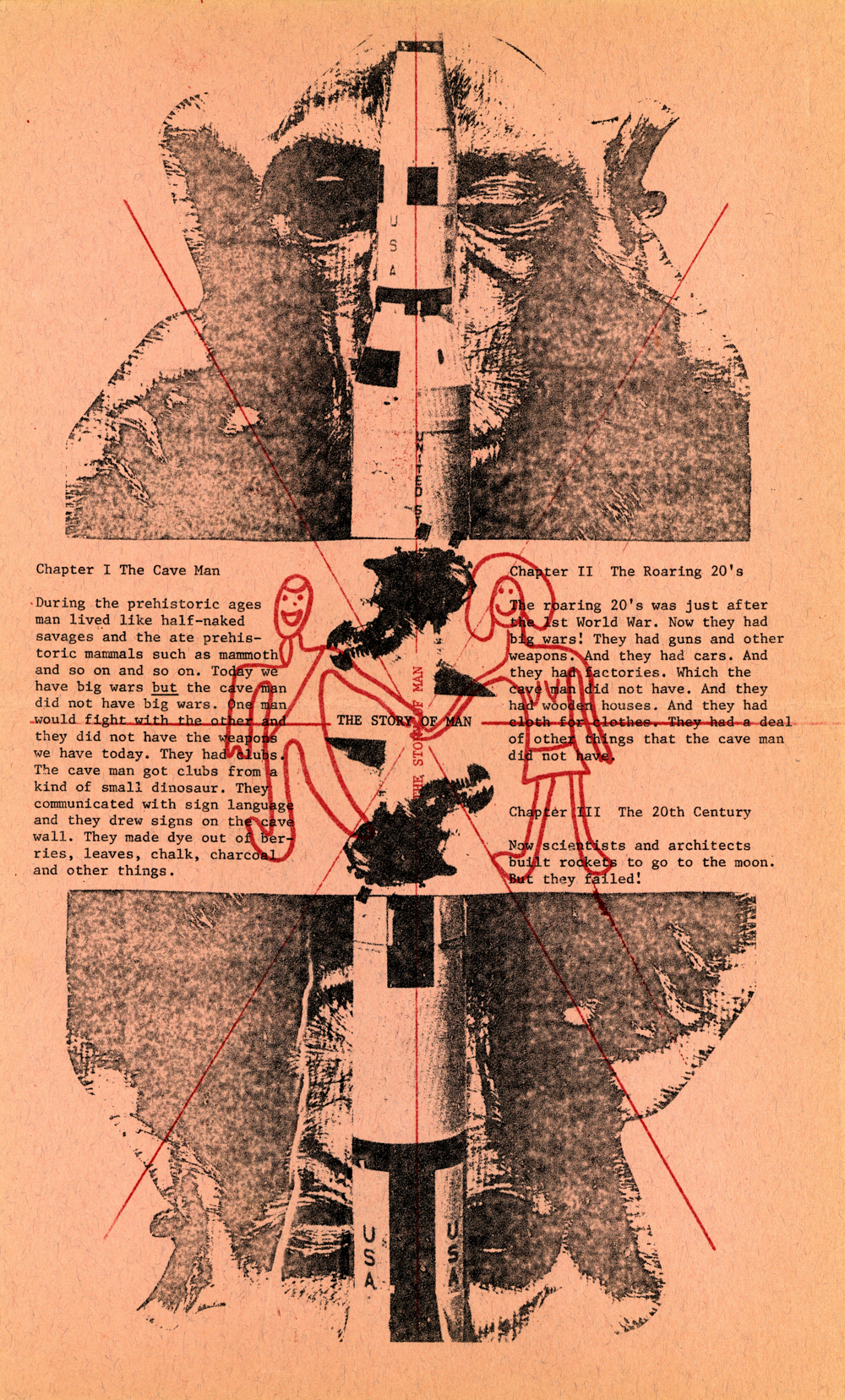
Cat. No.: FC-2-006a Full record BibCit: n.d., ca. 11/1/1967. Broadsheet. Legal size. San Francisco: Free City Collective. Collection: SOLA-o; SS-o (MH). Abstract: A child’s-eye history of civilization in which progress means only bigger wars, better weapons, and a failed escape to the moon.
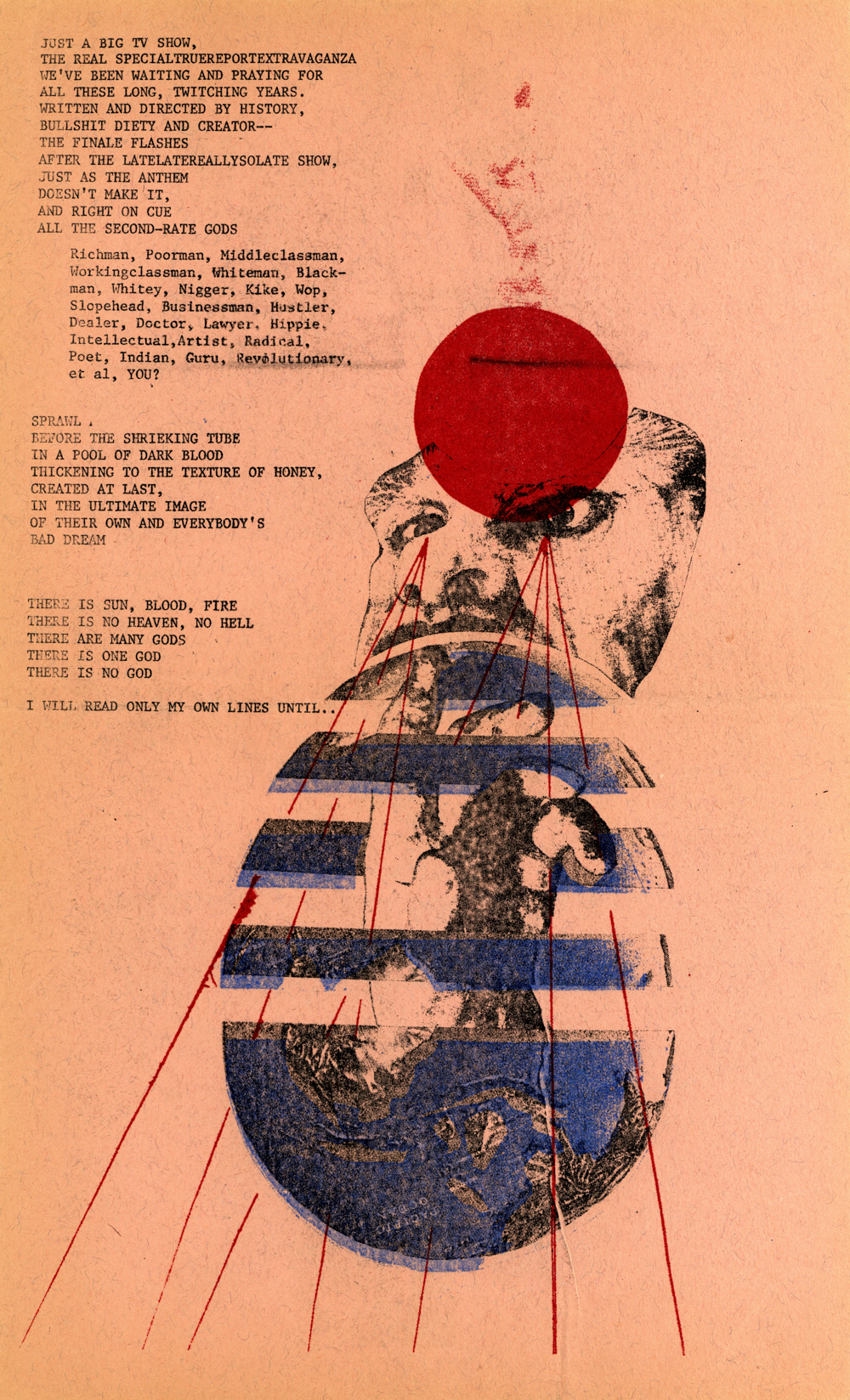
Cat. No.: FC-2-006b Full record BibCit: n.d., ca. 11/1/1967. Broadsheet. Legal size. San Francisco: Free City Collective. Collection: SOLA-o; SS-o (MH). Abstract: This companion piece to the reverse side pushes the critique of modern civilization into the register of nightmare spectacle. History appears here as a grotesque media event—part blood ritual, part collapsing theology, part televised hallucination—in which the categories by which people are sorted and managed and paraded only to be swallowed up in a bad dream of their own making. The closing line, “I will read only my own lines until…,” suggests a refusal of the prefabricated script, as though the only possible answer to this shrieking pageant were to step out of the roles history has assigned.
Note: The image is dominated by a dislocated face or mask suspended above a segmented blue globe, with a red disk—sun, wound, target, or bomb—lodged at the crown. The thin red lines read like beams, strings, or vectors of force, so that the figure seems at once irradiated, manipulated, and disassembled. Taken with the text, the image suggests a world consciousness broken into layers: history as spectacle, identity as fragmentation, and the planet itself as a stage for psychic and political catastrophe.
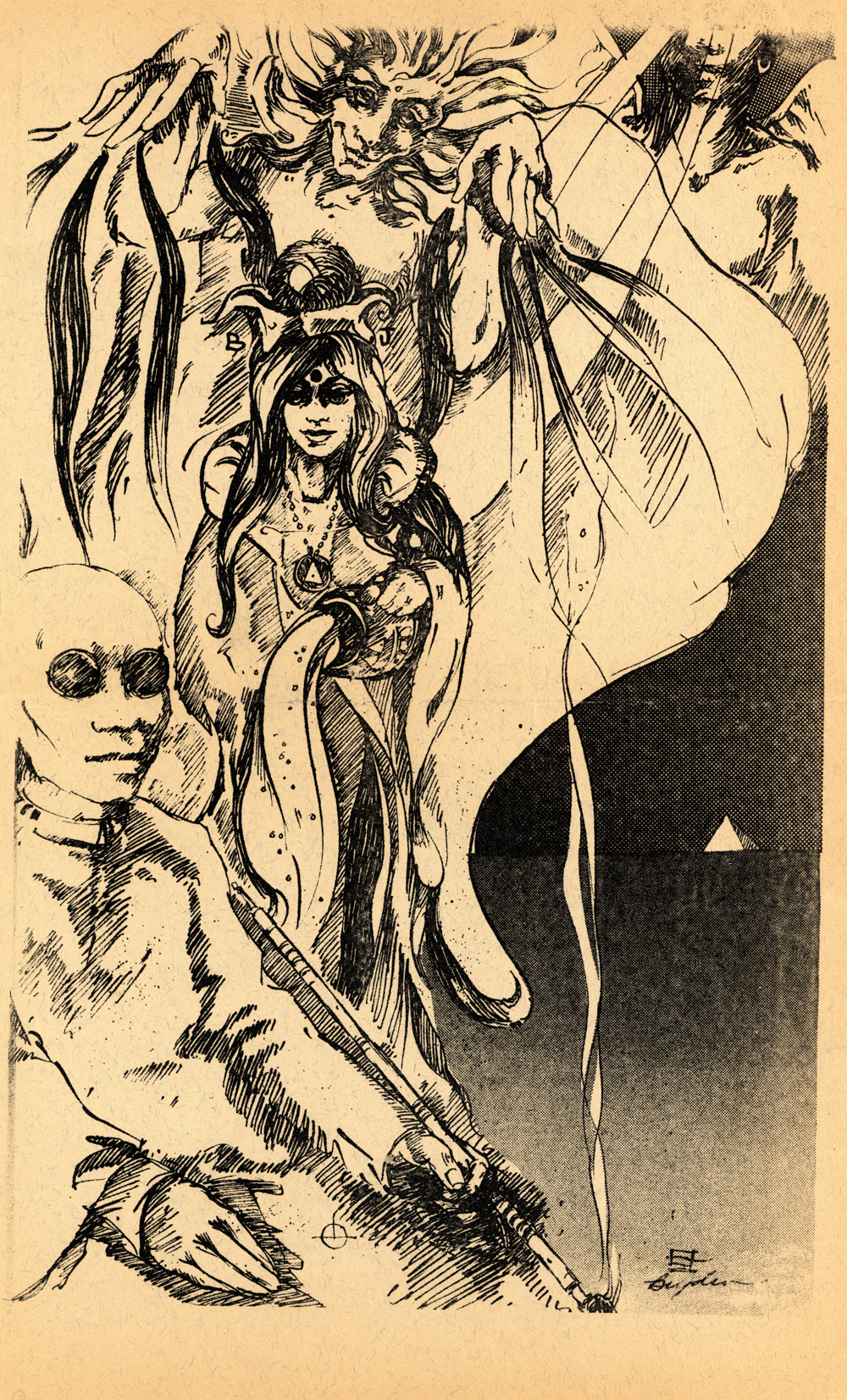
Cat. No.: FC-2-007 Full record BibCit: n.d., ca. 11/1/1967. Broadside. Legal size. San Francisco: Free City Collective. Collection: SOLA-o; SS-o (MH). Abstract: This image introduces a fantastical, almost tarot-like register into the Free City sequence. The horned woman, the bearded sorcerer figure, and the blank-eyed attendant suggest a procession of archetypes drawn from the occult revival, underground comics, and psychedelic poster art, where erotic power, ritual knowledge, and theatrical menace are all held in suspension. In the context of Free City, the piece reads as an emblem of the visionary imagination itself: seductive, ceremonial, and slightly dangerous, as though the new city required not only politics and prophecy but its own mythology.
Note: Drawing by Bryden, one of the few Free City artists to sign their work.
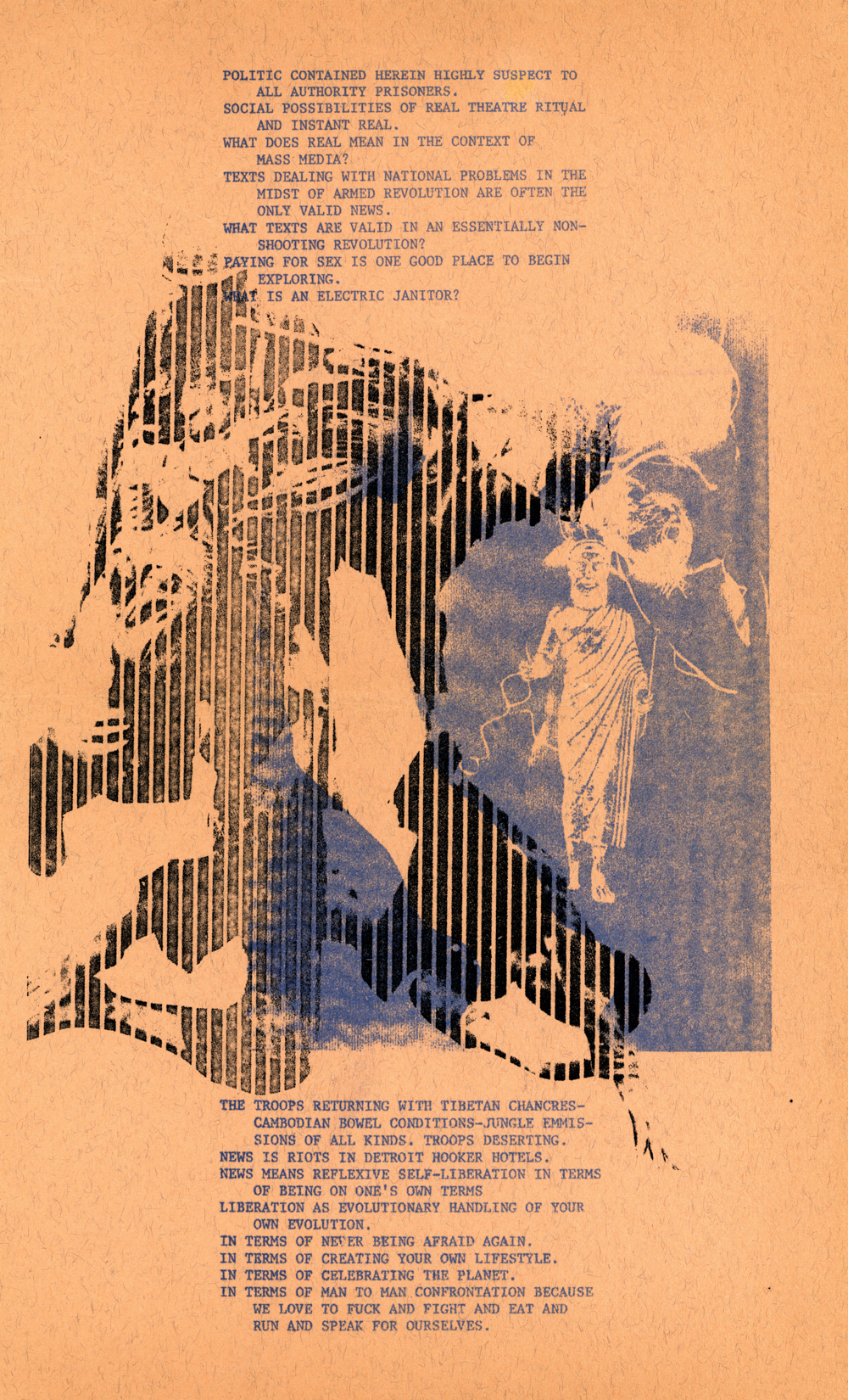
Cat. No.: FC-2-008 Full record BibCit: n.d., ca. 11/1/1967. Broadside. Legal size. San Francisco: Free City Collective. Collection: SOLA-o; SS-o (MH). Abstract: This sheet is one of Free City’s more explicit meditations on the problem of “news” in a revolutionary culture that is not, at least yet, founded on armed struggle. The text rejects the authority of mass media and official politics in favor of “instant real,” social theater, sexual candor, self-liberation, and the making of one’s own life as the valid ground of revolutionary speech. The layered imagery—part prison bars, part planetary or ritual apparition—suggests both confinement and breakthrough, as though the task were to invent forms of consciousness and communication adequate to liberation on one’s own terms.
Note: The design relies on superimposition, with prison-like vertical bars laid over photographic imagery and a small classical figure, reinforcing the sheet’s tension between confinement and revelation.
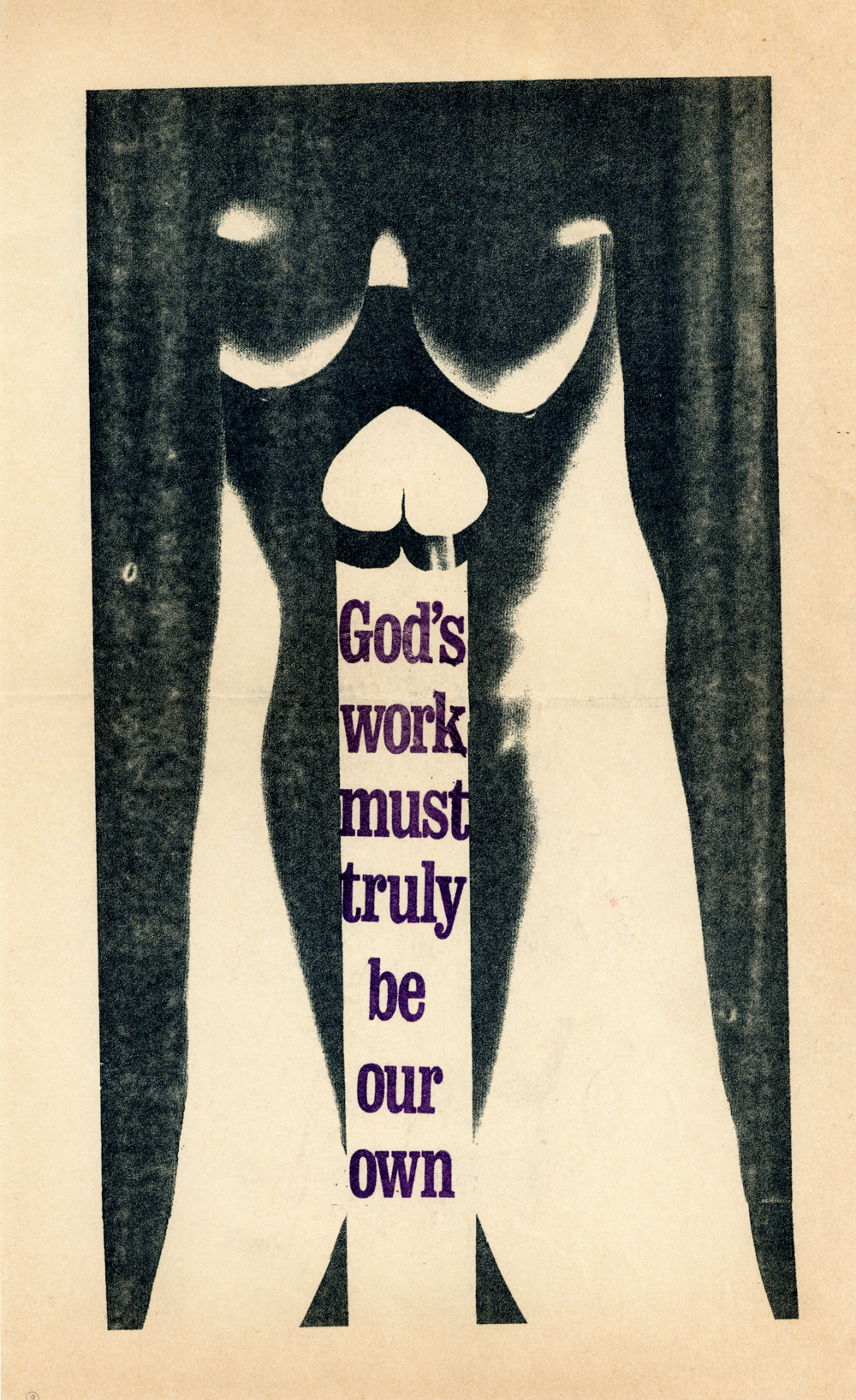
Cat. No.: FC-2-009 Full record BibCit: n.d., ca. 11/1/1967. Legal size. San Francisco: Free City Collective. Collection: SOLA-o; SS-o (MH). Abstract: This sheet reduces its message to a stark sexual icon: a frontal body in which female and male forms are fused, the erect phallus set within an otherwise female torso to create an androgynous or hieratic emblem of generative power. The slogan, “God’s work must truly be our own,” is thus made literal through the body itself, suggesting that creation, liberation, and sacred authority are not to be delegated upward but reclaimed in human form. Spare, confrontational, and deliberately unsettling, the design turns sexual wholeness into manifesto.
Note: One of the more frequently reproduced images from Free City.
Cat. No.: FC-2-010 Full record BibCit: n.d., ca. 11/1/1967. Broadside. Legal size. San Francisco: Free City Collective. Collection: SOLA-o; SS-o (MH). Abstract: As the final sheet in the second Free City set, with only this image on the back of the sheet, the piece reads like a parting shot. A delicate botanical specimen is overprinted with the blunt imperative “Fuck Off,” the joke residing in the contrast between courtesy of form and discourtesy of message. In that final position, the sheet becomes an elegant rebuff to intrusion, authority, or unwanted claim on the self: a deadpan farewell and a last irreverent flourish at the end of the sequence.
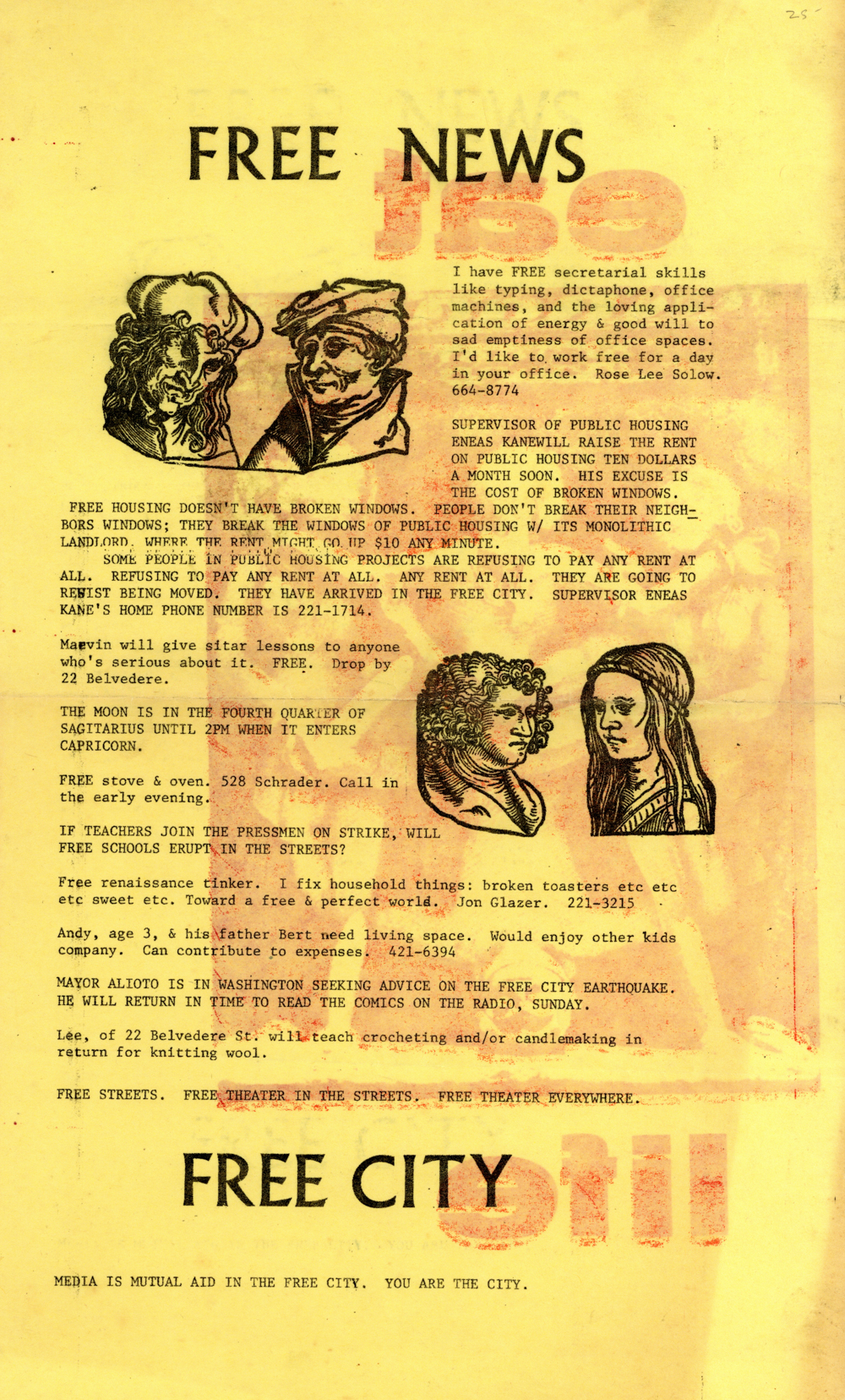
Cat. No.: FC-NEWS-006a Full record BibCit: 1/26/1968. Broadsheet. Legal size. San Francisco: Free City Collective. Collection: SOLA-o. Abstract: This Free News sheet presents the Free City as a lived network of mutual aid rather than a slogan or abstraction. Offers of free labor, housing help, lessons, repair work, childcare, and domestic exchange sit alongside political provocation, astrological timekeeping, and calls for free schools, free streets, and free theater. The effect is to collapse classifieds, manifesto, and street poetry into a single form, where everyday need becomes the ground of social transformation. Its closing line states the principle plainly: “Media is mutual aid in the Free City. You are the city.”
Note: The inserted portrait heads, suggestive of an older, even medieval civic world, reinforce the sheet’s sense that the Free City is not merely a contemporary improvisation but a recovery of older communal forms.
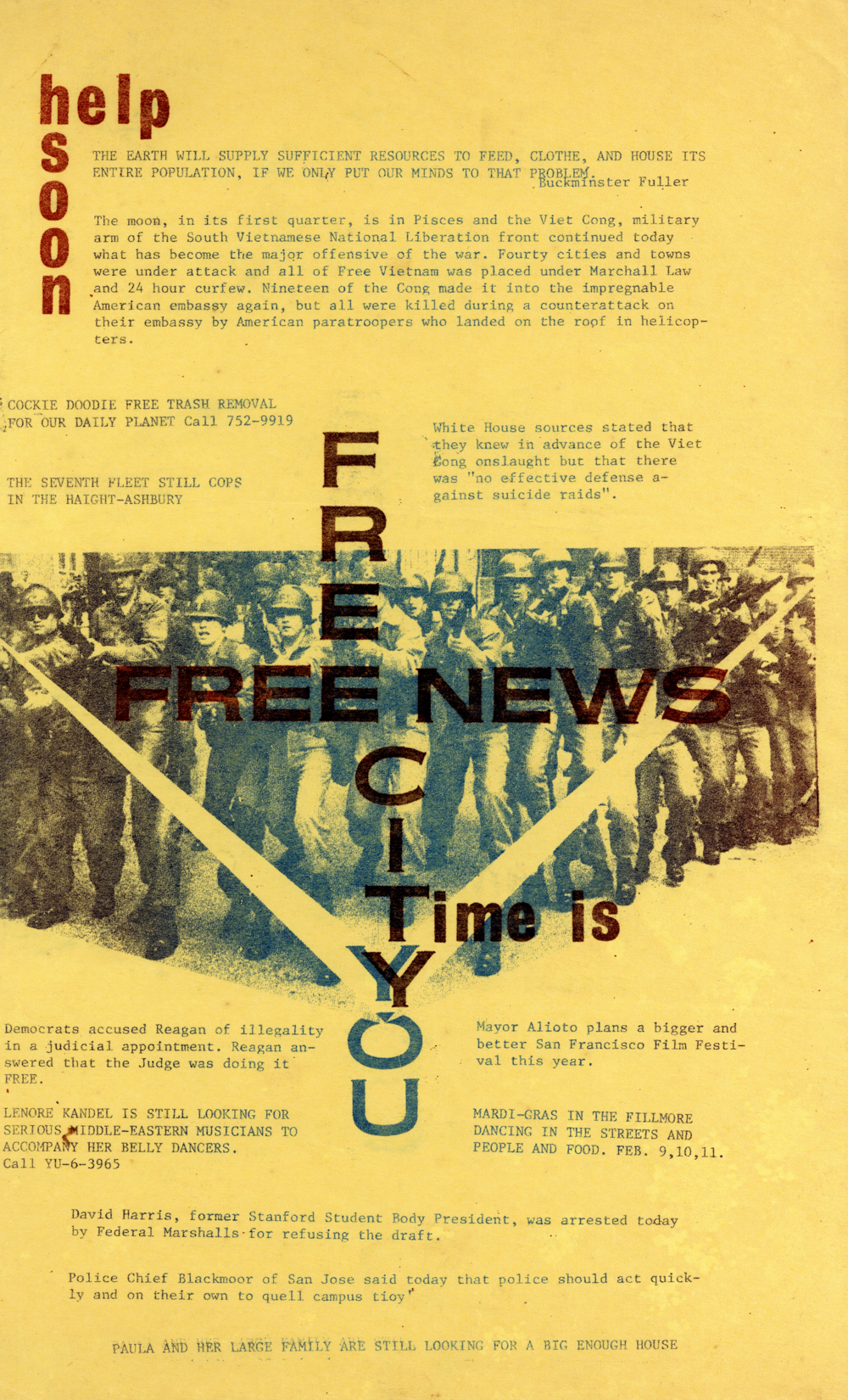
Cat. No.: FC-NEWS-004 Full record BibCit: 2/1/1968. Broadside. Legal size. San Francisco: Free City Collective. Collection: SOLA-o. Abstract: This Free News sheet stages a confrontation between war, authority, and the counter-image of a liberated city. Across a photograph of helmeted police advancing in formation, the words FREE CITY descend vertically while FREE NEWS cuts across the image, turning the page itself into a graphic act of resistance. Around that central collision, the sheet juxtaposes fragments of the Tet Offensive, Vietnam, Reagan, Alioto, Lenore Kandel, Mardi Gras in the Fillmore, housing needs, free trash removal, and street rumor, collapsing official news and local countercultural life into a single field. The result is not a conventional newspaper page but a visual manifesto: the city is figured as a contested zone in which police power, war, festival, need, and free sociality all meet. The phrase “Time is You” gives the sheet its deeper claim, shifting history from the abstractions of the state to the lived agency of the people in the street.
Note: Dating: February 1, 1968. The assault on the US Embassy in Saigon during the Tet Offensive began January 31 with 19 Vietcong successfully invading the compound. The moon in Pisces confirms the dating.
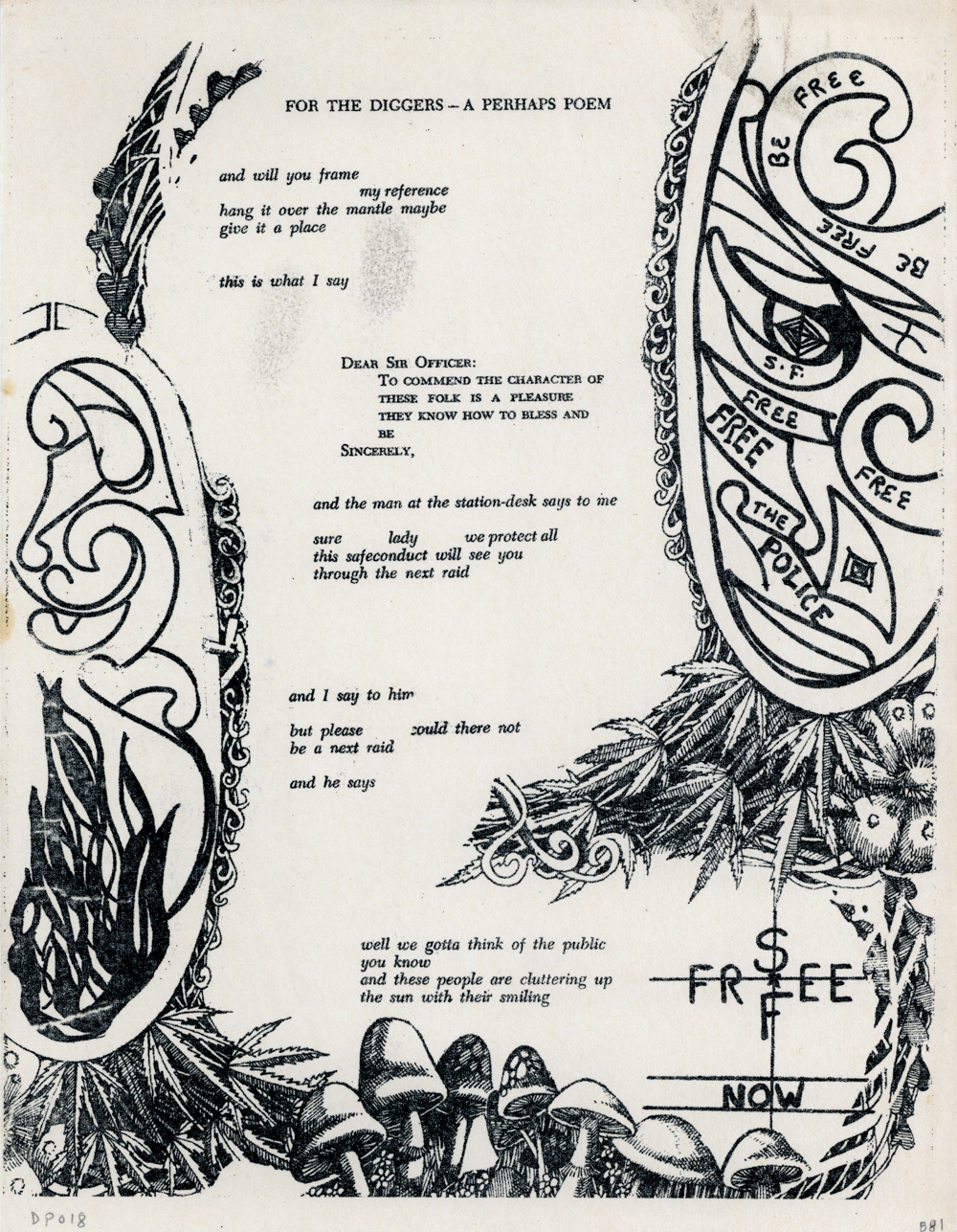
Cat. No.: DR-005 Full record BibCit: n.d., ca. 3/1/1968. Broadside. Letter size. Collection: SOLA-o. Abstract: This sheet folds a short poetic exchange with the police into an ornate graphic field of spirals, leaves, mushrooms, and repeated invocations to “be free.” The poem begins with the language of polite official endorsement—“Dear Sir Officer”—but quickly exposes the absurdity of being promised protection only “through the next raid.” Its quiet irony is one of the sheet’s strengths: the speaker asks, almost gently, whether there might not be a next raid, only to be answered by the bureaucratic logic of public order. The surrounding artwork turns that exchange into a Free City emblem, setting police power, money, and “the public” against the Digger insistence on freedom now.
Note: The SF | FREE | NOW imagery dates this sheet most likely to the Spring 1968 Free City period.
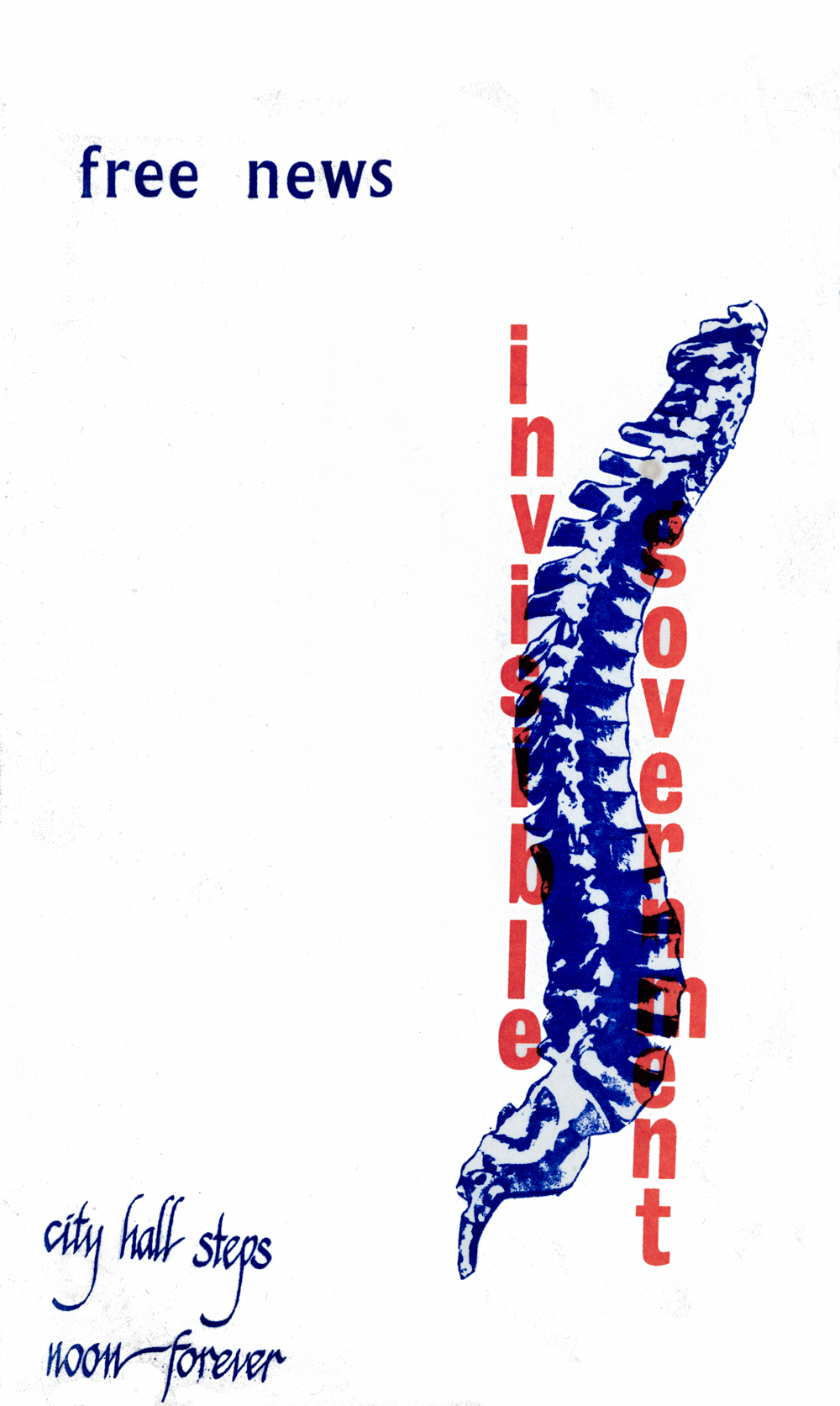
Cat. No.: FC-NEWS-001 Full record BibCit: n.d., ca. 3/1/1968. Broadside. San Francisco: Free City Collective. Collection: SOLA-o. Abstract: A Free News sheet that announces the daily happenings at San Francisco's City Hall.
Note: The daily gatherings on the City Hall steps began around the spring equinox of 1968.
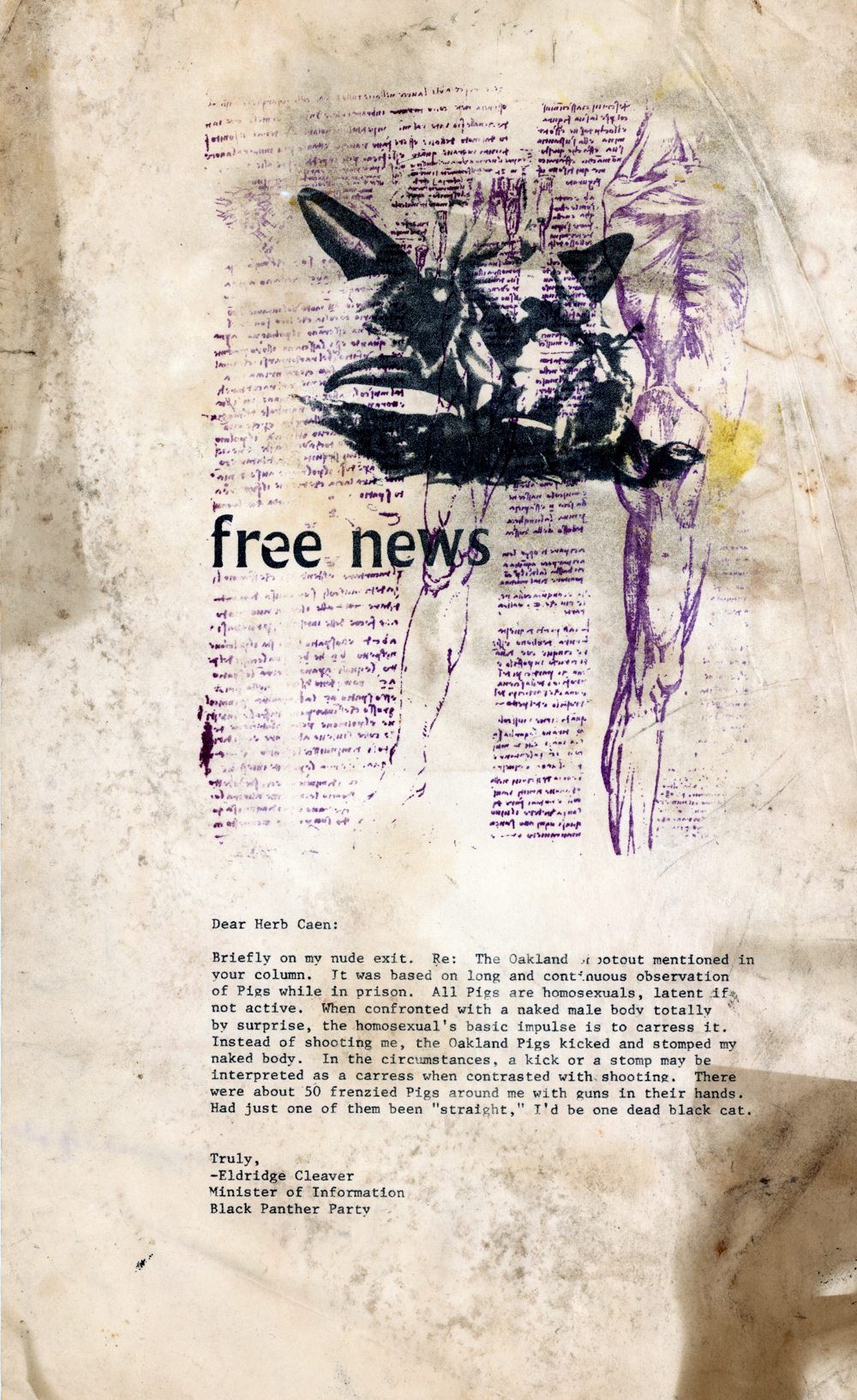
Cat. No.: FC-NEWS-005 Full record BibCit: n.d., ca. 4/15/1968. Broadside. Legal size. San Francisco: Free City Collective. Collection: SOLA-o. Abstract: This Free News sheet layers nude figuration and political mockery into a single charged image. Beneath the spectral purple and black composition appears Eldridge Cleaver’s letter to Herb Caen on the Oakland shootout, turning the naked body into an instrument of irony directed against police power, sexual panic, and public hypocrisy. The piece works less as straightforward reportage than as a visual provocation, fusing underground print aesthetics with the volatile politics of the street.
Note: Re: Dating. Herb Caen mentioned the Oakland shootout in his column on April 15, 1968. "When young Bobby Hutton and Eldridge Cleaver were trapped by the cops in that Oakland house, the experienced Cleaver told the kid: 'Take off all your clothes before we walk outside — that way they can't claim you were trying to pull a gun and shoot you." Cleaver thereupon stripped but Hutton was too shy: he kept his shorts on. And was shot dead. The naked Cleaver was wounded."
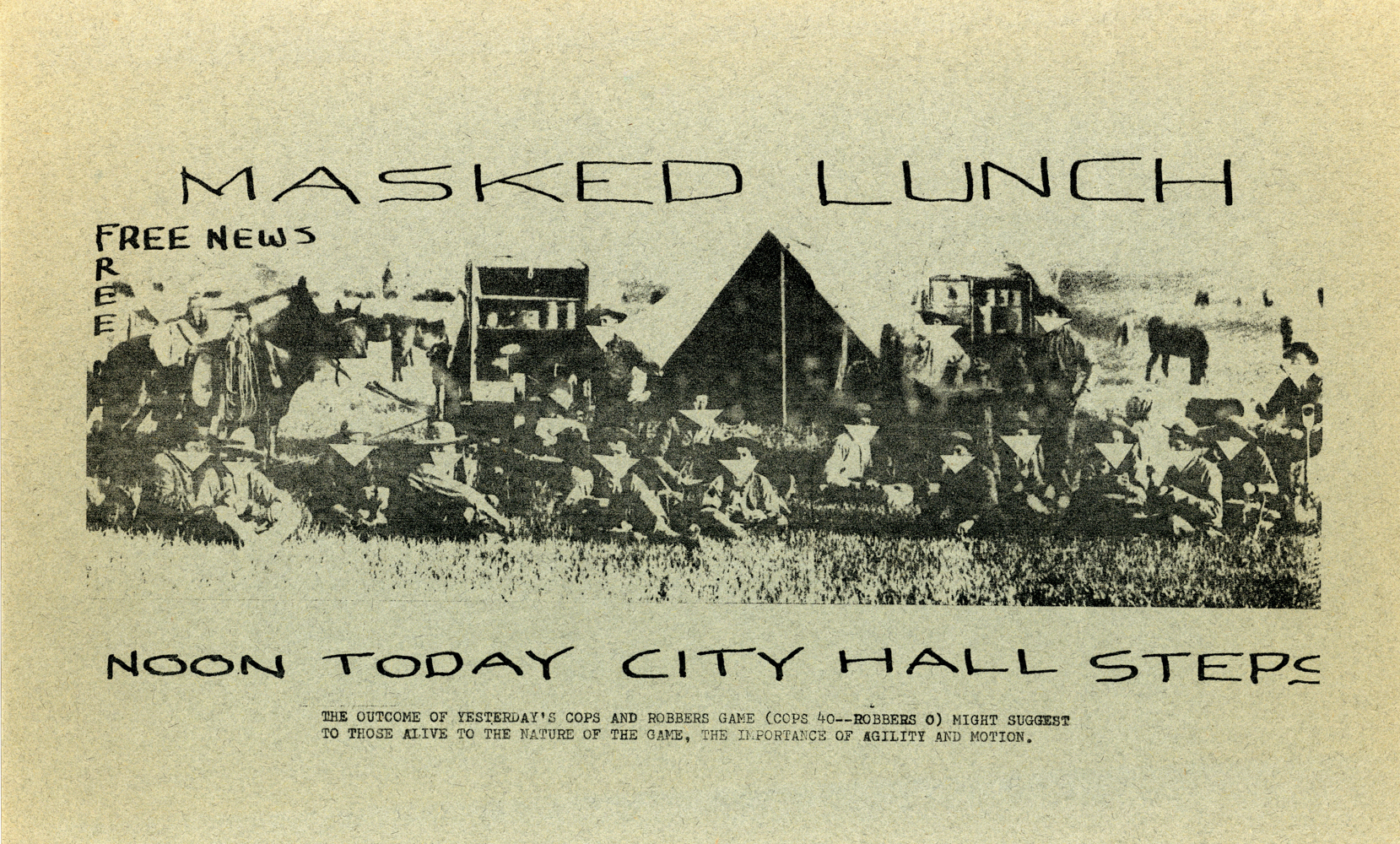
Cat. No.: FC-NEWS-003 Full record BibCit: 5/8/1968. Broadside. Legal size. San Francisco: Free City Collective. Collection: SOLA-o. Abstract: Announcement of a mass "mask-in" at City Hall to protest the "Poetry Bust" the previous day when Ron Thelin was arrested after Judge Axelrod confronted him for wearing a bandanna covering his face. Four others were also arrested, including Ama (aka Thomas C. Baker III) of Willard Street Commune (for wearing an American flag); Israel Jackson, also of Willard Street (for interfering with a police officer); Phyllis Wilner (for interfering with a police officer); and, Charles Perkel (for using profanity). The photograph appears to depict a nineteenth-century mining camp, over which a Free City printer has superimposed triangular masks on each face, converting a historical image into a contemporary emblem of anonymity, collectivity, and social theater.
Note: See: Sixties Date Machine. Also: "Hippies Make Faces at City Hall" by Dick Hallgren, S.F. Chronicle, May 9, 1968, p. 3.
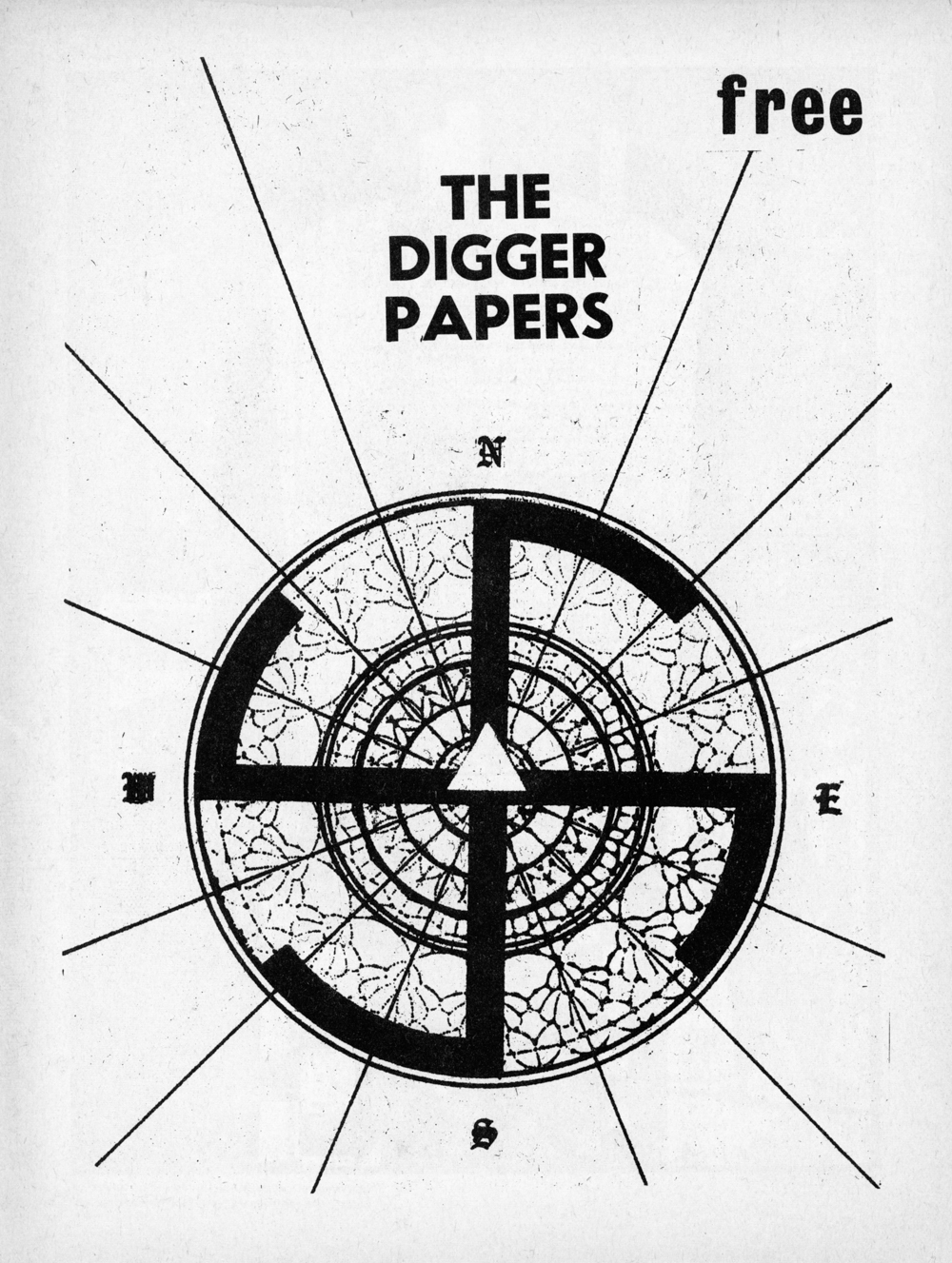
Cat. No.: FC-OTHER-DP68-001 Full record BibCit: n.d., ca. 6/1/1968. Pamphlet. Letter size. 24 pp.. [The Realist]. Abstract: The anthology of digger articles and street sheets compiled by Emmett Grogan and published by The Realist. This is the "digger" or "free" edition. The cover is a full-page graphic of the "running man" symbol (Native American swastika). Other than the cover, all pages are the same as the Realist edition.
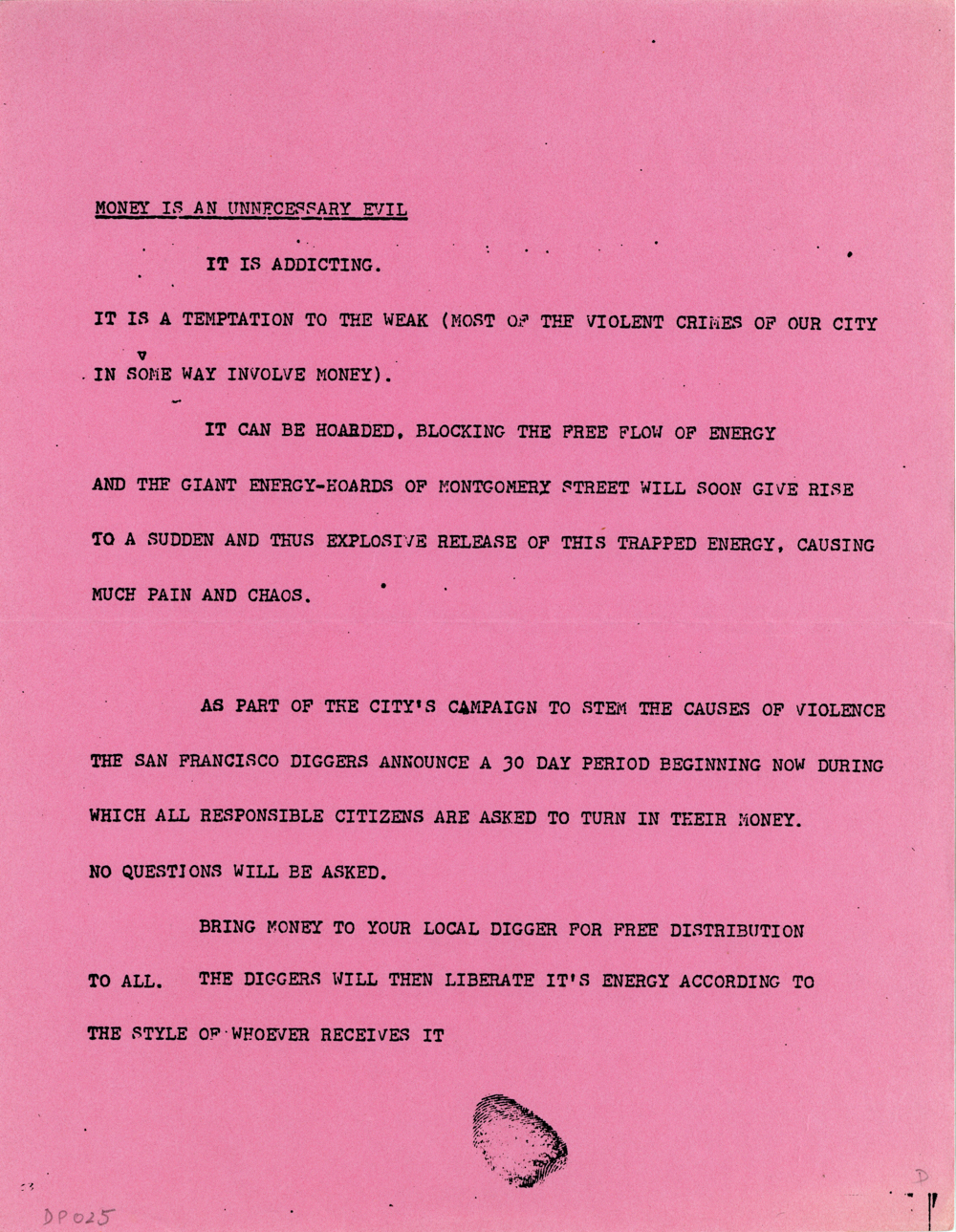
Cat. No.: DP-018 Full record BibCit: n.d., ca. 7/24/1968. Broadside. Letter size. Collection: SOLA-o. Abstract: This sheet is a classic Digger parody of civic reform language, recasting money itself as a social toxin and then proposing, with deadpan seriousness, a thirty-day campaign to rid the city of it. By calling money an “unnecessary evil,” addictive, corrupting, and productive of violence, the piece turns conventional public-safety rhetoric inside out, while its warning about hoarded wealth on Montgomery Street gives the satire a distinctly San Francisco target. The joke, of course, is inseparable from the Digger principle behind it: money is not simply to be condemned but released, redistributed, and stripped of its frozen power. In that sense, the sheet is both mock proclamation and real provocation, using humor to expose the unnaturalness of accumulation and to imagine the “free flow of energy” in place of financial control.
Note: Dating: see San Francisco Express Times, July 24, 1968, p. 2. Under the title, "Turn In Your Money," the Express Times notice reproduces the broadside’s language closely, but not exactly. It converts the Digger proclamation into a short newspaper item, shifting several sentences into reported speech and correcting “it’s” to “its.”