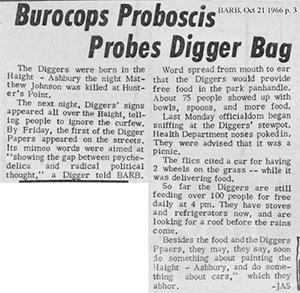




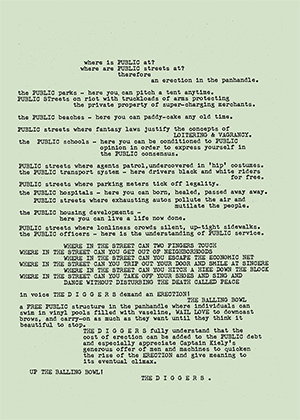
The story of the first Digger free feeds was recounted in the Berkeley BARB three weeks later. After the police shooting of Matthew Johnson, a Black teenager in Hunters Point, the Diggers posted signs urging people to ignore the curfew the Mayor had imposed. That Friday (Sept 30 1966), according to the BARB, the first Digger Paper appeared, which was intended to show "the gap between psychedelics and radical political thought." The Diggers then announced the first Free Feed in the Panhandle where 75 people showed up "with bowls, spoons, and more food."
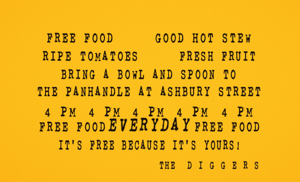
Facsimile of the first Digger street notice for free food in the Panhandle, ca. September 30, 1966, during the National Guard occupation of San Francisco.
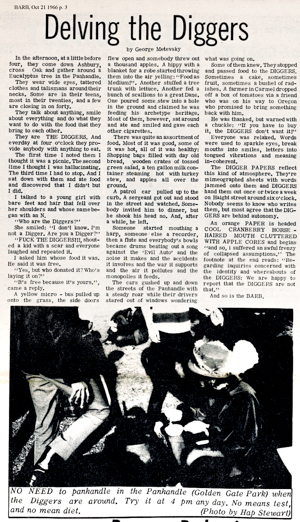
The same issue of the BARB had an article, "Delving the Diggers" by George Metesky. This was a pseudonym used by the two boyhood friends from Brooklyn who started the Diggers. The article was written tongue-in-cheek with a sardonic tone. (In response to someone asking, "Who are the Diggers?" one response was "Fuck the Diggers.")
"Delving" gives a vivid description of the early Free Feeds in the Panhandle. When someone asked whose food it was, the reply, in a phrase that would become a signature Digger motto, was, "It's free because it's yours." The article names the street sheets that the Diggers had been producing for the previous month. "The DIGGER PAPERS ... [are] mimeographed sheets with words jammed onto them and DIGGERS hand them out once or twice a week on Haight Street around six o'clock. Nobody seems to know who writes them, but most agree that the Diggers are behind autonomy."
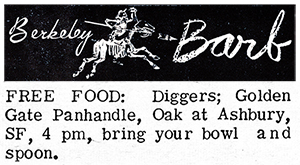
The first announcement of the Digger Free Feeds in the Berkeley BARB, November 4, 1966. This was a weekly notice in "The Scenedrome" section of the BARB for the next year. The last notice was June 16, 1967. The next week saw the start of the Digger Free Bakery at All Saints Church. Notices in the BARB for the free bakery continued until 1969.
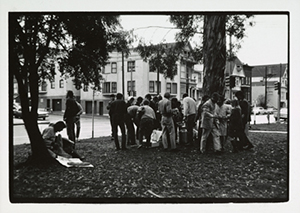
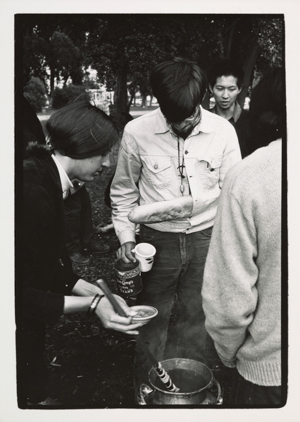
"In the afternoon, they come down Ashbury, cross Oak, and gather around a Eucalyptus tree in the Panhandle." (From "Delving the Diggers" in the BARB, October 21, 1966.) Photo by William Gedney.
The idea of daily free meals served to all comers was not new. The Catholic Worker Movement had been operating soup kitchens since the 1930s, offering hot meals free without any expectations religious or otherwise. But the San Francisco Diggers were doing something new. Their Free Feeds were acts of theater. Here is an excerpt from Emmett Grogan's account of the Free Feeds in Ringolevio:
Butcher Brooks was a photographer and he had a battered VW bus painted a bright yellow, with a slogan written on the outside panel in orange Day-Glo, "The Road of Excess Leads to the Palace of Wisdom!" He had been working as a Digger for about a month, and his bus became known around the streets as the yellow submarine, often carrying the Digger women - Natural Suzanne, Fyllis, Cindy Small, Bobsie, NanaNina -in the back with the prepared food. The crowd would see the yellow submarine coming down Ashbury Street and they would mill around near the curb in the park. Brooks sometimes felt the people were taking the Free Food too much for granted so, instead of parking and unloading, he often teased them by continually passing, until he sparked them into some sort of action, like waylaying the bus when it became delayed in traffic, removing the ignition keys, and seizing the cooked food. He also made them work for it by sealing the milk cans tight, banging the lids firmly shut with a hammer. It would take some time for several guys in the park to tug the jammed cover free of the blisterhot can and ladle out the stew. This Free Food theater evolved to a point where Billy constructed a giant, thirteen-foot square Frame of Reference from four two-by-fours bolted together, and Emmett painted it a golden orange. The frame would be set up between two large oak trees in the Panhandle every day before 4 P.M. When the Free Food arrived, it would be placed on one side of the frame and the hungry would be made to walk through it to get at the stew and whatever else was being shared on the other side, changing their frame of reference as they did.