Including Ephemera, Broadsides, Posters, Street Sheets, Collections, etc. for the
San Francisco Diggers, Communication Company, Free City Collective,
Kaliflower Intercommunal Network, Free Print Shop, Planetedge Manifestation,
Earth/Life Defense Commune, &c.
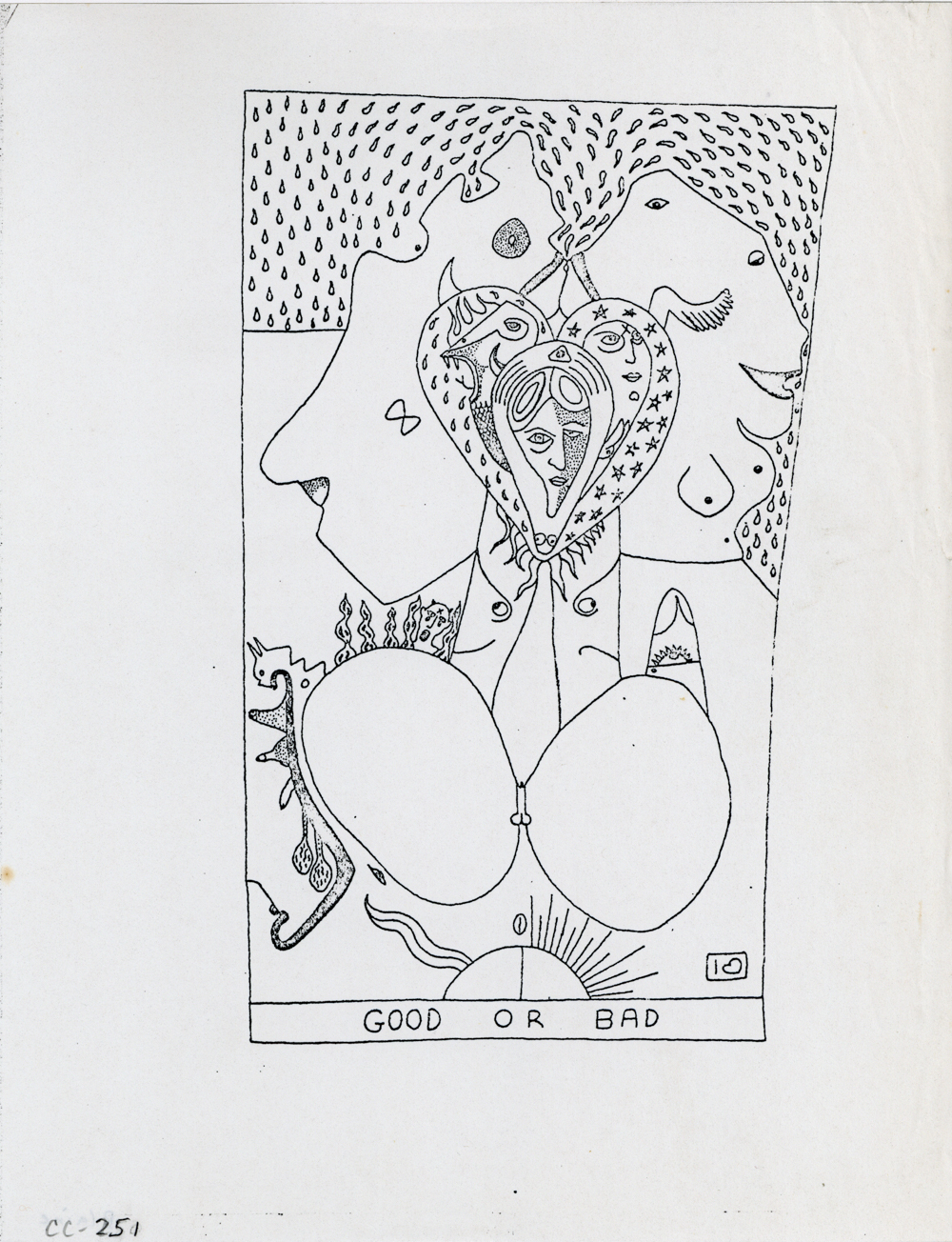
Cat. No.: CC-251 Full record BibCit: Broadside. Letter size. San Francisco: Communication Company. Imprint: None, presumably ComCo. Collection: SOLA-x(unk). Abstract: Title appears below a drawing signed by the artist with a small rectangular box surrounding a heart shape. Drawing is by the same artist as CC-157. Design has several faces, in a quasi-Picasso style, with raindrops (possibly sperm) shooting through the sky.
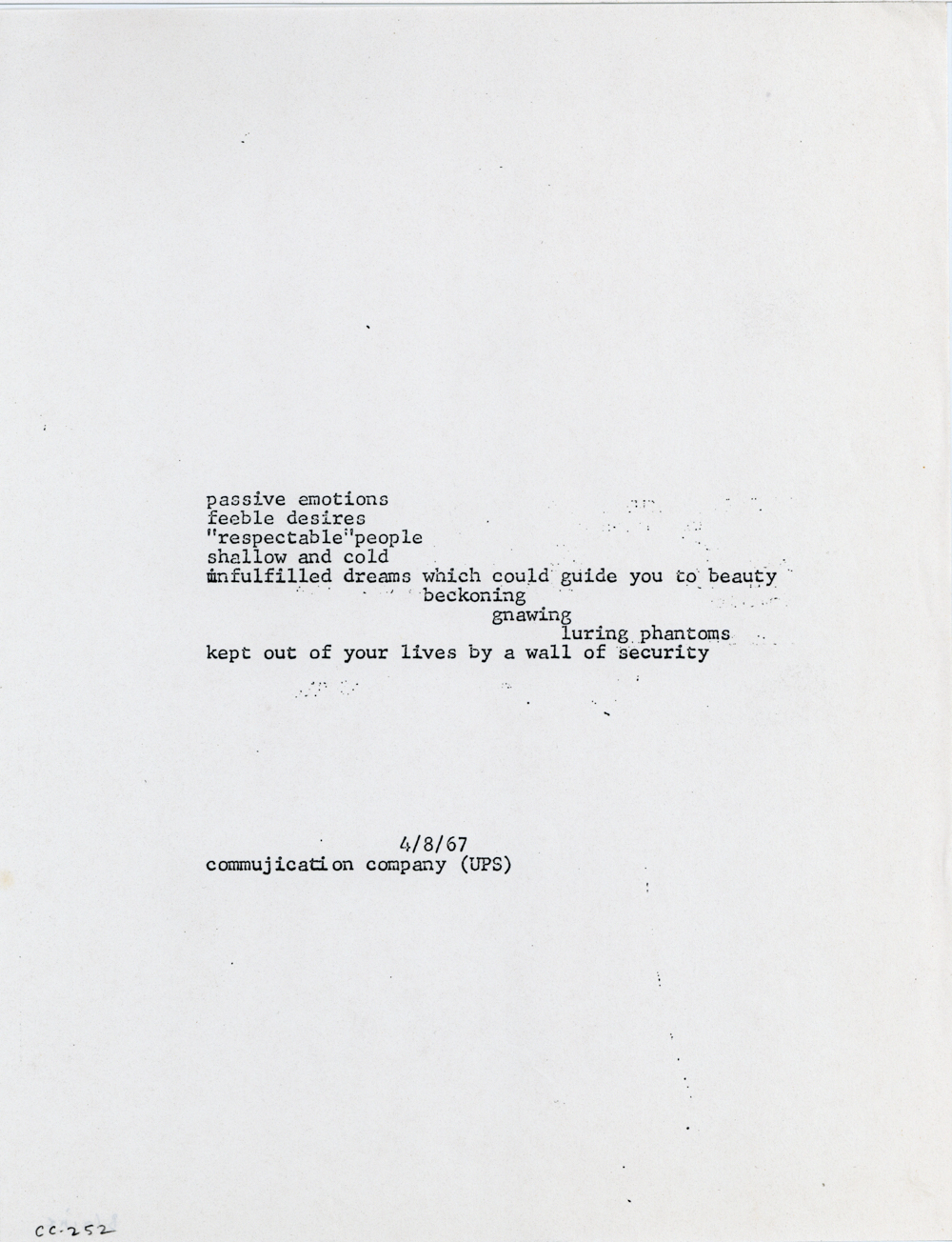
Cat. No.: CC-252 Full record BibCit: 4/8/1967. Broadside. Letter size. San Francisco: Communication Company. Imprint: commujication company (UPS). Collection: SOLA-x(unk). Abstract: Nine-line poem.
Cat. No.: CC-253 Full record BibCit: 4/17/1967. Leaflet. Letter size. San Francisco: Communication Company. Imprint: the communication company (u.p.s.) be advised. Collation: 4 pages (2 sheets?). Collection: SOLA-x(unk). Abstract: Detailed chemistry instructions for making DMT. First page is a cover sheet with block letters "DMT" in various patterns. Drawing of left hand points to the title. Imprint at bottom of first page.
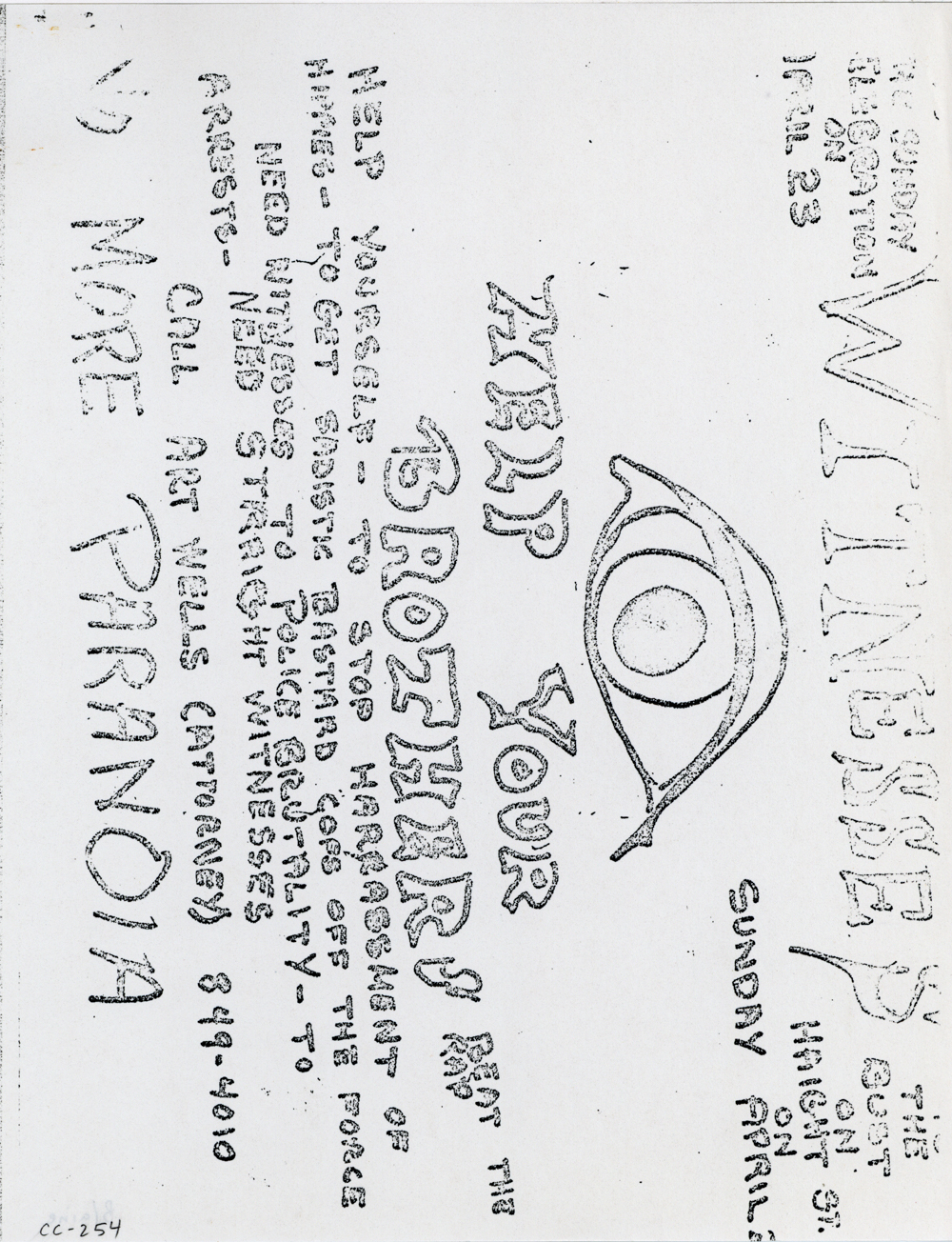
Cat. No.: CC-254 Full record BibCit: Broadsheet. Letter size. San Francisco: Communication Company. Imprint: Comm Comp. Collation: This page has landscape orientation.. Collection: SOLA-x(unk). Abstract: Plea for witnesses to a bust on Haight Street on April 23, to "help your brothers beat the rap" and to stop police harassment. Witnesses are asked to clal Art Wells, an attorney, at 849-4010. "No More Paranoia." Lettering is hand drawn. Drawing of eyeball at top of page below title.
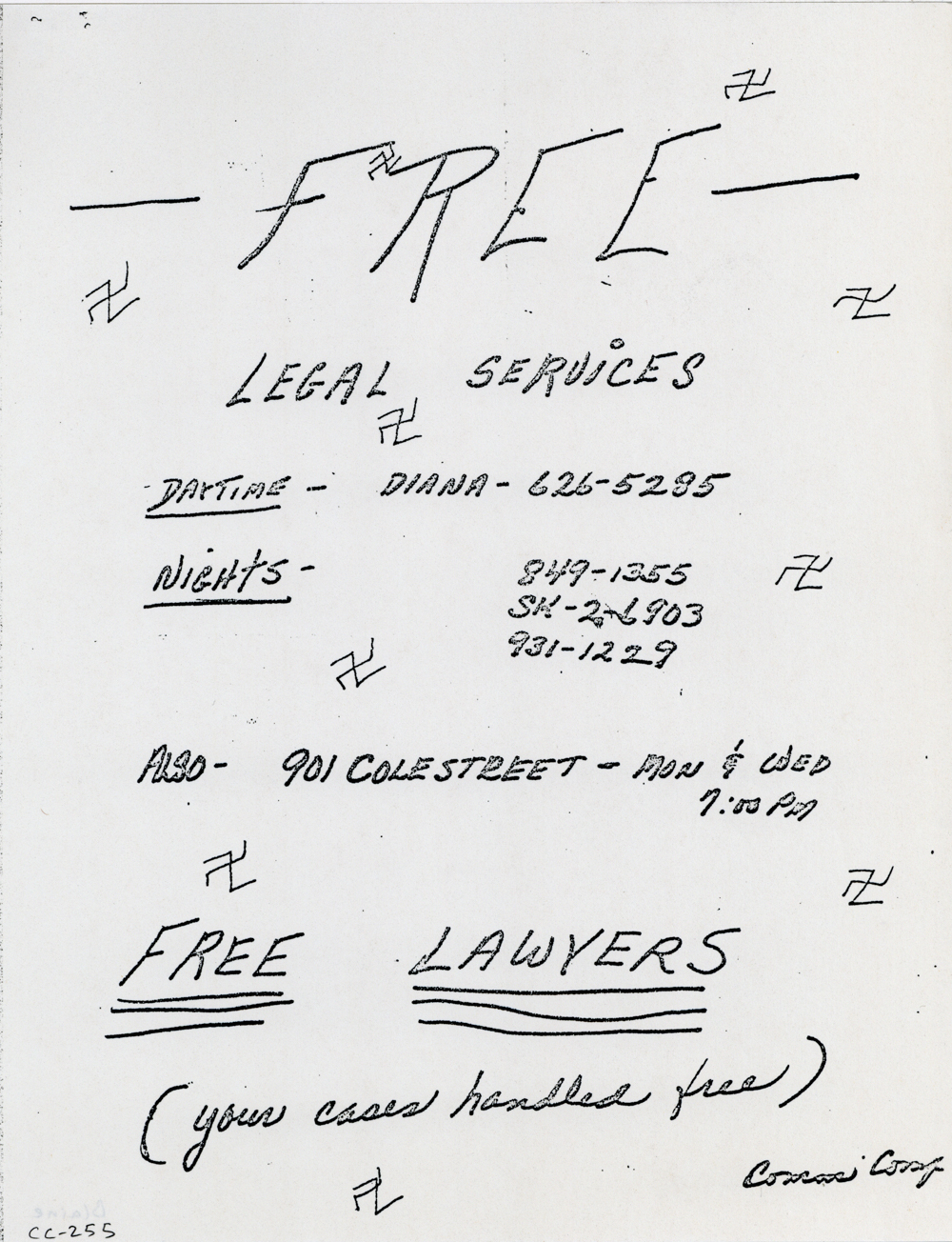
Cat. No.: CC-255 Full record BibCit: N.d., ca. 4/23/1967. Broadsheet. Letter size. San Francisco: Communication Company. Imprint: Comm Comp. Collation: This page has normal (letter) orientation.. Collection: SOLA-x(unk). Abstract: Announces "Free Lawyers (your cases handled free)" with several phone numbers listed, both daytime and nights. Address listed: 901 Cole Street, Mondays and Wednesdays at 7:00 pm. Imprint is lower right corner on this side of B.S. Lettering is hand drawn, with several reverse swastikas as background.
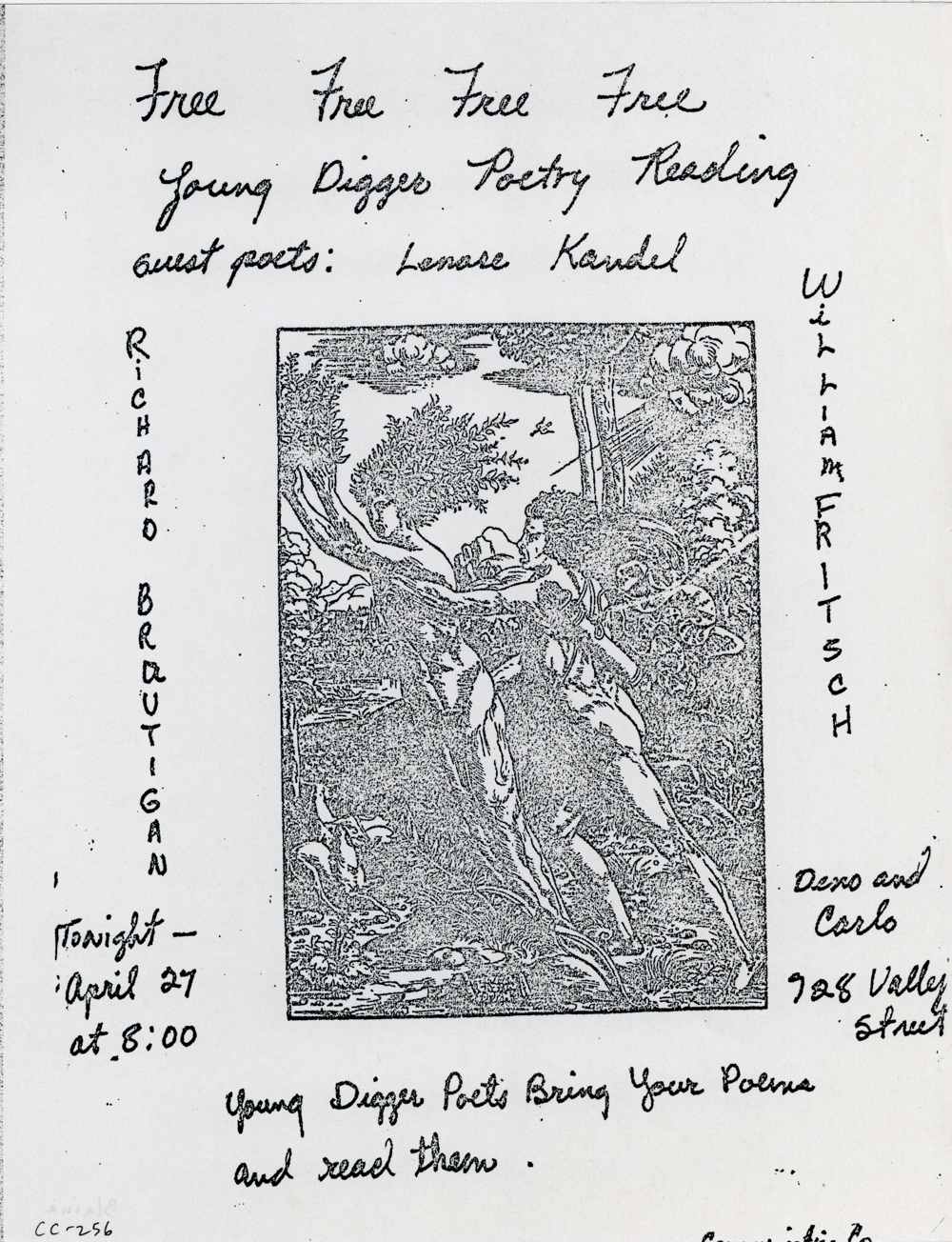
Cat. No.: CC-256 Full record BibCit: 4/27/1967. Broadside. Letter size. San Francisco: Communication Company. Imprint: Communication Co.. Collection: SOLA-x(unk). Abstract: Announcement for a Digger poetry reading featuring Lenore Kandel, Richard Brautigan, William Fritsch, at "Deno and Carlo, 728 Vallejo Street." "Young Digger Poets Bring Your Poems and read them." Imprint is lower right corner. All lettering is hand drawn, mostly in script. Drawing in middle of sheet appears to be similar to William Blake illustrations.
Cat. No.: CC-257 Full record BibCit: 5/1/1967. Broadsheet. Letter size. San Francisco: Communication Company. Imprint: COMMUNICATION COMPANY (hdw). Collection: SOLA-x(unk). Abstract: Listing of activities at the Straight Theater's Drama Studio, Dance Studio, and Studio III for May to May 7, 1967. Lists names of workshop coordinators, including Kevin, Oscar Criner, Olaf Odegaard, Joe Gostanian, Ama, John Birrell, Caitlin Huggins, Peter Swain, Peggy Mundt, Molly Huggins, Jane Lapiner, and Pat Omirers. Imprint is hand lettered at bottom of first page. Address of Straight Theater: 1748 Haight Street, 387-5074.
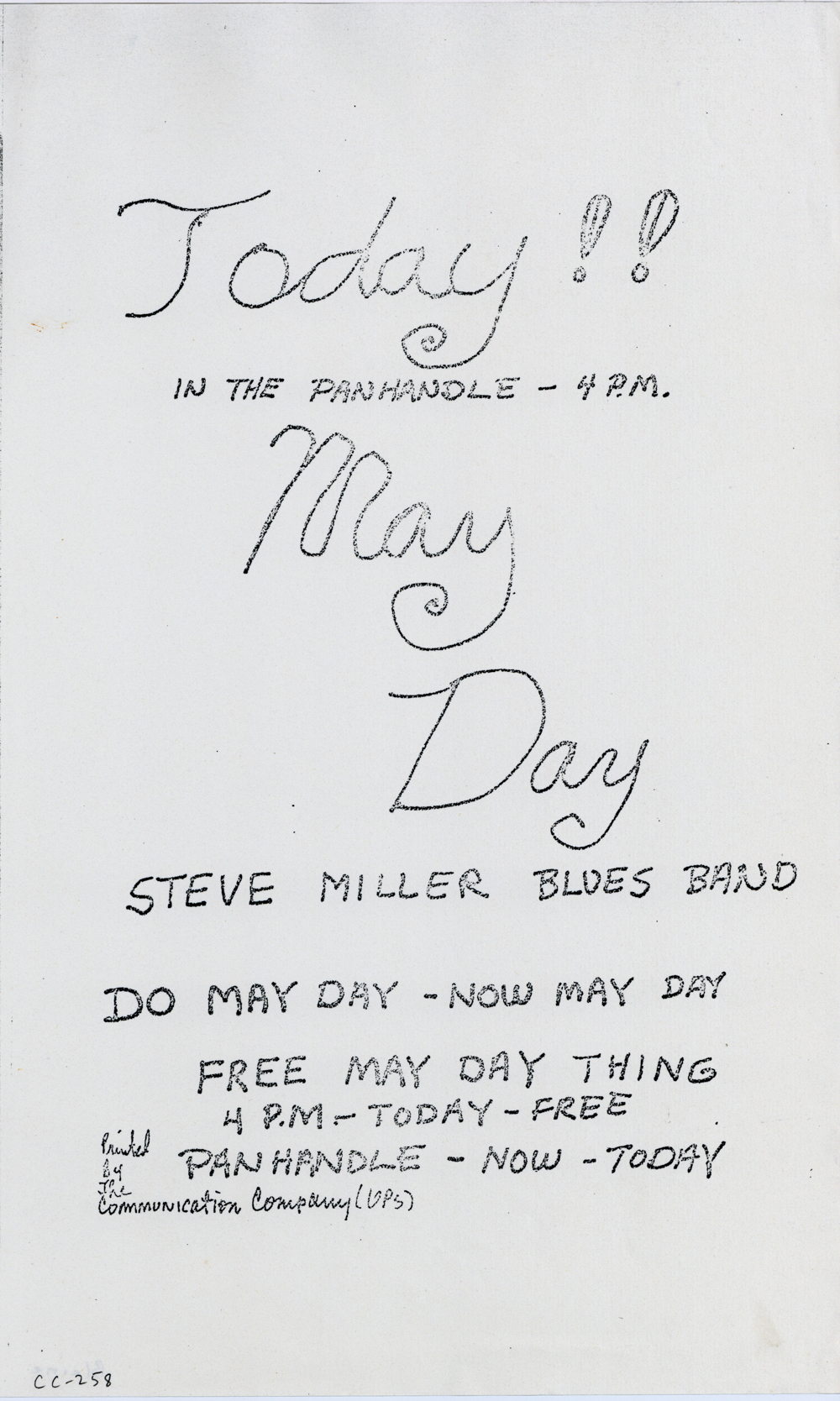
Cat. No.: CC-258 Full record BibCit: Broadside. Legal size. San Francisco: Communication Company. Imprint: The Communication Company (UPS). Collection: SOLA-x(unk). Abstract: Announces a free May Day concert in the Panhandle featuring the Steve Miller Blues Band.
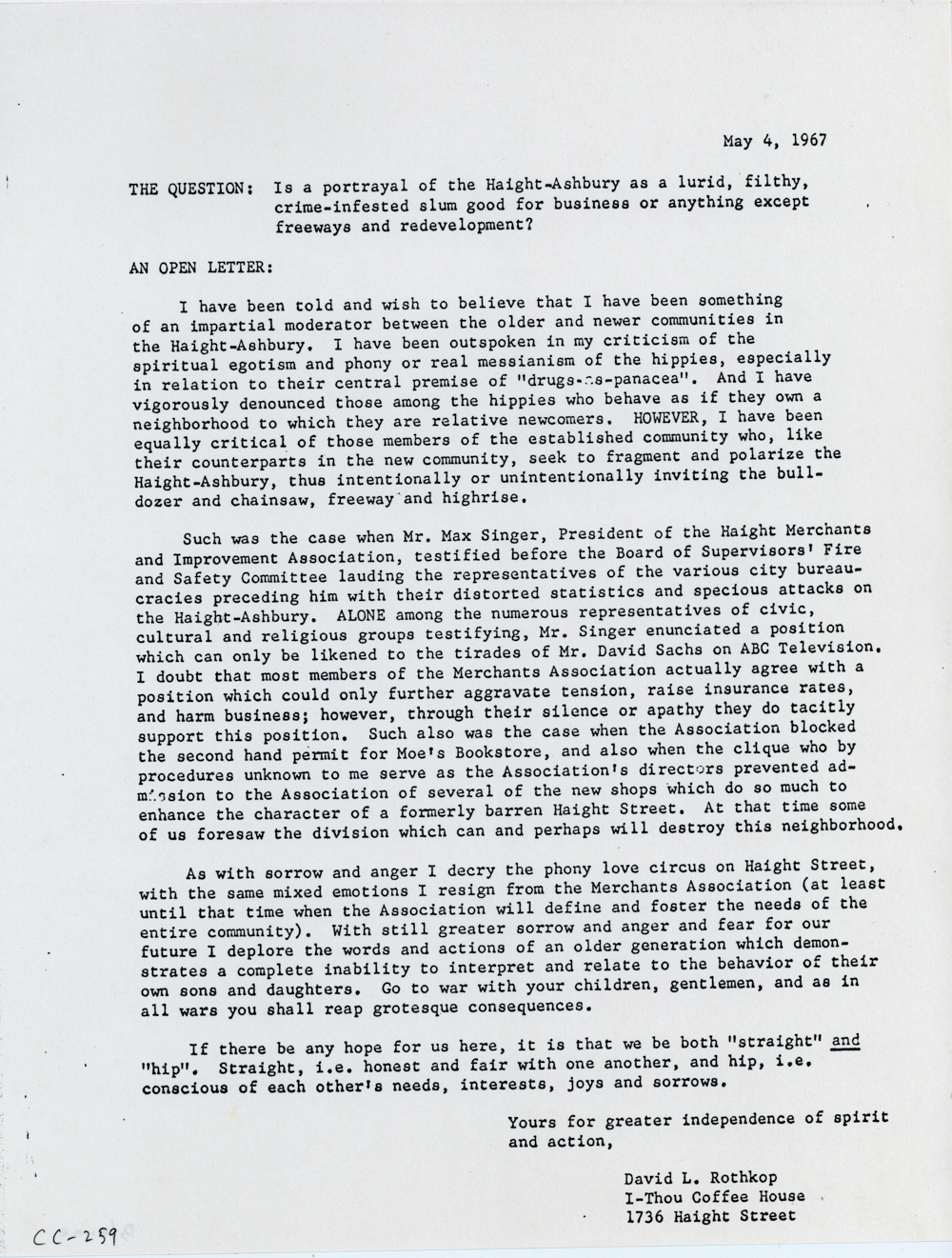
Cat. No.: CC-259 Full record BibCit: 5/4/1967. Broadside. Letter size. San Francisco: Communication Company [presumably]. Imprint: None, presumably ComCo. Collection: SOLA-x(unk). Abstract: A letter from the owner of David L. Rothkop, of the I-Thou Coffe House, 1736 Haight Street, calling for a coming together of the diverse elements among the Haight merchants, including the "old guard" Merchants Association and the new hip merchants. Criticizes the hippies for their naïve belief in "drugs-as-panacea" as well as the reactionary elements of the Merchants Association who blocked Moe's Bookstore's request for a second-hand permit.
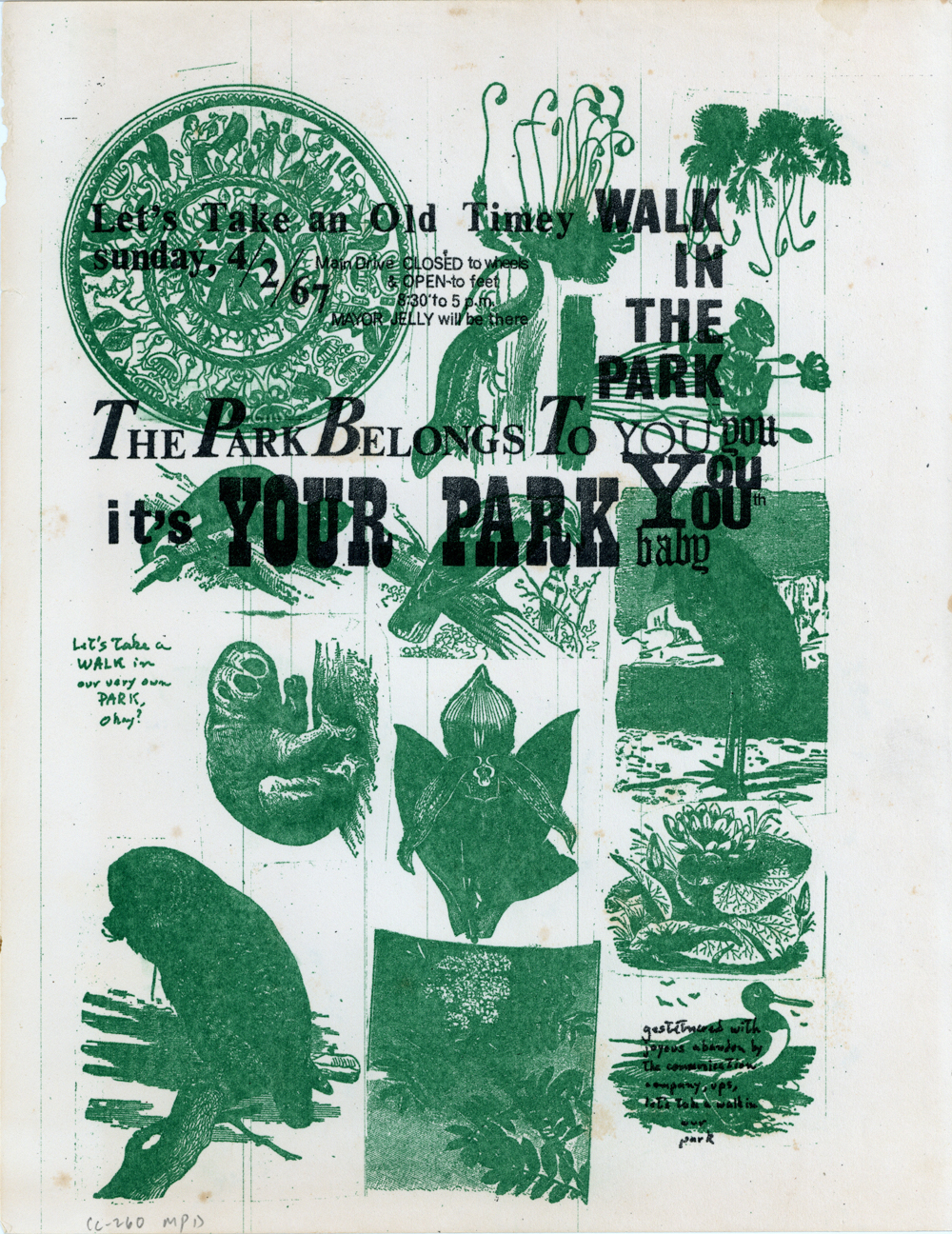
Cat. No.: CC-260 Full record BibCit: 4/2/1967. Broadside. Letter size. San Francisco: Communication Company. Imprint: "gestetnered with joyous abandon by the communication company, ups, let's take a walk in our park". Collection: SOLA-o(MPD).
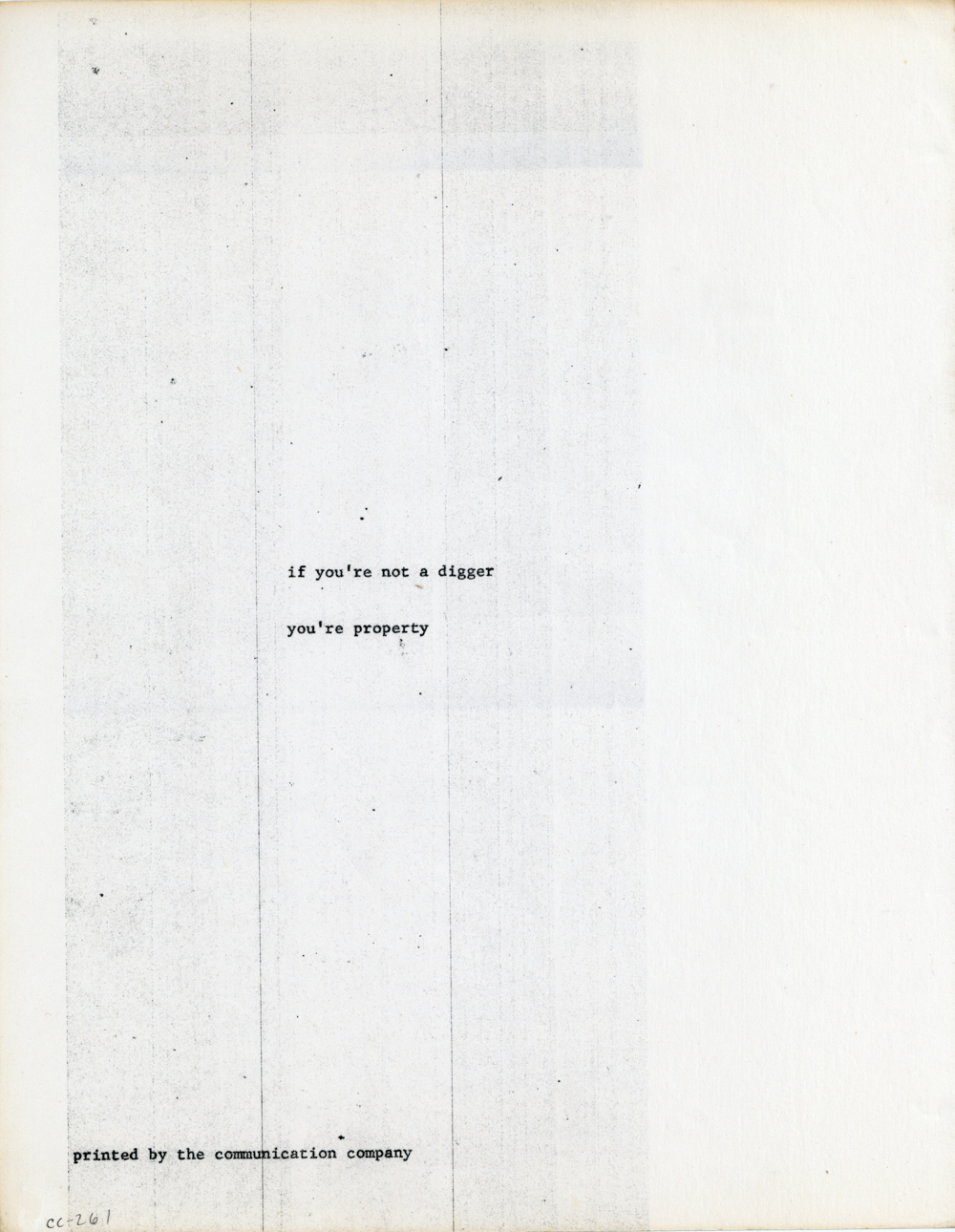
Cat. No.: CC-261 Full record BibCit: N.d., ca. 1/28/1967. Broadside. Letter size. San Francisco: Communication Company. Imprint: the communication company. Collection: SOLA-o($) | o-BL/CA. Abstract: Title is complete text.
Note: Date is handwritten by Chester Anderson on copy sent to archivist. See "January 28, 1967" by Anderson, for notes on the Diggers.
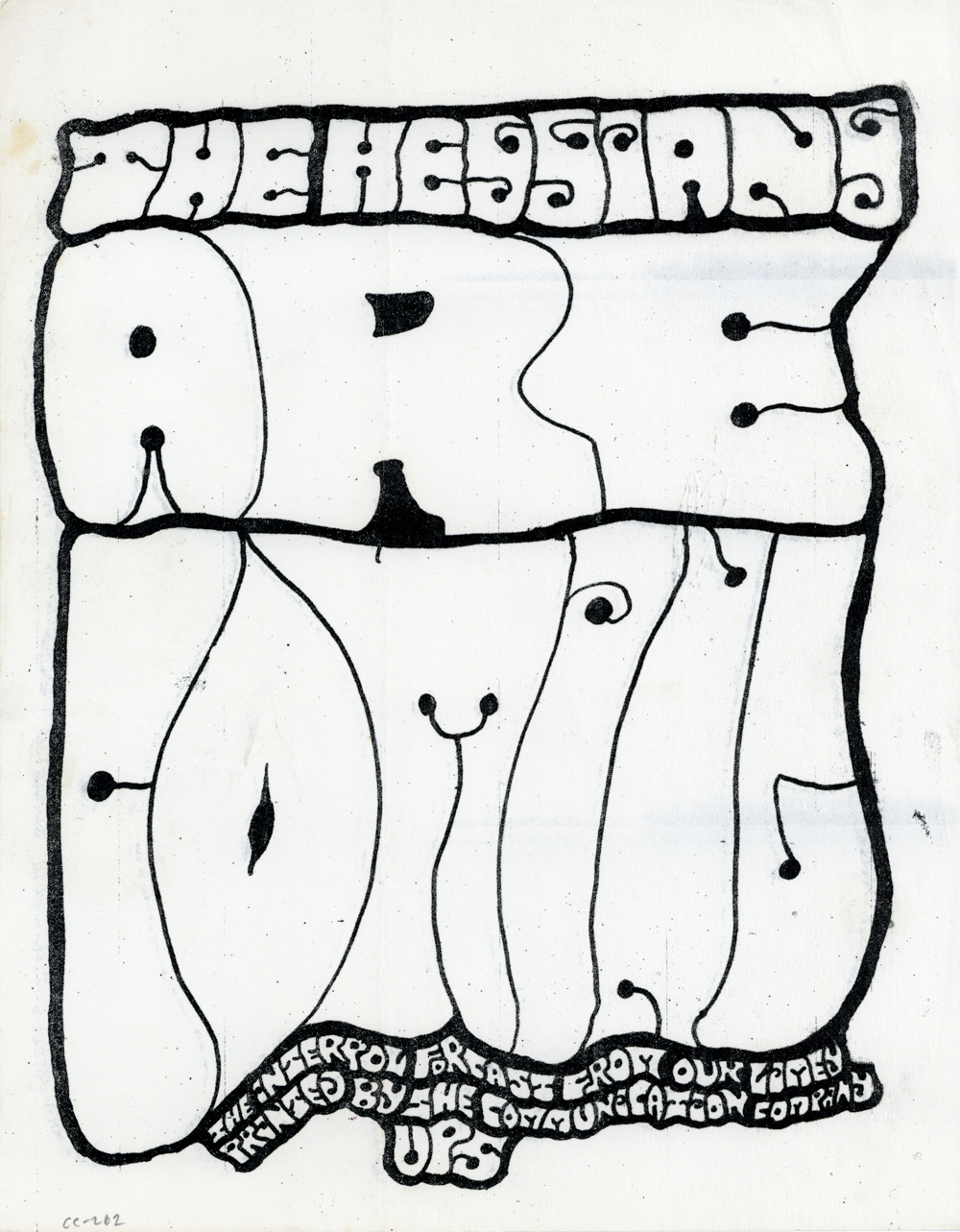
Cat. No.: CC-262 Full record BibCit: Broadside. Letter size. San Francisco: Communication Company. Imprint: ComCo UPS. Collection: SOLA-o($). Abstract: Psychedelic lettering continues: "The Interpol forcast from our limey | printed by the Communication Company UPS".
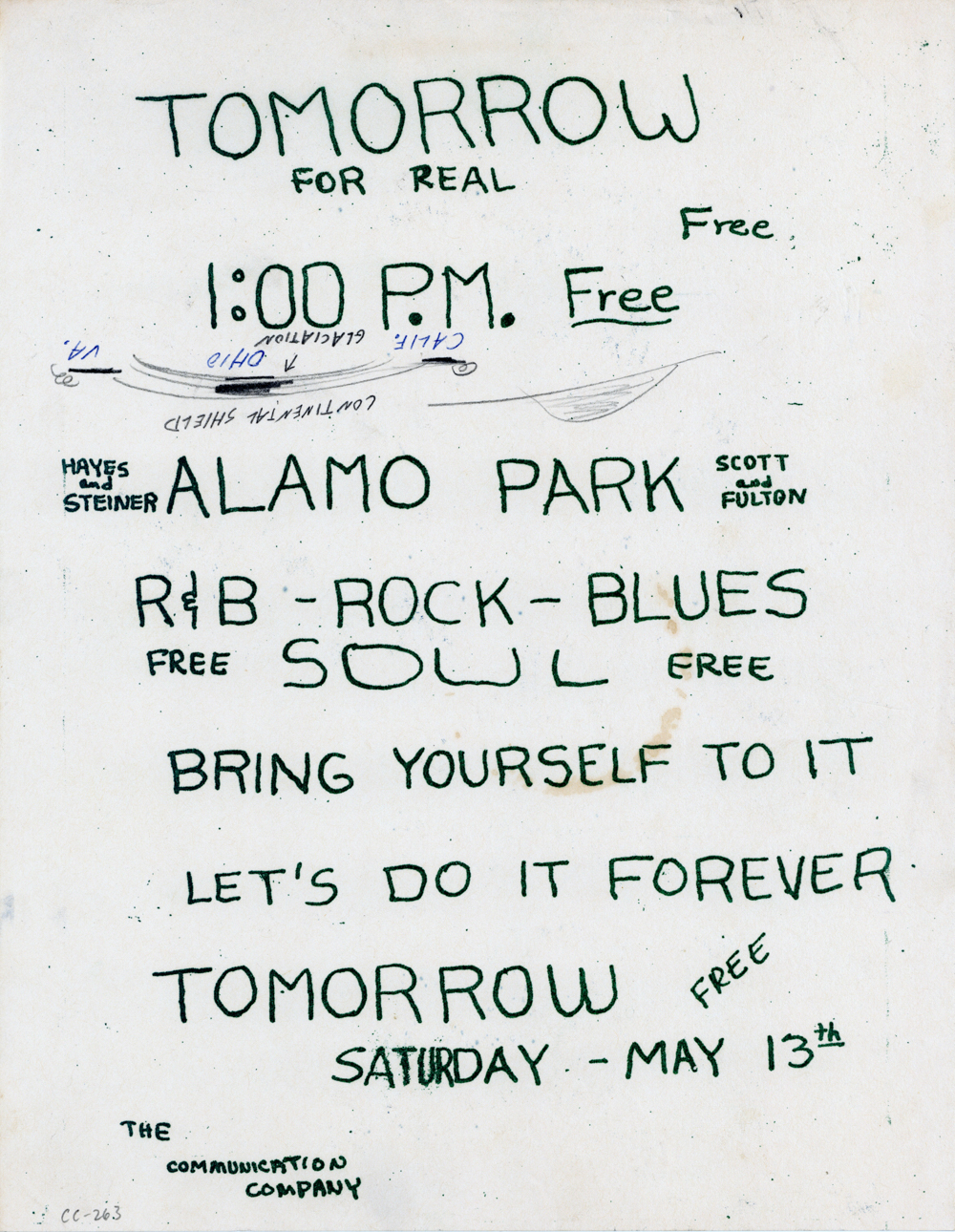
Cat. No.: CC-263 Full record BibCit: 5/13/1967. Broadside. Letter size. San Francisco: Communication Company. Imprint: ComCo. Collection: SOLA-o($). Abstract: Announces a free event at Alamo Park with "R&B - Rock - Blues | Soul" Saturday, May 13. "Bring yourself to it / Let's do it forever".
Cat. No.: CC-264 Full record BibCit: N.d. internal evid. Broadsheet. Letter size. Imprint: No ComCo designation. Collection: SOLA-o($). Abstract: Most likely produced by Chester et al. at the Invisible Circus. Text continues: "Live audience bored to tears as Peter Berg takes his clothes off: (foto below … of Obscenity In Motion conference in the Fellowship Room / Live action fotos / Fotos by Edmund Shea".
R.s.: "See Carol Doda / As a perplexed minister was decoyed by a flutter of FUCK ENTROPY posters, Peter Berg quickly undressed. The audience was unmoved. … The Invisible Nudist Circus".
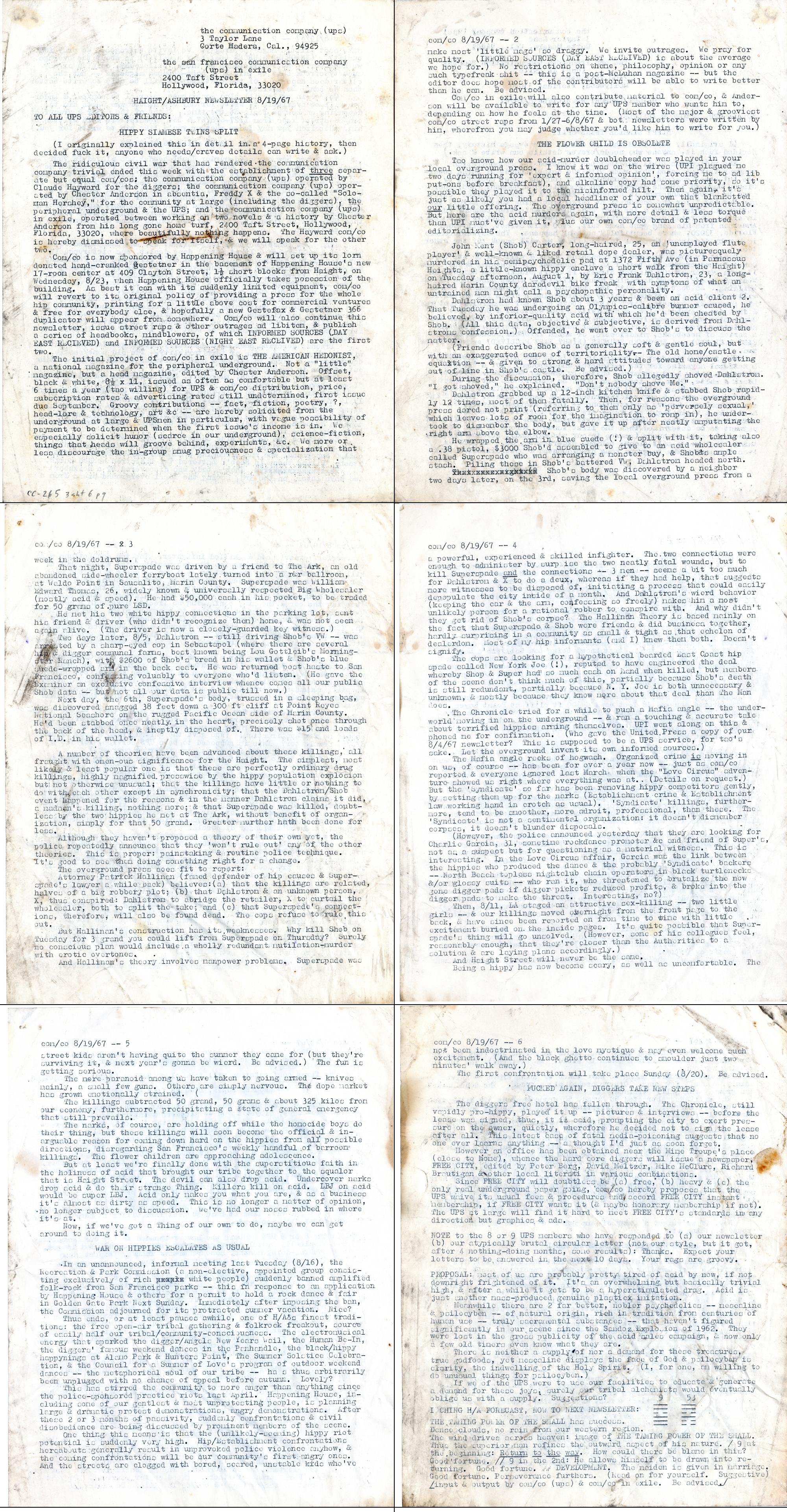
Cat. No.: CC-265 Full record BibCit: By Anderson, Chester. 8/19/1967. Leaflet. Letter size. 3 shts; 6 pgs. Corte Madera, Cal.: Communication Company. Imprint: includes ComCo/UPS ("in exile") from Corte Madera, CA and Hollywood, FL. Collection: SOLA-o(LH). Abstract: This six-page Haight/Ashbury Newsletter of August 19, 1967, written by Chester Anderson, reads as both street report and factional document from the breakup of the Haight underground. Issued under the Communication Company imprint, it moves through the split between Com/Co and the Diggers, the forced appropriation of Com/Co’s mimeograph equipment, the murder of Shobol, the atmosphere of retaliation and suspicion that followed, police pressure, speed, paranoia, and the steady unraveling of the Haight scene. The tone is immediate, aggrieved, and insiderly, mixing reportage, accusation, and political interpretation. What emerges is not the utopian Haight of popular memory but a movement world breaking apart over control of resources, authority, and the meaning of “free,” with Anderson writing from the wounded edge of that fracture.
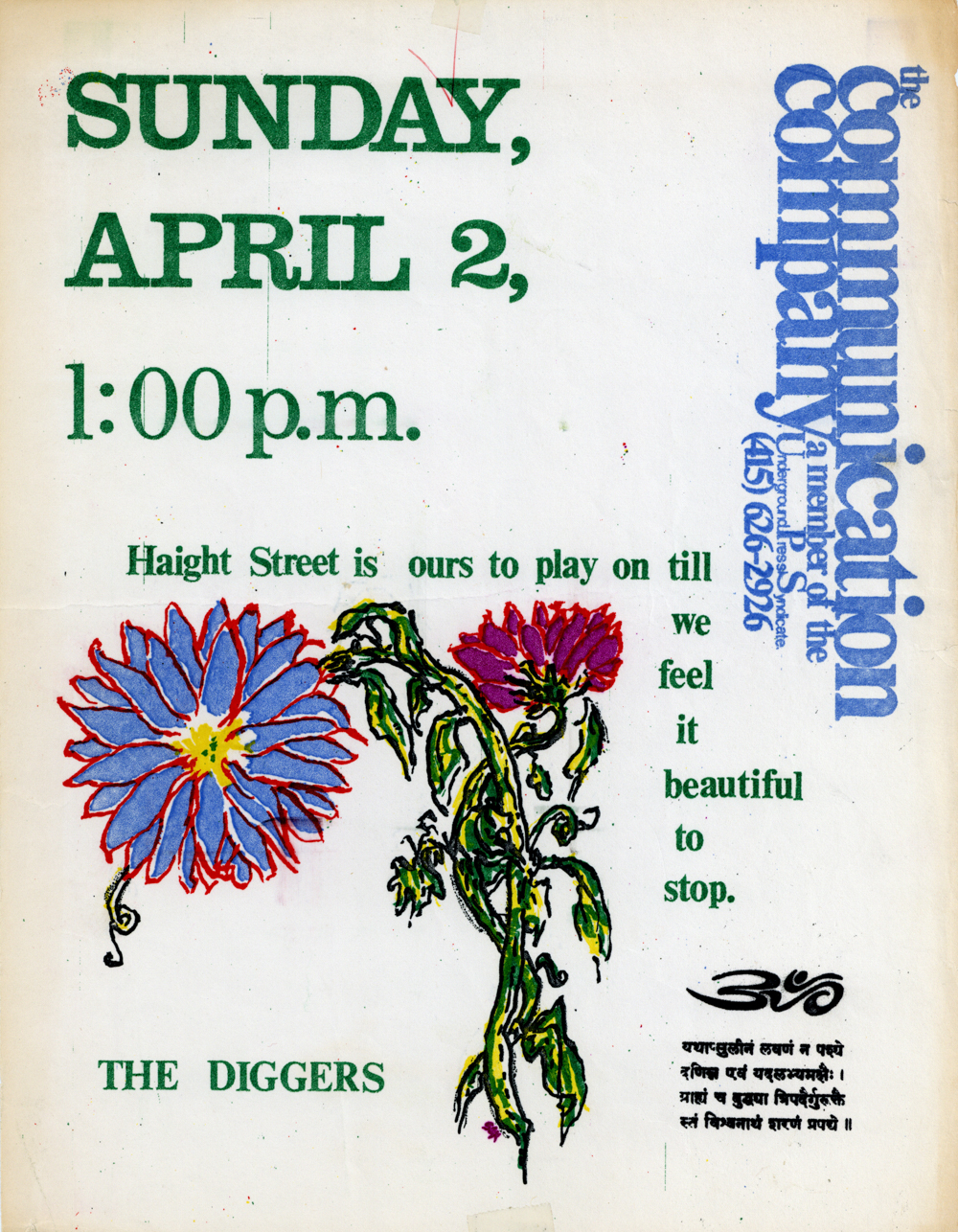
Cat. No.: CC-266 Full record BibCit: 4/2/1967. Broadside. Letter size. San Francisco: Communication Company. Imprint: ComCo/UPS. Collation: Multi-color design on white paper. Signed "The Diggers". Collection: SOLA-o(PW). Abstract: A companion piece to CC-233. Where *Gentleness in the Pursuit of Extremity is No Vice* spells out the social philosophy of the action, this sheet renders the same call in a more visual and lyrical key, and distills the message into image, typography, and slogan: “Haight Street is ours to play on till we feel it beautiful to stop.” The flowers, the spacious design, and the playful imprint embody the very sensibility the first sheet describes—an occupation of the street through beauty, improvisation, and presence rather than confrontation. Together, the two pieces function as theory and lyric, manifesto and poster, each completing the meaning of the other.
Note: Lower right corner contains a stylized Om symbol above a short text in Devanagari script, probably Sanskrit, used here as a decorative spiritual element. Its inclusion reflects the Indian religious and visual motifs that circulated widely in the Haight-Ashbury community.
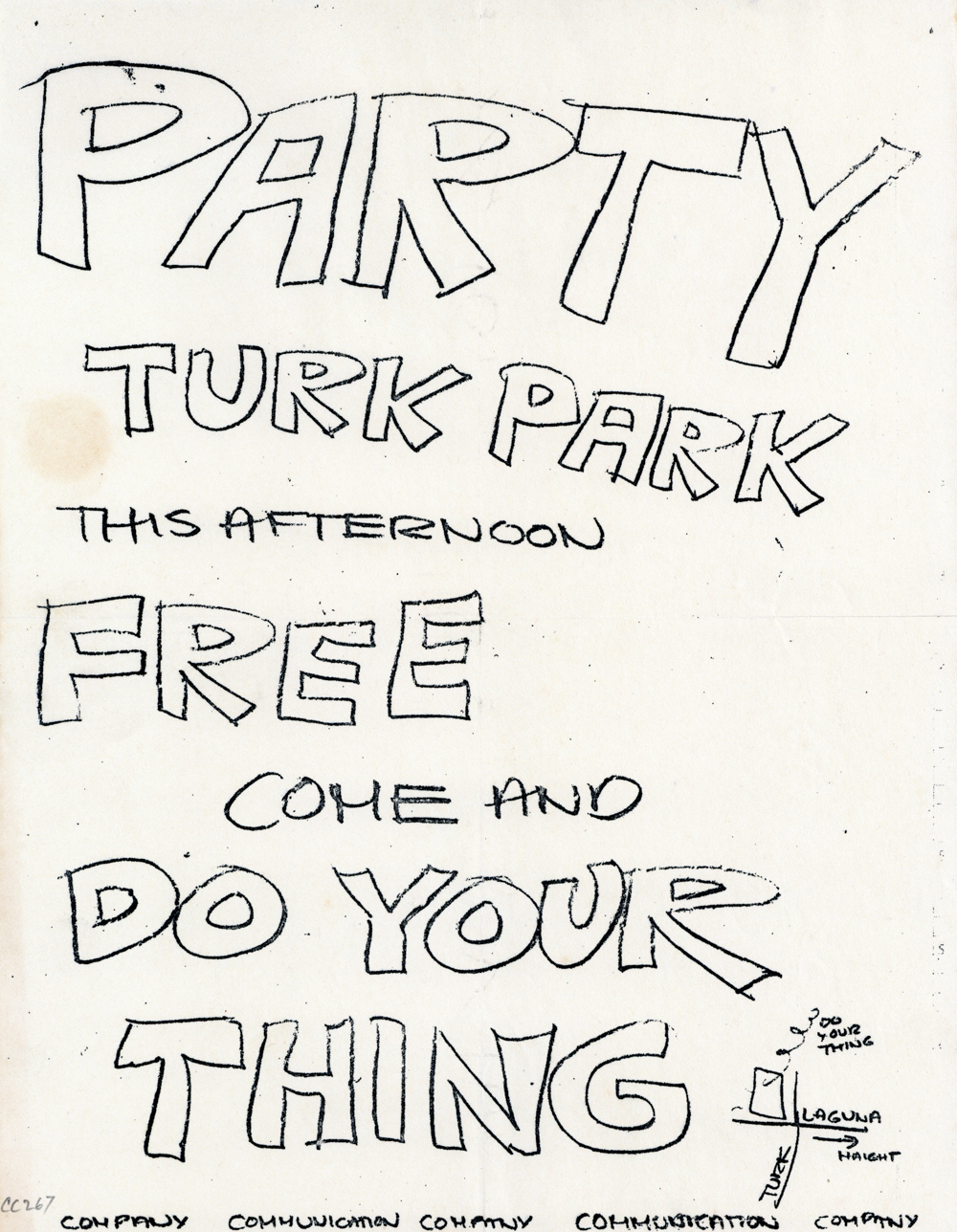
Cat. No.: CC-267 Full record BibCit: Broadside. Letter size. San Francisco: Communication Company. Imprint: ComCo. Collation: o-EN($). Abstract: Announces a party at the public park located at Turk and Laguna streets. "Free / Come and Do Your Thing".
Cat. No.: CC-268 Full record BibCit: 1/10/1967. Broadside. Legal size. San Francisco: Communication Company. Imprint: n/a (presumably com/co). Collation: Hdw. lettering; B/W. Collection: o-BL/CA.
Note: The first [presumably] Communication Company sheet in the Anderson Papers. The date is handwritten, presumably by Chester.
Note at BL: Folder 1:1/4. What would be the result if all the little kids used their water pistols (hand dated 1/10/67). (No ComCo imprint.) B.s. Lgl. BL-CAP-Bx-1-Fdr-01-Item-004
Cat. No.: CC-269 Full record BibCit: By Anderson, Chester. 1/13/1967. Broadside. Legal size. San Francisco: Communication Company. Imprint: The Communication! Company. Collation: Tpw text over watermark of drawing (?).. Collection: o-BL/CA. Abstract: Various hikes, and locales in the San Francisco Bay Area and Northern California recommended for taking trips (both the literal and psychedelic variety.)
Note: Date is hdw (presumably by Chester). Title is block lettered, and author is "by c. anderson."
Note at BL: Folder 1:1/6. trips by c. anderson (hand dated 1/13/67). [never seen] [list of bay area trippy places.] ComCo. B.s. Lgl. BL-CAP-Bx-1-Fdr-01-Item-006
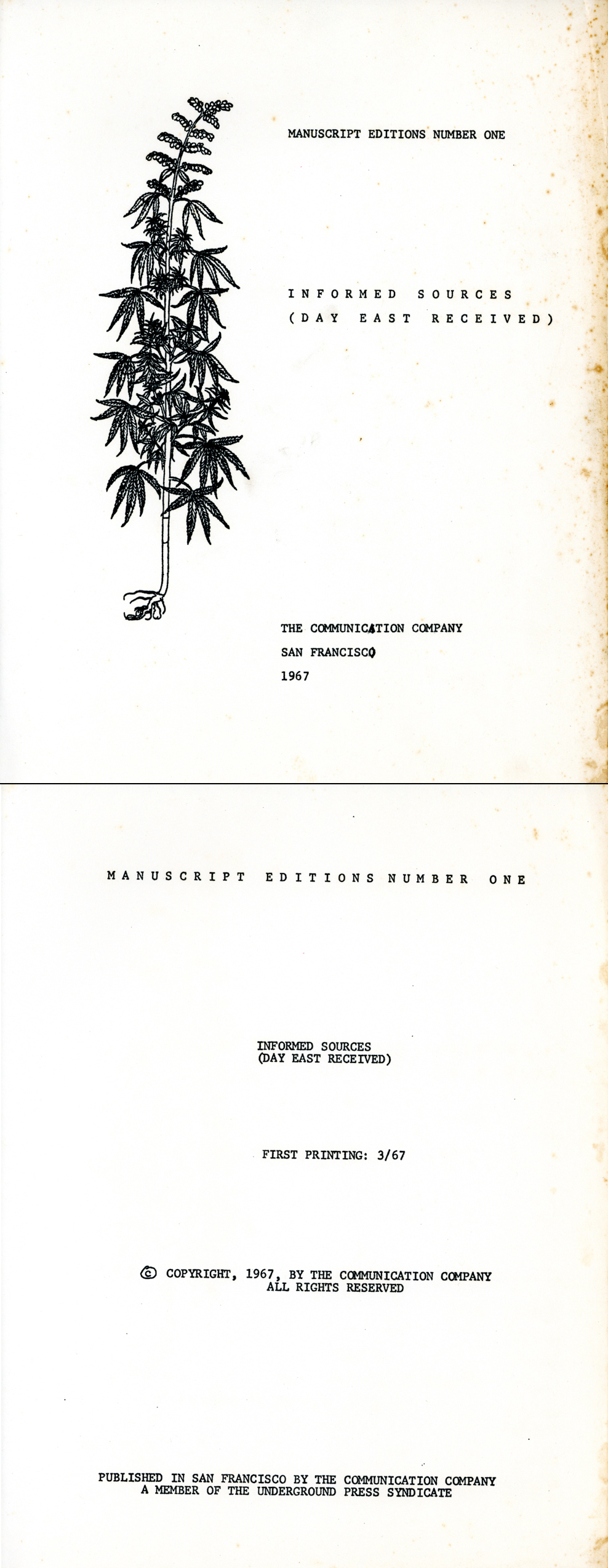
Cat. No.: CC-296 Full record BibCit: (Month of) 3/1/1967. Book. Letter size. 72 leaves (cover + 140 pp.). San Francisco: Communication Company. Imprint: Manuscript Editions Number One | The ComCo. Collation: Issued as loose sheets in a clear plastic enclosure.. Abstract: Informed Sources is a novel by Willard Bain (not attributed in this first edition) that used a series of Associated Press–style dispatches to expose how language and news media function as instruments of social control, and to imagine their seizure and transformation by revolutionary forces. The book is framed as the internal information network of the Peripheral Underground Movement (PUM), a parody of and challenge to establishment wire services. Its “dispatches” follow multiple stories at once, including sensational, distorted crime items and countervailing bulletins, making visible how the media define reality by selecting, angling, and repeating information in ways that keep people “chained to capitalism and to consumer consciousness.”
Drawing on a "post-Burroughs" and "post-McLuhan" sensibility (as John Sinclair wrote in a review), Bain mimics the cadence, typography, and language of the mainstream press in order to show that whoever controls information flow also controls the limits of possible action. Within the novel’s world, the alternative service Informed Sources initially merely reproduces the “decadent form” of the establishment media, but it is ultimately infiltrated and overthrown by “Green Dreams,” a purer revolutionary current that represents the conscious transformation rather than the continuation of existing media forms.
Note: This is the first edition, with no indication of authorship on the cover nor the imprint page. A second edition with the author's name (Willard Bain) and date of 9/67 appeared, also by The Communication Company, with the notation, "Printed in and around San Francisco ..." In 1969, Doubleday published the third edition in a trade paperback. See John Sinclair's review in: Fifth Estate # 76, April 3-16, 1969.
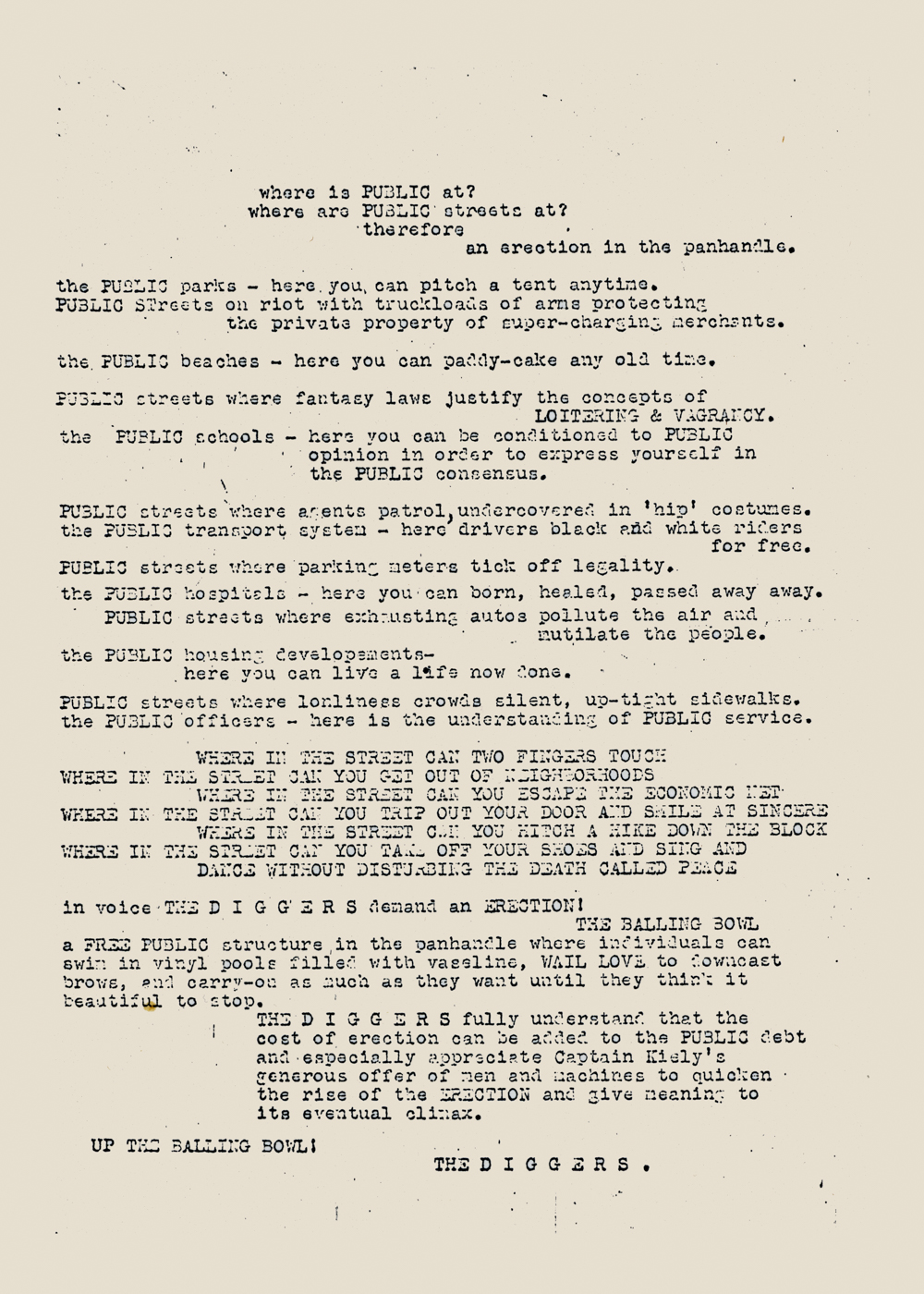
Cat. No.: DP-001 Full record BibCit: n.d., ca. 10/1/1966. Broadside. Letter size. San Francisco: The Diggers. Imprint: THE D I G G E R S. Collection: SOLA-x(SS) | SS-x(PB). Abstract: This text is a biting, surreal critique of the collapse of “public” life in a privatized society. Through ironic repetition, it exposes how spaces meant for communal use—streets, schools, parks—have become instruments of surveillance, conditioning, and control. The Diggers respond with parody and provocation, proposing a literal and symbolic “erection” of freedom: a public, ecstatic, collective space where love and liberation replace property and repression. It transforms civic frustration into theatrical revolt—an anarchic vision of reclaiming the commons.
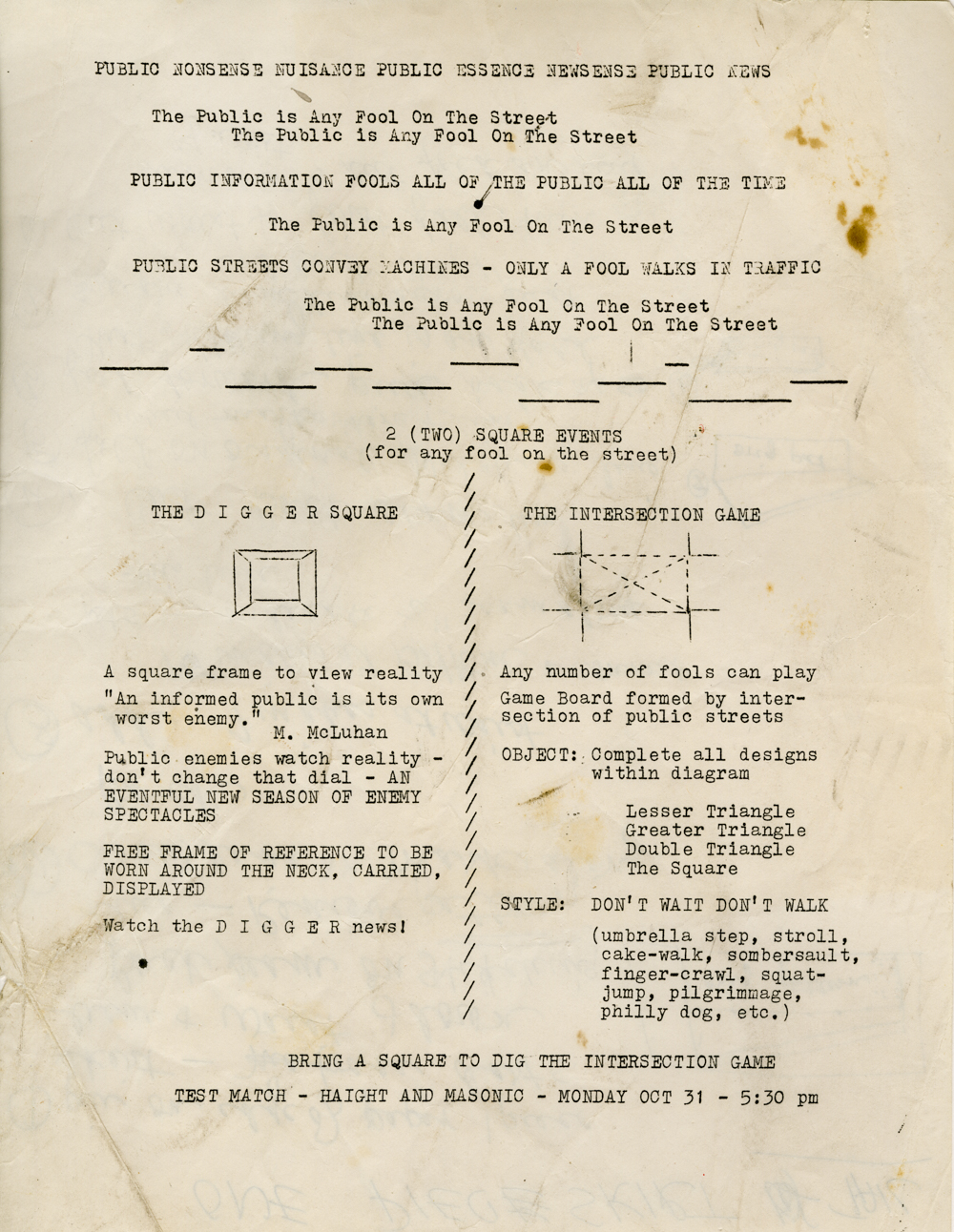
Cat. No.: DP-002 Full record BibCit: 10/31/1966. Broadside. Letter size. San Francisco: The Diggers. Collection: SOLA-x(SS) | SS-x(PB). Abstract: This sheet turns public space into a site of satire and performance, mocking the passive “public” created by media, traffic, and official information. By proposing the “Digger Square” and the “Intersection Game,” it invites people to stop being spectators and instead reframe the street through play, movement, and collective action. The piece treats the city not as a space to be managed and consumed, but as a stage where perception itself can be disrupted and remade. The first Digger street theater (Halloween, 1966).
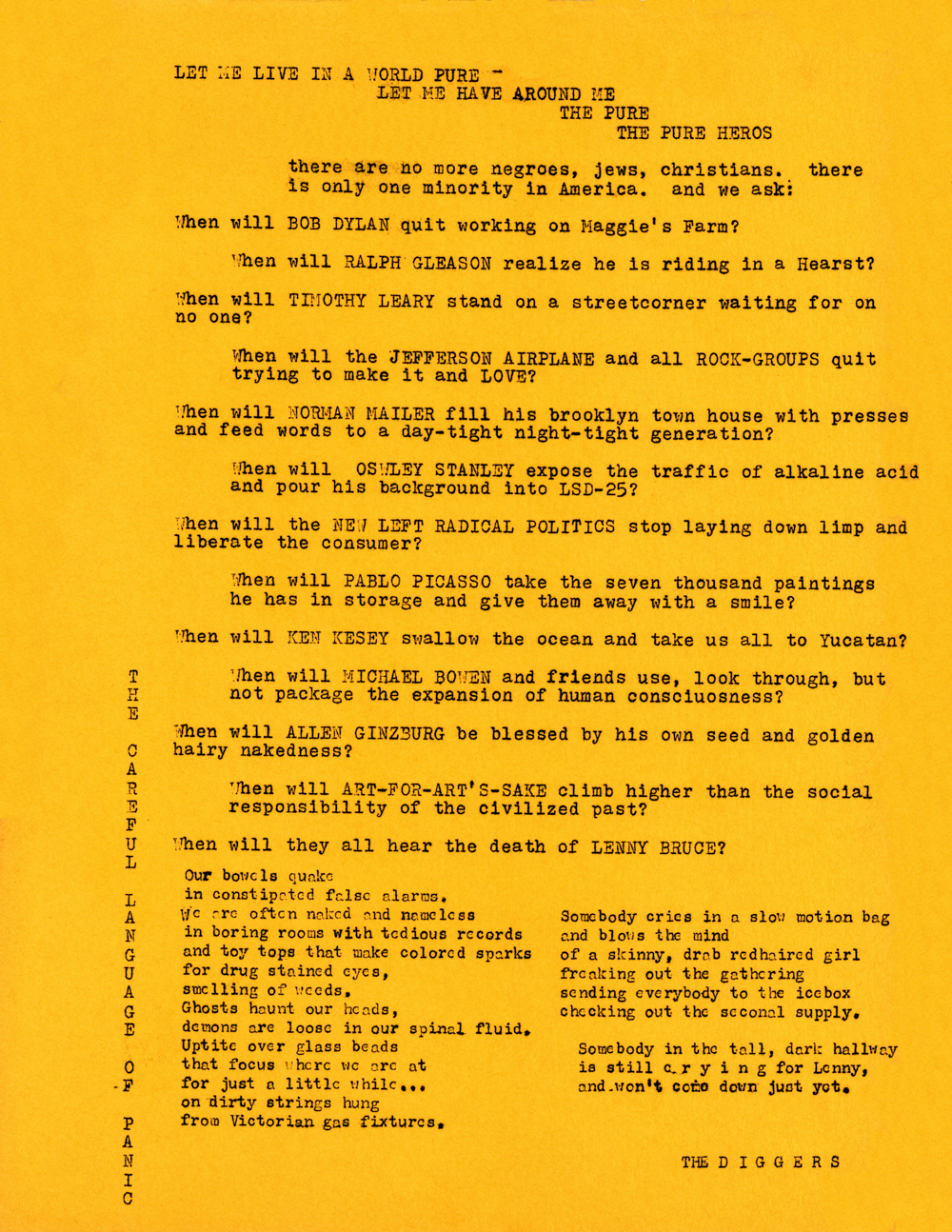
Cat. No.: DP-003 Full record BibCit: n.d., ca. 10/1/1966. Broadside. Letter size. The Diggers. Imprint: THE D I G G E R S. Collection: SOLA-o. Abstract: This poetic manifesto mourns the spiritual decay of 1960s America while demanding renewal through authentic, liberated living. It calls out cultural figures—from Dylan to Ginsberg—for clinging to fame, ideology, or illusion rather than embracing communal purity and love. The piece condemns commercialism and false revolution, urging the destruction of social masks and the rebirth of genuine human connection. In its final invocation, the Diggers emerge as witnesses to a generation haunted by lost prophets and unfulfilled dreams.
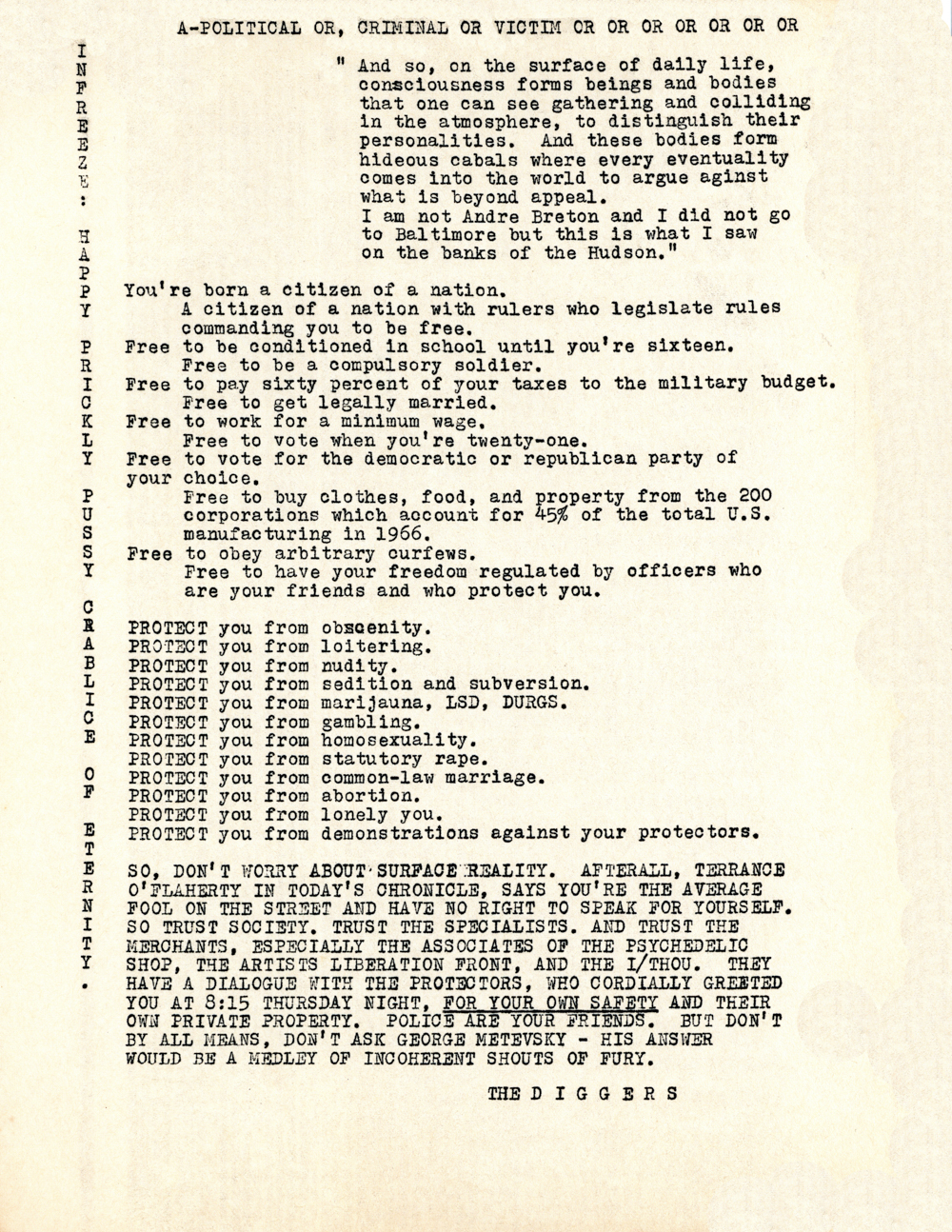
Cat. No.: DP-004 Full record BibCit: 9/30/1966. Broadside. Letter size. Imprint: THE D I G G E R S. Collection: SOLA-o. Abstract: Uses irony to argue that American “freedom” is largely a system of control. It presents citizenship as a series of regulated choices—schooling, military service, wage labor, limited political options, and consumer dependence—enforced by police and law in the name of protection. The piece also attacks journalists, merchants, and other intermediaries for collaborating with authority while claiming to represent the public. Overall, it exposes the gap between official freedom and lived repression.
Note: The date of this Digger Paper is Friday, September 30, 1966 which is known from the reference to "Terence O'Flaherty in today's Chronicle."
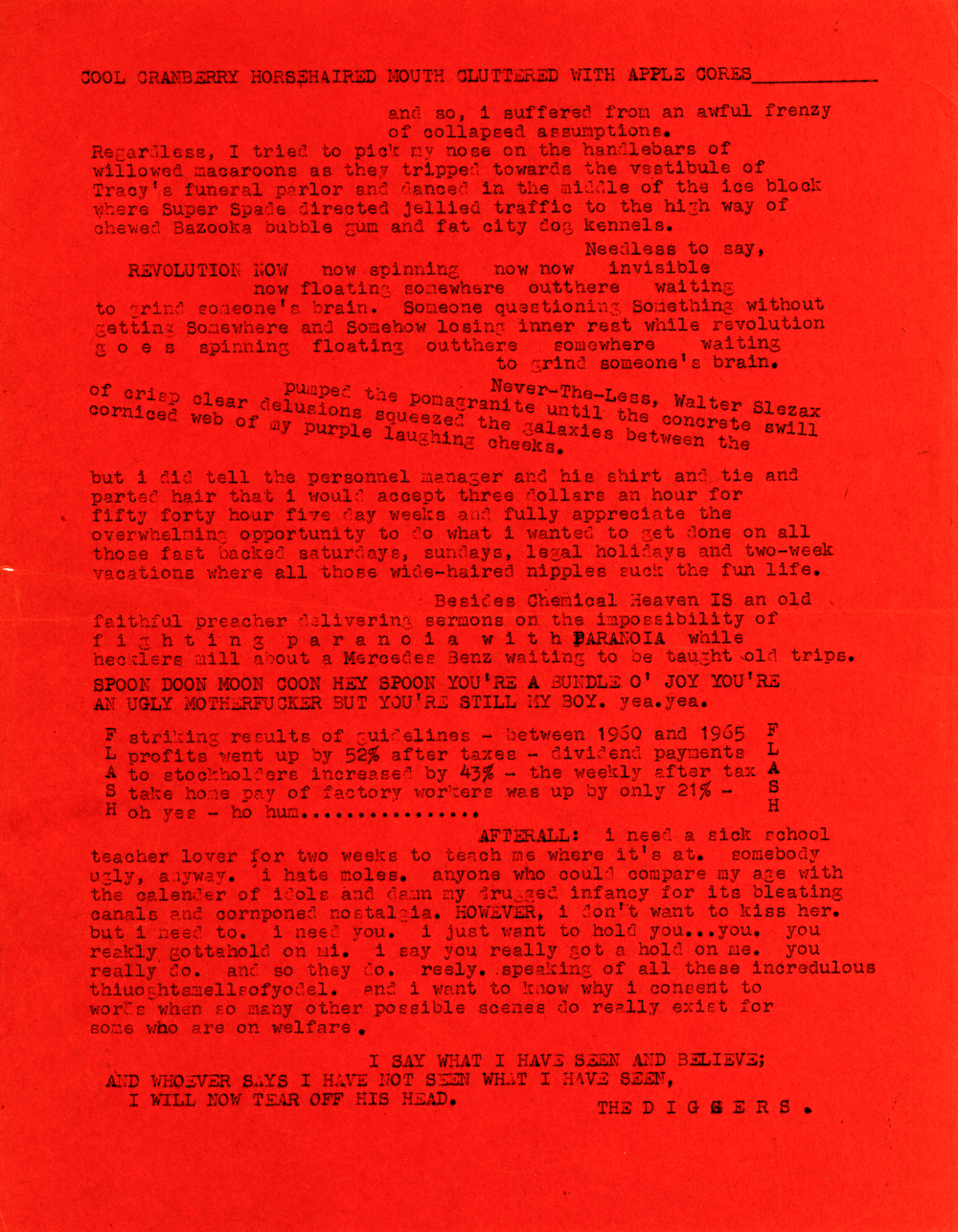
Cat. No.: DP-005 Full record BibCit: n.d., ca. 10/1/1966. Broadside. Letter size. Imprint: THE D I G G E R S. Collection: SOLA-o. Abstract: A deliberately chaotic collage of surreal images, countercultural slang, sexual anxiety, economic critique, and revolutionary longing. Beneath its stream-of-consciousness absurdity runs a serious tension: the speaker feels trapped between psychic dislocation, deadening work, consumer society, and the distant promise of “revolution.” Its fractured style is itself the point: it enacts the breakdown of stable meaning in a society experienced as both grotesque and coercive.