Including Ephemera, Broadsides, Posters, Street Sheets, Collections, etc. for the
San Francisco Diggers, Communication Company, Free City Collective,
Kaliflower Intercommunal Network, Free Print Shop, Planetedge Manifestation,
Earth/Life Defense Commune, &c.
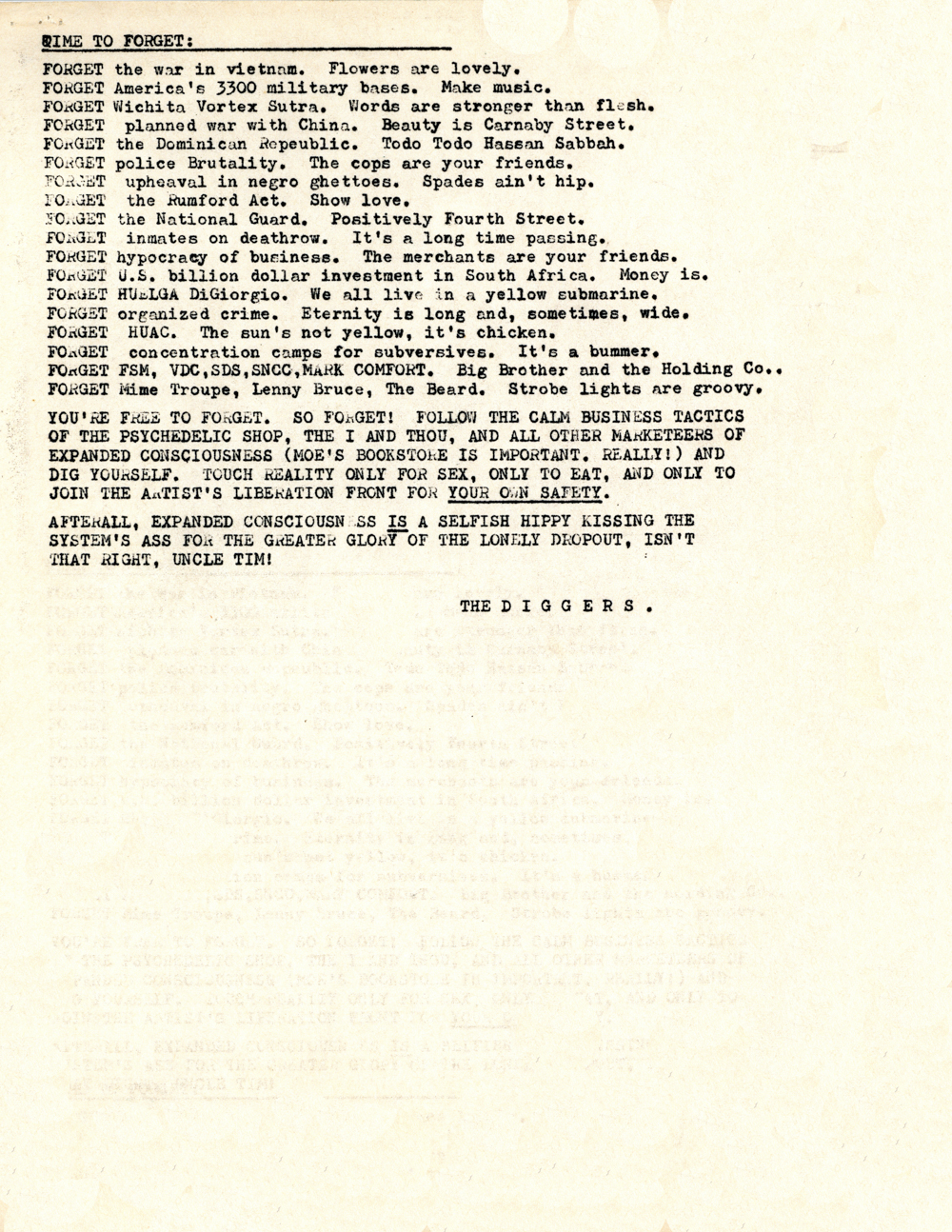
Cat. No.: DP-006 Full record BibCit: n.d., ca. 9/15/1966. Broadside. Letter size. Imprint: The D I G G E R S. Collection: SOLA-o. Abstract: Attacks the politics of withdrawal and fashionable “hip” disengagement. Repeating the command “FORGET,” it mocks the idea that beauty, music, style, and private consciousness can substitute for confronting war, racism, state repression, labor struggle, and corporate hypocrisy. Its target is the commercialization of counterculture and a dropout sensibility that turns inward while leaving the larger system intact.
Note: According to Ringolevio (page 238) this was the first Digger Paper.
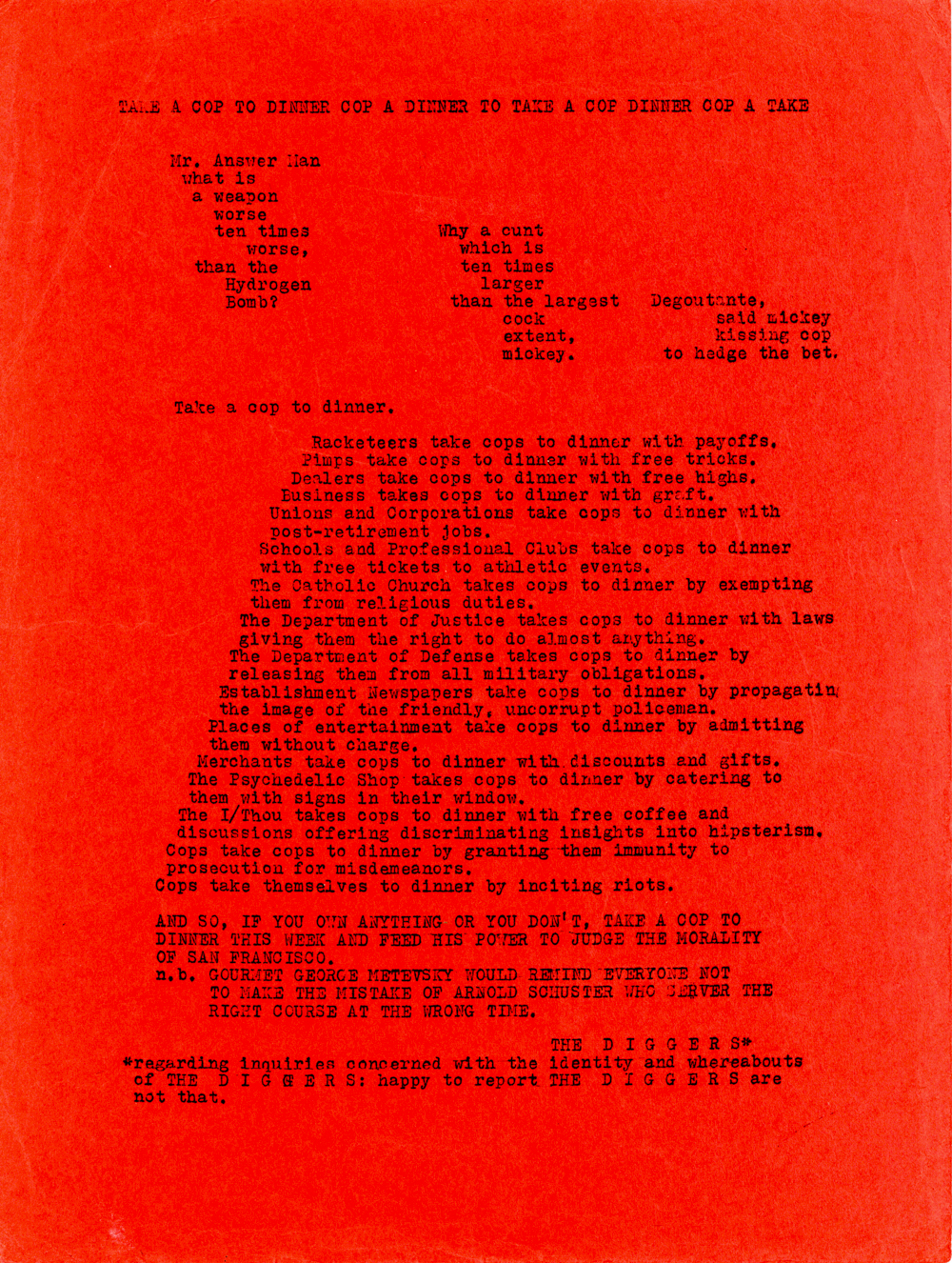
Cat. No.: DP-007 Full record BibCit: n.d. ca. 10/1/1966. Broadside. Letter size. The Diggers. Imprint: The D I G G E R S. Collection: SOLA-o. Abstract: Satirizes the many ways society sustains police power. Its refrain, “take a cop to dinner,” becomes a metaphor for the favors, privileges, exemptions, and public myths through which criminals, businesses, churches, government agencies, merchants, and even hip institutions all help legitimize and strengthen the police. Obscene and mocking in tone, the piece argues that police authority is socially fed, not merely legally granted.
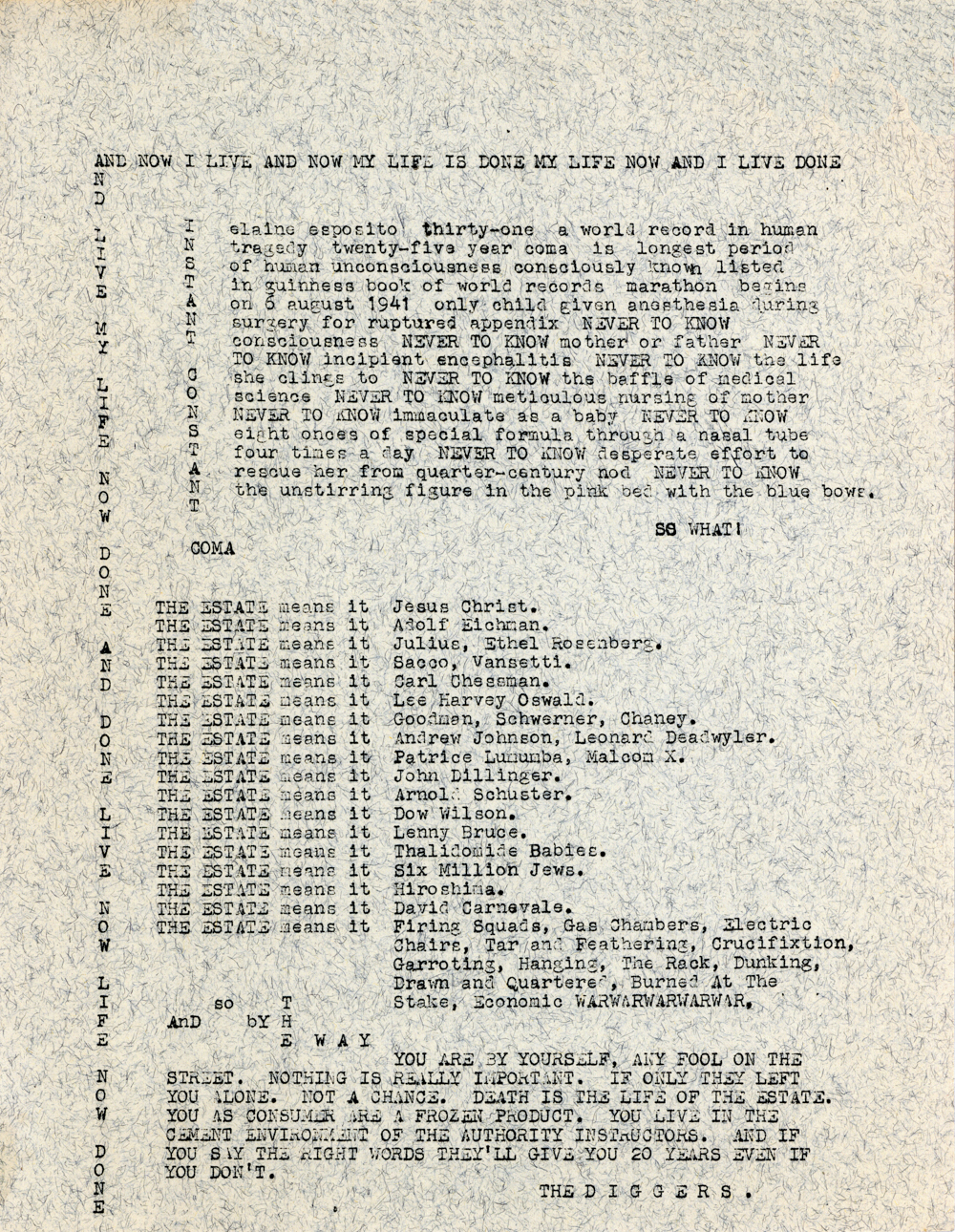
Cat. No.: DP-008 Full record BibCit: n.d., ca. 10/1/1966. Broadside. Letter size. The Diggers. Imprint: The D I G G E R S. Abstract: This piece merges tragedy and existential despair to expose how institutional power—“The Estate”—defines life and death in modern civilization. Beginning with Elaine Esposito’s lifelong coma as metaphor, it portrays society itself as an unconscious body sustained by authoritarian systems and consumer conditioning. Through a litany of victims, the text equates political violence and everyday passivity as symptoms of systemic control. The Diggers’ closing declaration is both lament and warning: under “The Estate,” consciousness itself has become captivity.
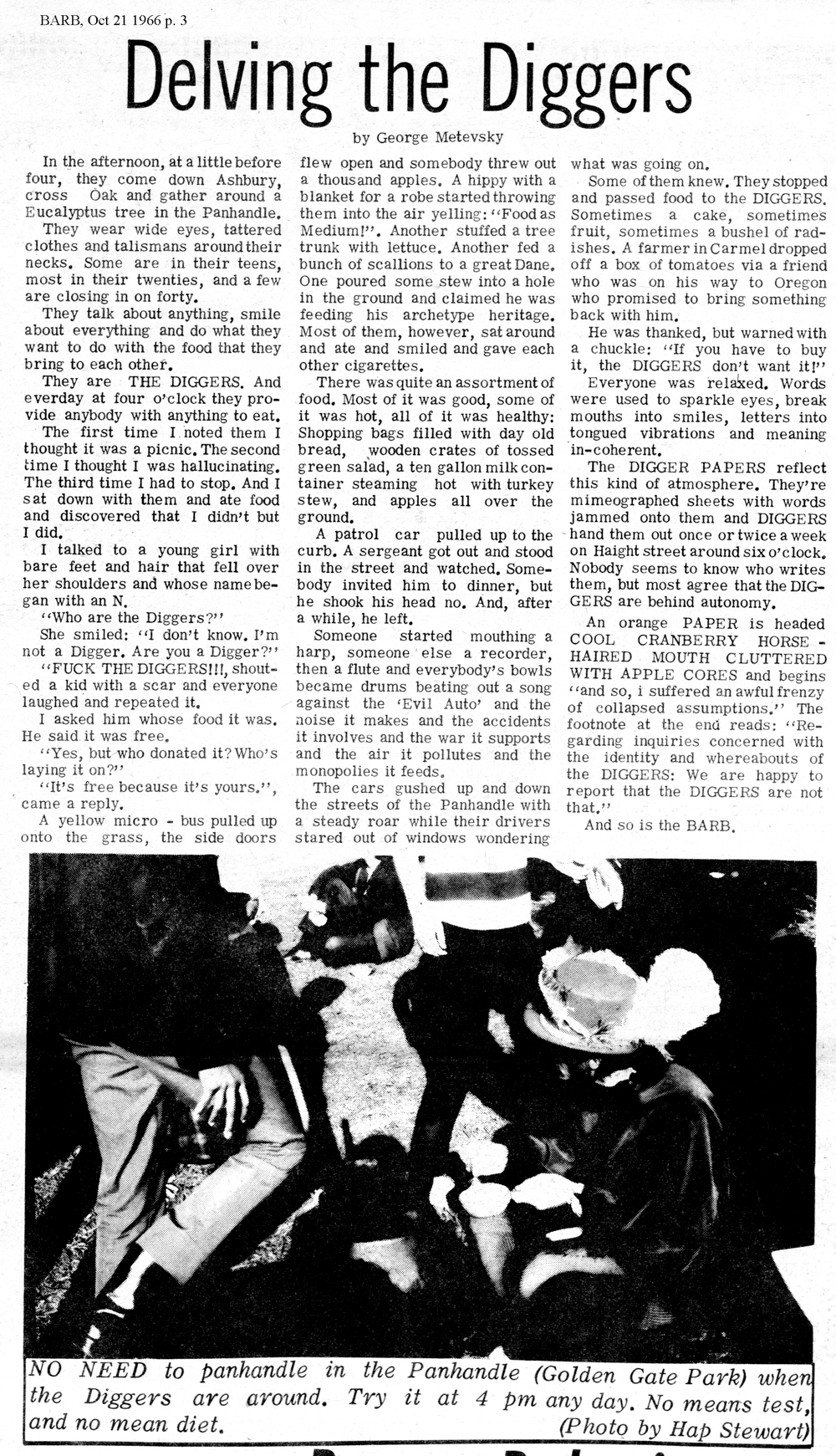
Cat. No.: DP-1966-10-21 Full record BibCit: By George Metevsky [pseud.]. Berkeley Barb, 10/21/1966, p. 3. Abstract: “Delving the Diggers,” published in The Berkeley Barb on October 21, 1966, appears under the byline “George Metevsky,” a pseudonym used by Diggers Emmett Grogan and Billy Murphy to channel insider reportage into the underground press while preserving the group’s anonymity and prankster mystique. The article offers a vivid, first-person account of the Diggers’ daily free food distribution in the Panhandle, presenting their communal meal as both radical generosity and street theater in which “food as medium” becomes a critique of property, scarcity, and commodification. Against a backdrop of music, playful absurdity, and casual exchanges with police and passersby, Metevsky describes an improvised chant and percussion piece directed at the “Evil Auto,” explicitly linking cars to noise, accidents, war, pollution, and monopoly power. This early, performative attack on the automobile foreshadows the Diggers’ emerging deep ecological sensibility, in which their refusal of consumer capitalism broadened into an incipient critique of industrial modernity and its environmental costs. Read in this light, the piece functions as both self-mythologizing manifesto and field report, documenting the Diggers’ fusion of art, activism, and ecological imagination in the early Haight-Ashbury counterculture.
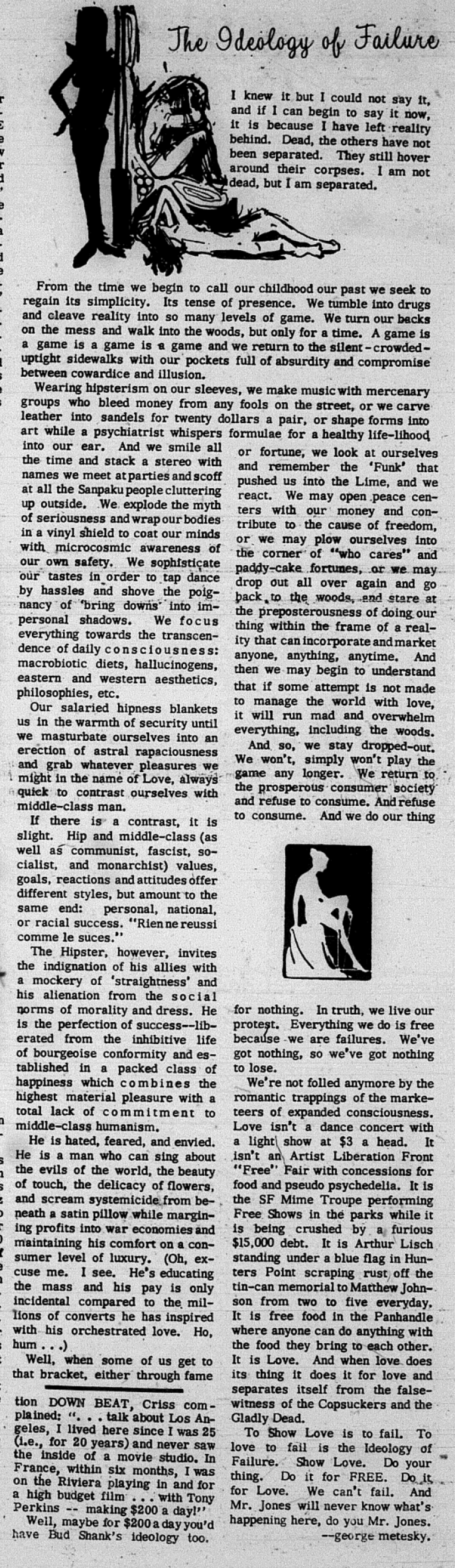
Cat. No.: DP-1966-11-18 Full record BibCit: By George Metesky [pseud.]. Berkeley Barb, 11/18/1966, p. 6. Abstract: This foundational Digger text is both a manifesto and a direct challenge to the “hip” merchants of the Haight-Ashbury, whom the Diggers saw as turning rebellion, consciousness, and even love itself into commodities for sale to the young bohemians fleeing middle-class conformity. Rejecting both straight society and its counterfeit hip counterpart, the piece argues that the culture of success corrupts every style it touches, unless one refuses the game altogether. Its answer is the “ideology of failure”: to do one’s thing for free, for love, and outside the marketplace. In that sense, the broadside throws down the gauntlet by defining authentic countercultural practice against the commercialized pseudo-radicalism that was already overtaking the Haight. That framing also helps show why the text was so foundational: it does not merely criticize hypocrisy in general, but identifies a concrete enemy within the emerging counterculture itself.
"And so, we stay dropped-out. We won't, simply won't play the game any longer. We return to the prosperous consumer society and refuse to consume. And refuse to consume. And we do our thing for nothing. In truth, we live our protest. Everything we do is free because we are failures. We've got nothing to lose, so we've got nothing to lose. We're not fooled anymore by the romantic trappings of the marketeers of expanded consciousness. Love isn't a dance concert with a light show at $3 a head. It isn't an Artist Liberation Front 'Free' Fair with concessions for food and pseudo psychedelia. It is the SF Mime Troupe performing Free Shows in the parks while it is being crushed by a furious $15,000 debt. It is Arthur Lisch standing under a blue flag in Hunters Point scraping rust off the tin-can memorial to Matthew Johnson from two to five everyday. It is free food in the Panhandle where anyone can do anything with the food they bring to each other. It is Love. And when love does its thing it does it for love and separates itself from the false-witness of the Copsuckers and the Gladly Dead. ... To Show Love is to fail. To love to fail is the Ideology of Failure. Show Love. Do your thing. Do it for FREE. Do it for Love. We can't fail."
Note: See the letter to Innerspace Magazine for an explanation of the Metesky pseudonym. This explains that all articles signed "George Metesky" or "Zapata" are to be considered Digger Papers.
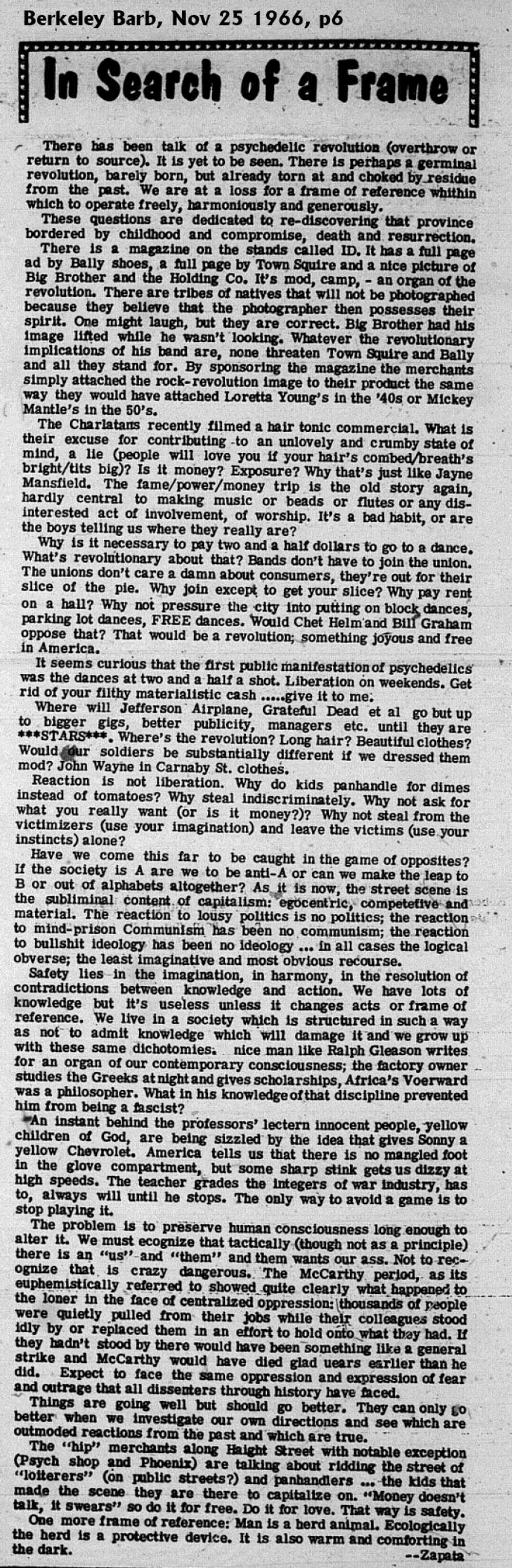
Cat. No.: DP-19661125 Full record BibCit: By Zapata [pseud.]. Berkeley Barb, 11/25/1966, p. 6. Collection: Bell & Howell. Abstract: This essay is a sharp Digger critique of the emerging psychedelic scene as it drifted toward commodification, celebrity, and empty reaction. Rejecting both the “hip” merchants of Haight Street and the pay-to-enter culture of psychedelic dances, it calls instead for a genuinely liberatory social frame grounded in free action, imagination, mutual aid, and collective resistance to capitalist and authoritarian structures. The piece argues that true revolution requires more than anti-establishment style or posture: it demands a transformed “frame of reference” that aligns knowledge with action and replaces competition, materialism, and passive complicity with love, courage, and communal solidarity.
Zapata frames the problem as a search for a new moral and social orientation, insisting that the existing counterculture is still trapped in “the game of opposites” and lacks “a frame of reference within which to operate freely, harmoniously and generously.” The essay contrasts false liberation—“Liberation on weekends”—with a deeper transformation rooted in imagination, free action, and solidarity. Its closing formulations are especially striking: “The only way to avoid a game is to stop playing it,” “Do it for free. Do it for love,” and “Man is a herd animal,” not as a call to conformity, but as an ecological and emotional argument for communal protection and warmth.
Note: See the letter to Innerspace Magazine for an explanation of the Zapata pseudonym. This explains that all articles signed "George Metesky" or "Zapata" are to be considered Digger Papers.
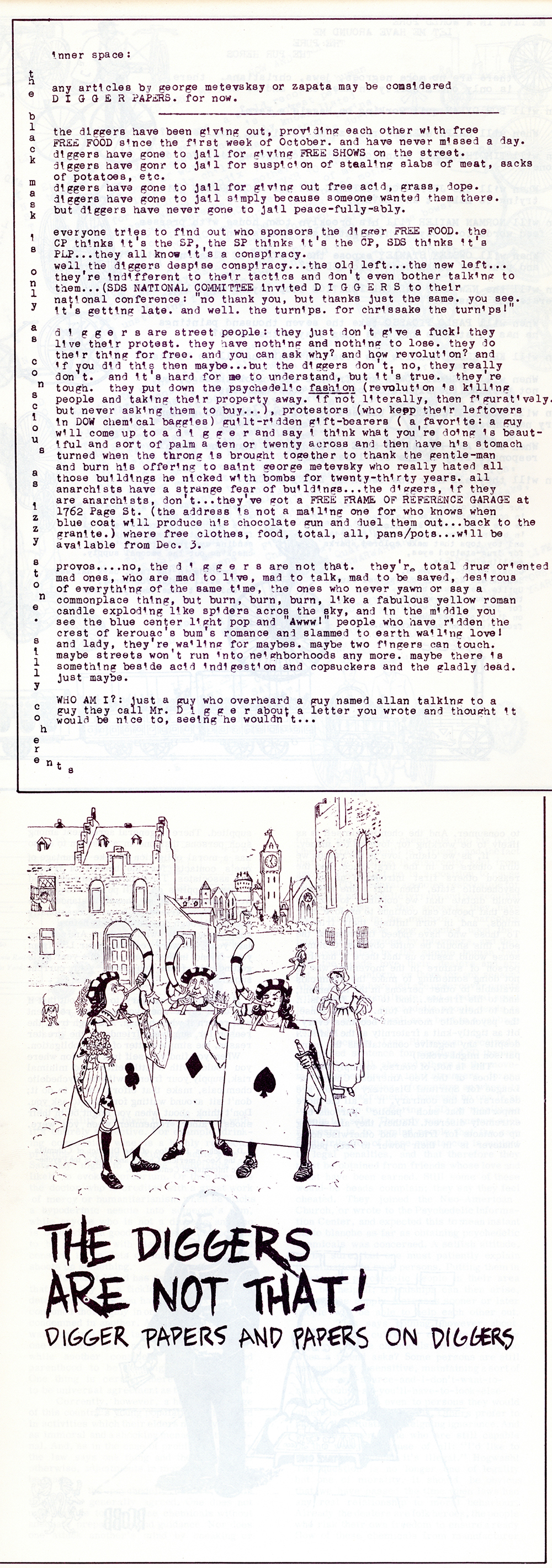
Cat. No.: DP-19661200 Full record BibCit: Innerspace Magazine, ca. 12/1/1966, vol. 1, no. 3 (December 1966). Abstract: This letter is both a declaration and a performance: it identifies the writings of “Metevsky” and “Zapata” as Digger papers, then defines the Diggers not as a political sect or ideological faction but as people who “live their protest” through free action in the street. It catalogs their public practices—free food, free shows, free drugs, arrests, refusal of respectable behavior—and sharply rejects the frameworks through which others try to explain them, whether Old Left, New Left, SDS, or conspiracy politics. The Diggers are presented as indifferent to doctrine and organization, committed instead to immediacy, risk, and a lived revolution grounded in giving things away, refusing commodification, and collapsing the distance between idea and act.
At the same time, the piece is mythmaking in a distinctly Digger register: funny, confrontational, improvisational, and ecstatic. It mocks money, protest pieties, and conventional radicalism while celebrating a wild collective energy that is closer to beat prophecy than programmatic politics. The announcement of the “FREE FRAME OF REFERENCE GARAGE” gives this vision a concrete social form, a place where free goods and free relations might actually be practiced. In its closing passage, borrowing and transforming Kerouac’s language, the letter casts the Diggers as burning figures of desire and refusal, driven not by certainty but by possibility: that “maybe two fingers can touch,” “maybe streets won’t run into neighborhoods any more,” and “maybe there is something” beyond repression, deadness, and the false choices of the existing order.
Note: "any articles by metevsksy or zapata may be considered D I G G E R PAPERS. for now."
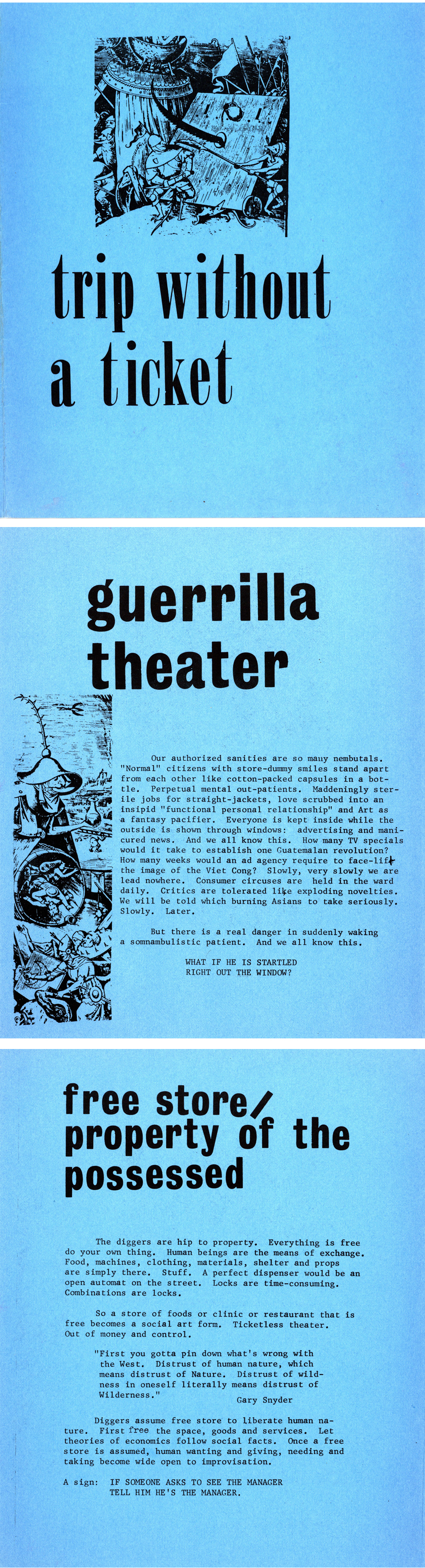
Cat. No.: DP-twat-ed1 Full record BibCit: n.d., ca. 2/1/1967. Booklet. 7 x 8.5 in. 8 p. Collation: printed on 2 8.5"x14" sheets of paper on both sides, folded in half to make 7" wide by 8.5" tall pages, the two sheets interfolded to make a publication that is 8 pages, illus. Abstract: One of the foundational texts of the Diggers that fuses Digger theories of guerrilla theater, the Free Store, and street events into a vision of cultural and social liberation. It argues that modern capitalist society functions as a kind of managed asylum, numbing people through consumer spectacle, work discipline, media distance, and property relations. Against this enclosure, the text proposes “life-actors” who break the glass of passive spectatorship through direct action: theater that abolishes the boundary between stage and street, free stores that turn goods into shared social improvisation, and public rituals that reclaim urban space for collective joy, imagination, and human exchange.
These practices are not merely symbolic but prefigurative: they model a world beyond wages, prices, ownership, and bureaucratic control. The Free Store becomes a social form in which “human beings are the means of exchange,” while the “Birth of Haight / Funeral for $ Now” street event demonstrates how public ritual can transform a crowd into a temporary free community. The closing sections widen the frame further, linking Digger action to ecological critique, antiwar politics, and the technological obsolescence of wage labor, and calling for a society in which necessary work is automated, wealth is shared, and people are freed for uncommodified life with one another. The final imperative—“Give up jobs. Be with people. Defend against property.”—condenses the text’s program into a stark revolutionary ethic.
Note: There were three subsequent editions (all slightly different) published by the Diggers. Communication Company reprinted it. And a third edition appeared in the 1968 Digger Papers. In 2025, a critical edition was published for the Our Commons Are Free exhibition at Fort Mason in San Francisco. For scans of all the pages of this first edition, see: https://diggers.org/digger_sheets.htm#trip
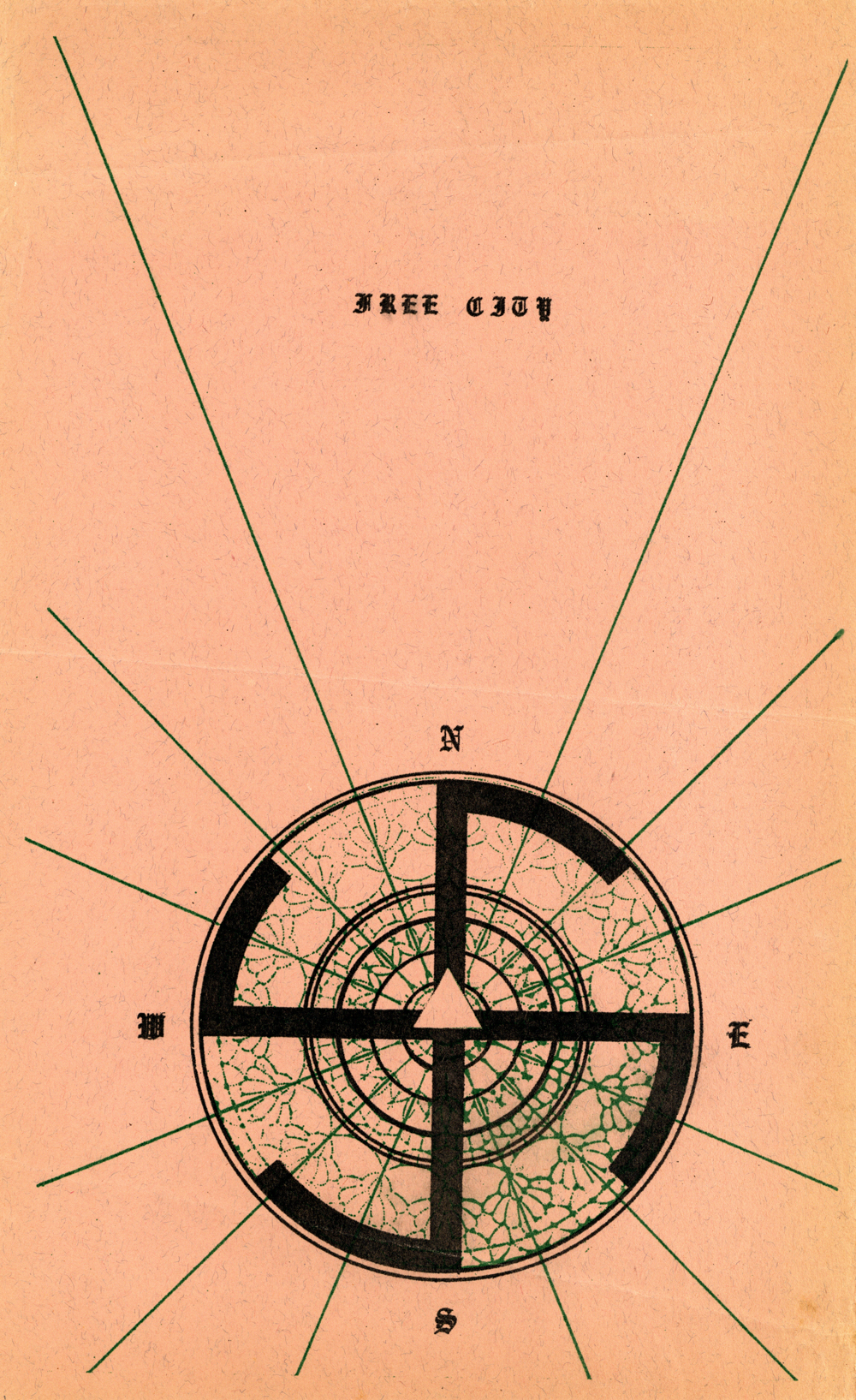
Cat. No.: FC-1-001 Full record BibCit: n.d., ca. 10/1/1967. Broadside. Legal size. 12 sheets (7 Bs, 5 bS). San Francisco: Free City Collective. Collection: SOLA-o; SS-o (MH). Abstract: This is the cover sheet of two bound sets of 8-1/2" x 14" sheets printed on one or two sides that were each titled "Free City." The cover illustration depicts what the Diggers described as a Hopi "Running Man" symbol against a Sun-Ray mandala. The inside sheets contain news of the Free community, poetic pronouncements, and philosophical diatribes.
We can date the publication of this first set by an announcement in the Berkeley Barb. The September 29, 1967, issue contained a notice which read: "Free City," the San Francisco Diggers free newspaper-magazine-rap sheet, is due to hit the streets at any moment. A pre-release copy of the multi-color Gestetner publication reached BARB's hands."
Note: The first set of "Free City" is cataloged as FC-1-001 through FC-1-012.
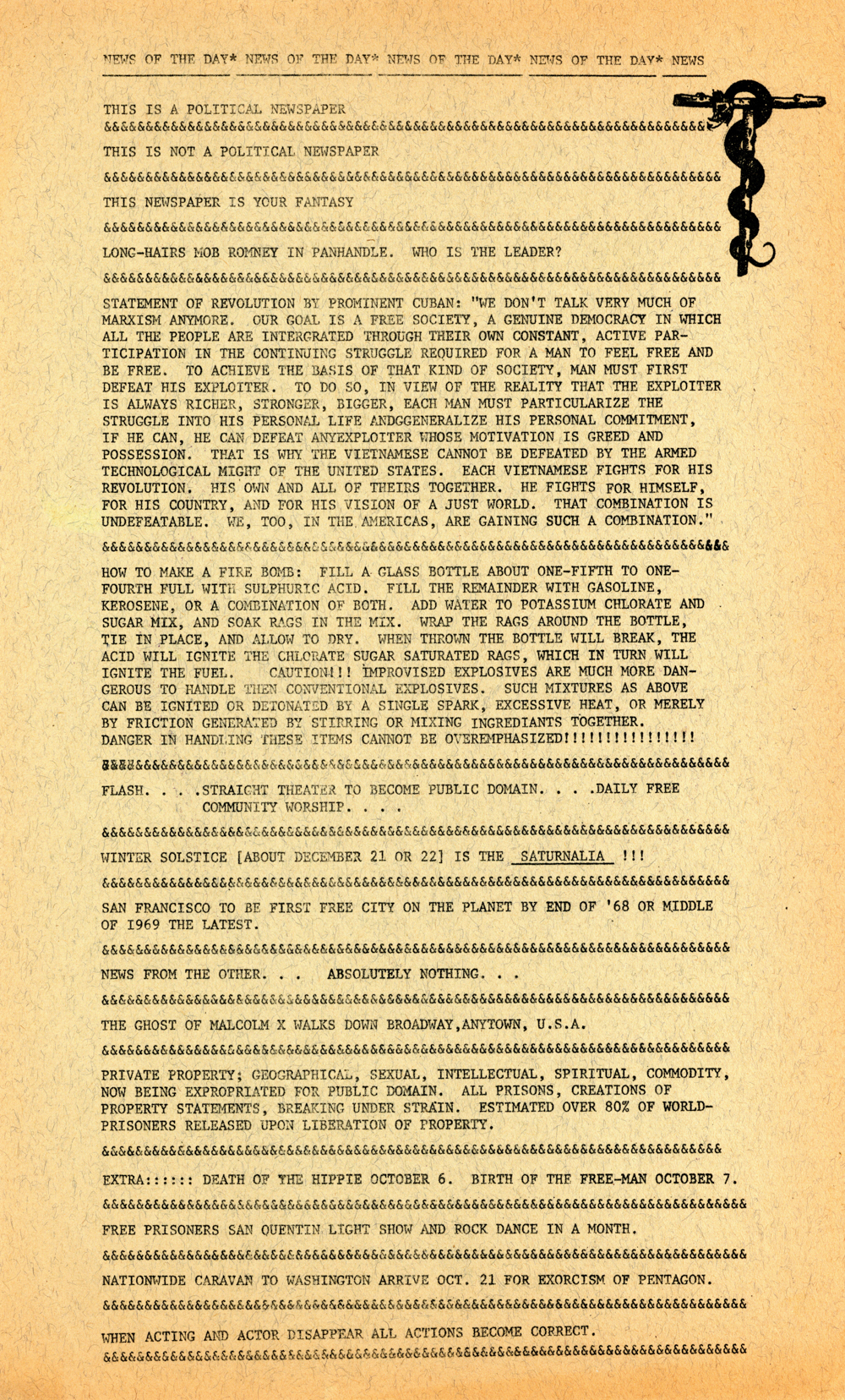
Cat. No.: FC-1-002a Full record BibCit: n.d., ca. 10/1/1967. Broadsheet. Legal size. San Francisco: Free City Collective. Collection: SOLA-o; SS-o (MH). Abstract: Reads like a delirious dispatch from the edge where news, prophecy, parody, and insurgent desire all collapse into one another. It mimics the form of a newspaper only to sabotage its authority at every turn: “This is a political newspaper / This is not a political newspaper / This newspaper is your fantasy.” In that refusal, it announces a Digger understanding of politics not as platform or party, but as lived transformation—personal, collective, theatrical, and immediate. The piece moves restlessly from world revolution to Panhandle street scenes, from the ghost of Malcolm X to the coming “Free City,” from the Exorcism of the Pentagon to the Death of the Hippie and Birth of the Free Man. Its real subject is the dissolution of private property in every sense—material, sexual, spiritual, even artistic—and the emergence of a participatory social world in which ordinary life itself becomes liberated performance.
Note: Text in all capitals; paragraphs divided by ampersand rules; caduceus vignette at upper right.
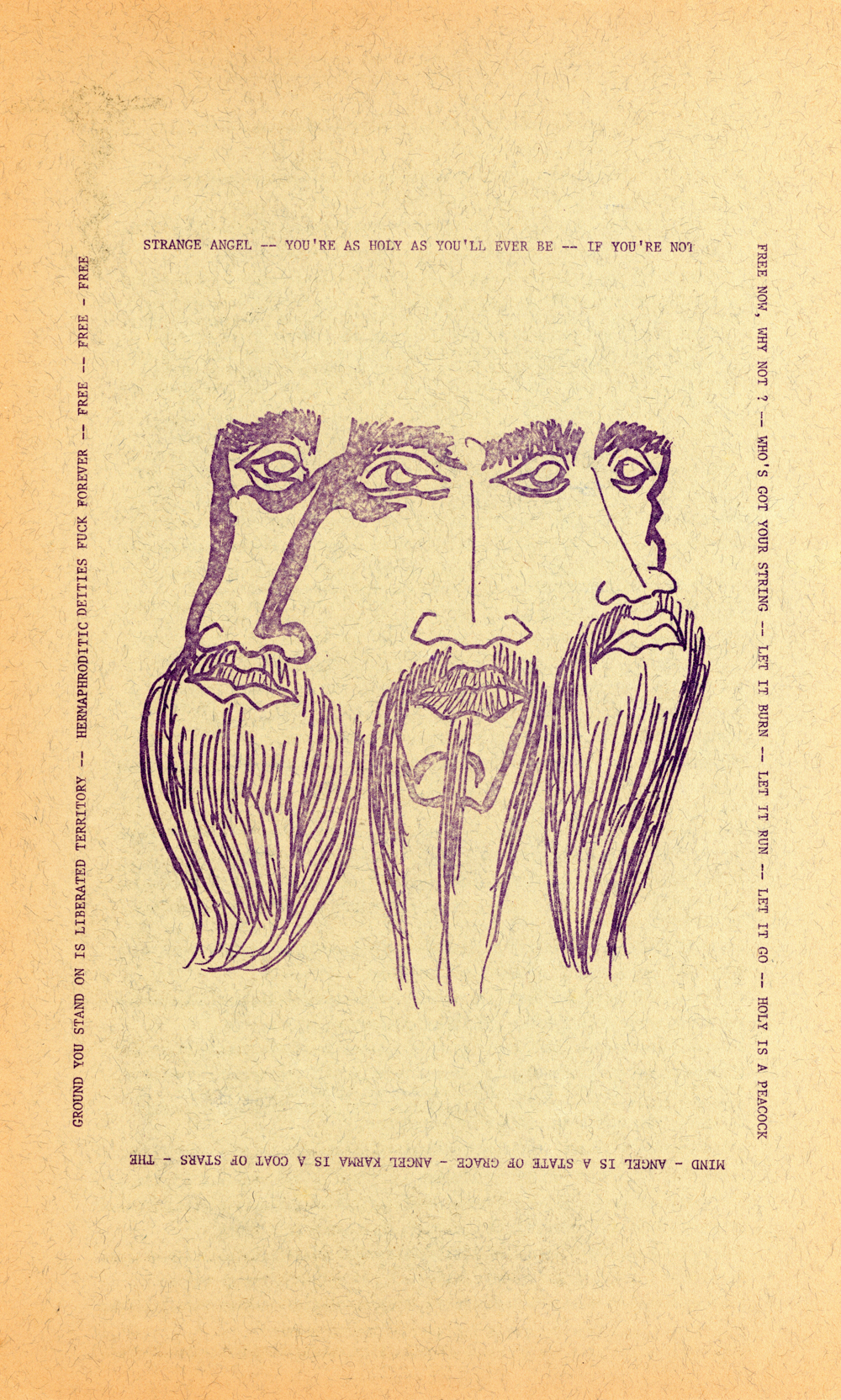
Cat. No.: FC-1-002b Full record BibCit: n.d., ca. 10/1/1967. Broadsheet. Legal size. San Francisco: Free City Collective. Collection: SOLA-o; SS-o (MH). Abstract: This striking and highly economical sheet functions less as a news item or argument than as a visionary invocation. At its center is a purple line drawing of a triple-faced, bearded figure—part saint, prophet, trickster, and street oracle—floating in a large field of textured paper. Around the margins runs a ring of incantatory text: “STRANGE ANGEL,” “YOU’RE AS HOLY AS YOU’LL EVER BE,” “FREE NOW, WHY NOT?,” “LET IT BURN,” “LET IT RUN,” “LET IT GO,” and “GROUND YOU STAND ON IS LIBERATED TERRITORY.” Other phrases—“HOLY IS A PEACOCK MIND,” “ANGEL IS A STATE OF GRACE,” and “ANGEL KARMA IS A COAT OF STARS”—give the piece the air of queer mysticism, absurdist prophecy, and countercultural mantra. Spare, talismanic, and theatrical, the sheet reads as a kind of portable street icon, fusing underground print aesthetics with a rhetoric of liberation, psychic unbinding, and transformed social being.
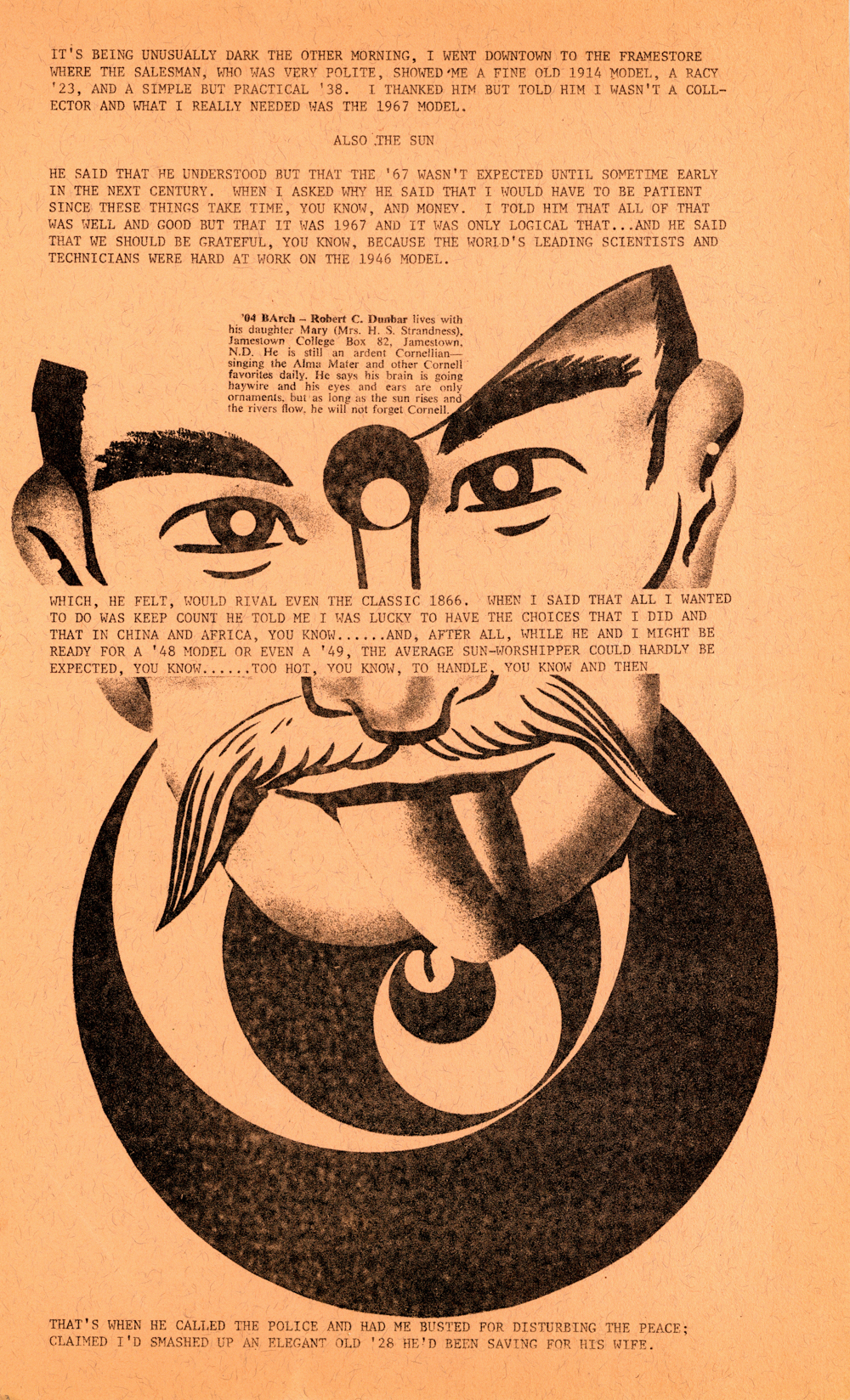
Cat. No.: FC-1-003a Full record BibCit: n.d., ca. 10/1/1967. Broadsheet. San Francisco: Free City Collective. Collection: SOLA-o; SS-o (MH). Abstract: This sheet takes the form of a comic monologue but underneath it is a pointed critique of managed desire, technological delay, and the absurd promises of modern progress. Framed as a visit to a “framestore” in search of the long-awaited “1967 model,” the text parodies the logic of endless postponement, in which people are told to be patient, grateful, and content with obsolescence while the future is always deferred. The salesman’s oily reassurances—full of “you know” and pseudo-reasonable explanations—mock the language of authority and expose a world in which scarcity and delay are normalized. Visually, the sheet is anchored by a large stylized face with a vaguely solar or hypnotic force, interrupted by a clipped biographical fragment that gives the whole page the feel of collage-poetry assembled from the debris of print culture. The final turn, in which the speaker is busted after smashing an old model, turns the joke into a small parable of frustration and revolt in a world where even the sun has been bureaucratized.
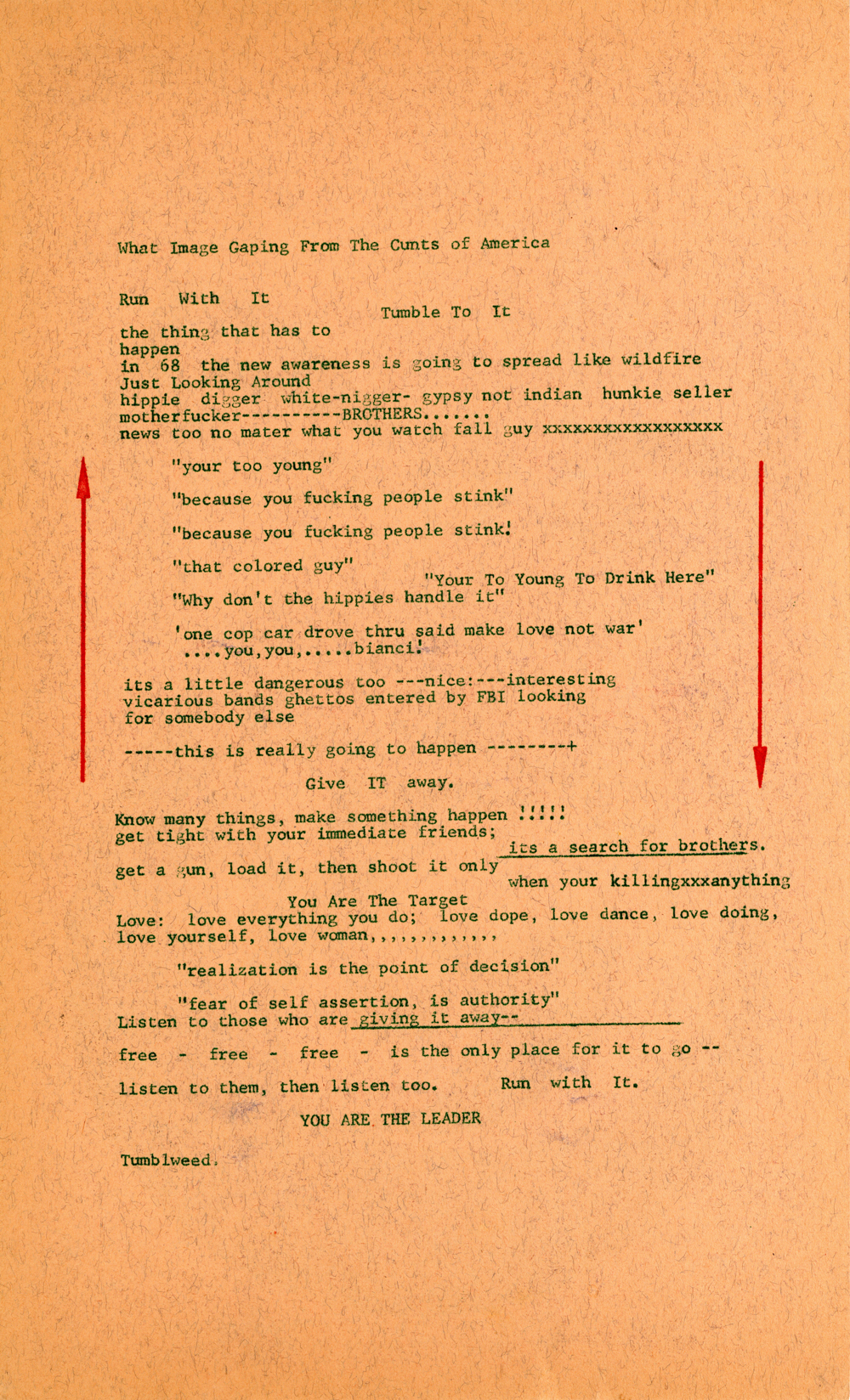
Cat. No.: FC-1-003b Full record BibCit: n.d., ca. 10/1/1967. Broadsheet. San Francisco: Free City Collective. Collection: SOLA-o; SS-o (MH). Abstract: Mixing street talk, racial tension, police menace, and countercultural exhortation, this piece pushes toward a new awareness that will spread “like wildfire.” Its argument is less program than impulse: get close to your friends, give things away, listen to those who are already living free, and recognize that the power to act is already in your hands. At once volatile and visionary, the piece channels the unstable atmosphere of 1968 through a rhetoric of love, danger, solidarity, and imminent rupture, ending by shifting agency onto the reader: “YOU ARE THE LEADER.”
Note: Signed "Tumbleweed" — one of the pseudonyms for Bill Fritsch. See Ringolevio, p. 281 ff., for Emmett Grogan’s description of Tumble.
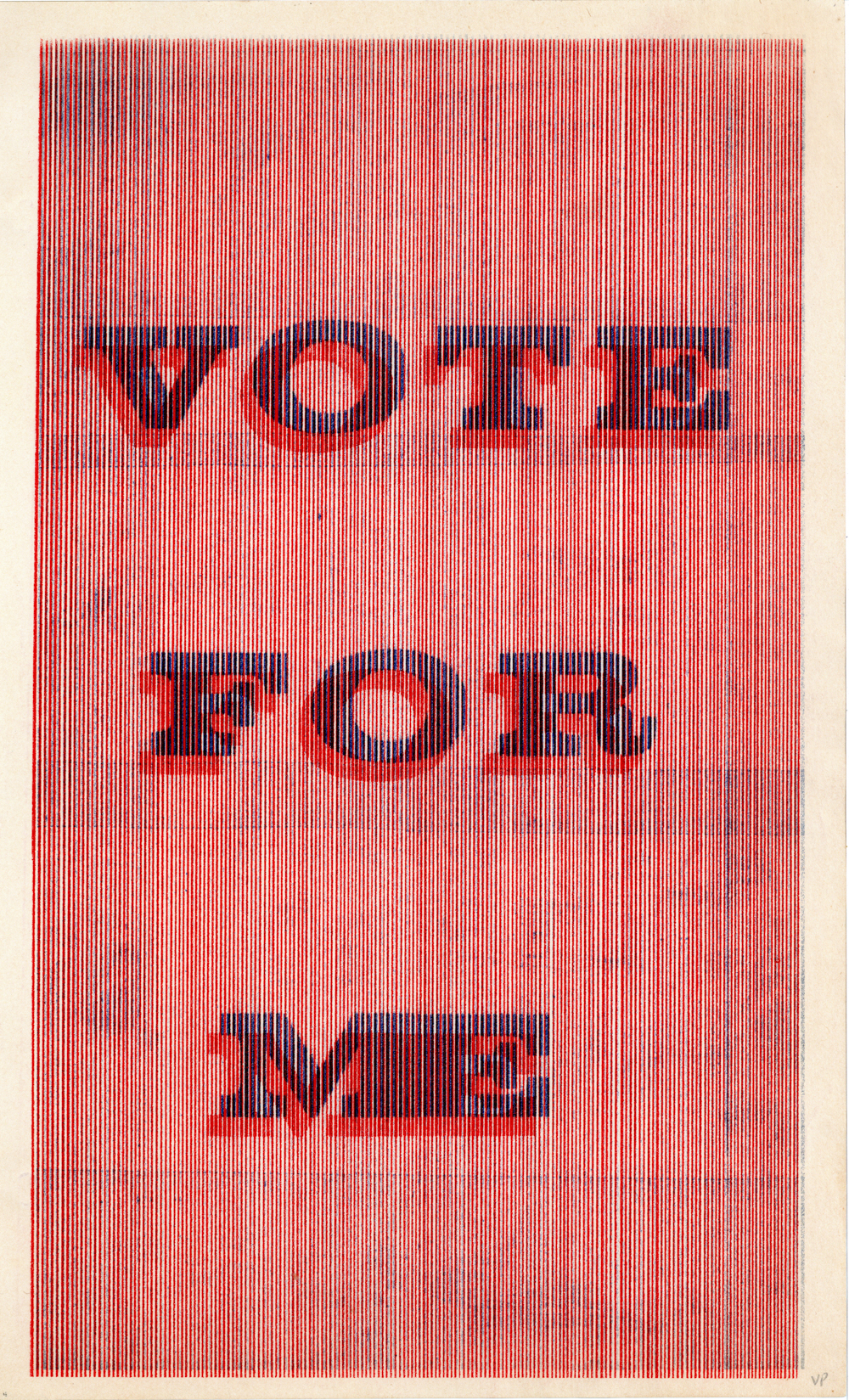
Cat. No.: FC-1-004 Full record BibCit: Broadside. San Francisco: Free City Collective. Abstract: The broadside inverts the traditional campaign slogan through a psychedelic rendering that parodies electoral politics. Stripped of any candidate or program, “Vote for Me” becomes a visual taunt, mocking the empty forms of representation.
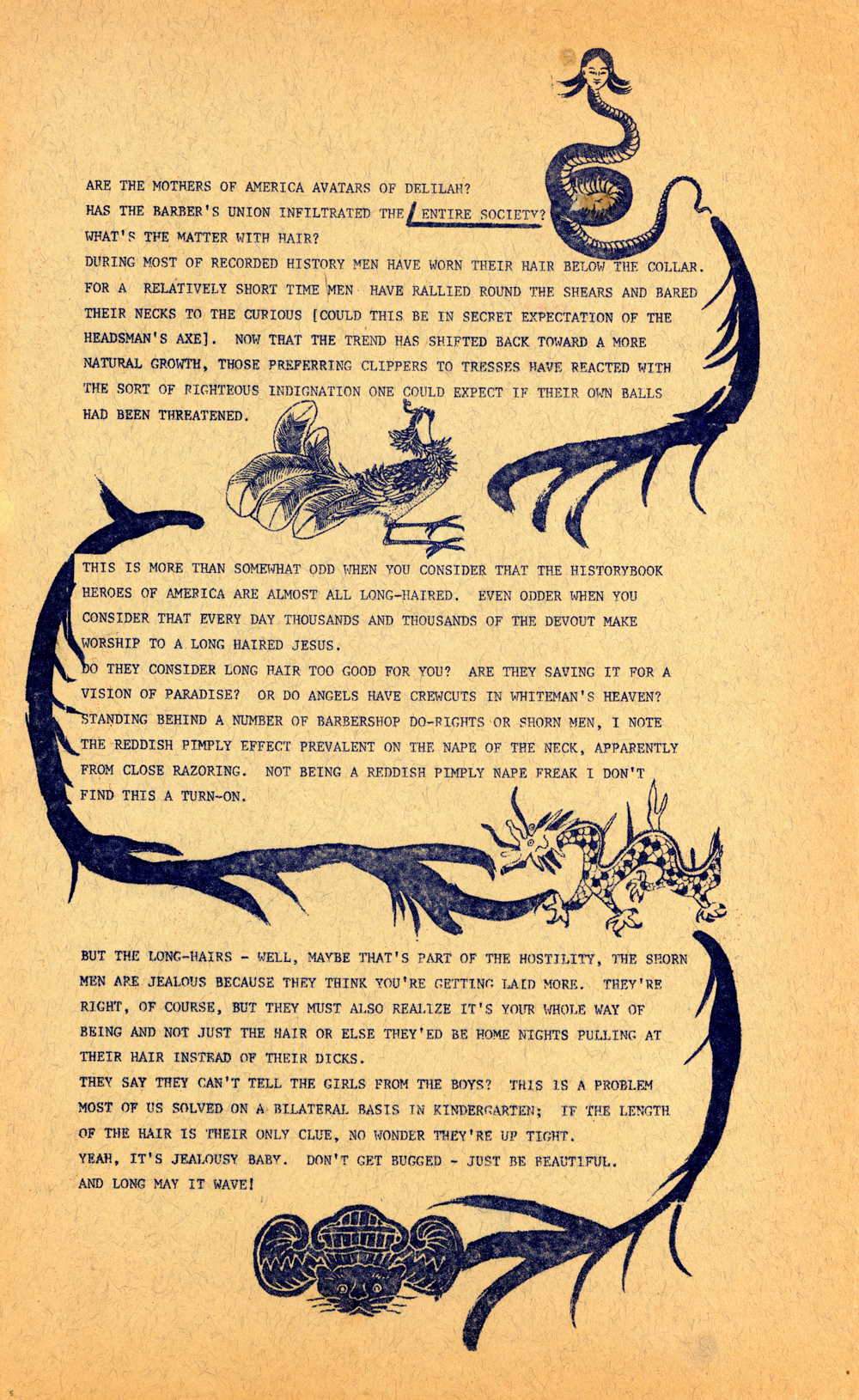
Cat. No.: FC-1-005a Full record BibCit: n.d., ca. 10/1/1967. Broadsheet. San Francisco: Free City Collective. Collection: SOLA-o; SS-o (MH). Abstract: This Free City sheet is a comic, confrontational defense of long hair as a mark of beauty, freedom, and nonconformity, turning the period’s obsession with male hair length into a satire on sexual anxiety, social control, and straight society’s moral panic. Written in a deliberately mocking, conversational voice, it argues that hostility to “long-hairs” reflects jealousy and repression more than principle, while linking barbers, shorn respectability, and conventional masculinity to a broader culture of conformity. The page’s whimsical yet slightly menacing graphic border—serpentine forms, hybrid creatures, and ornamental fantasy figures—reinforces the text’s blend of camp, provocation, and countercultural style.
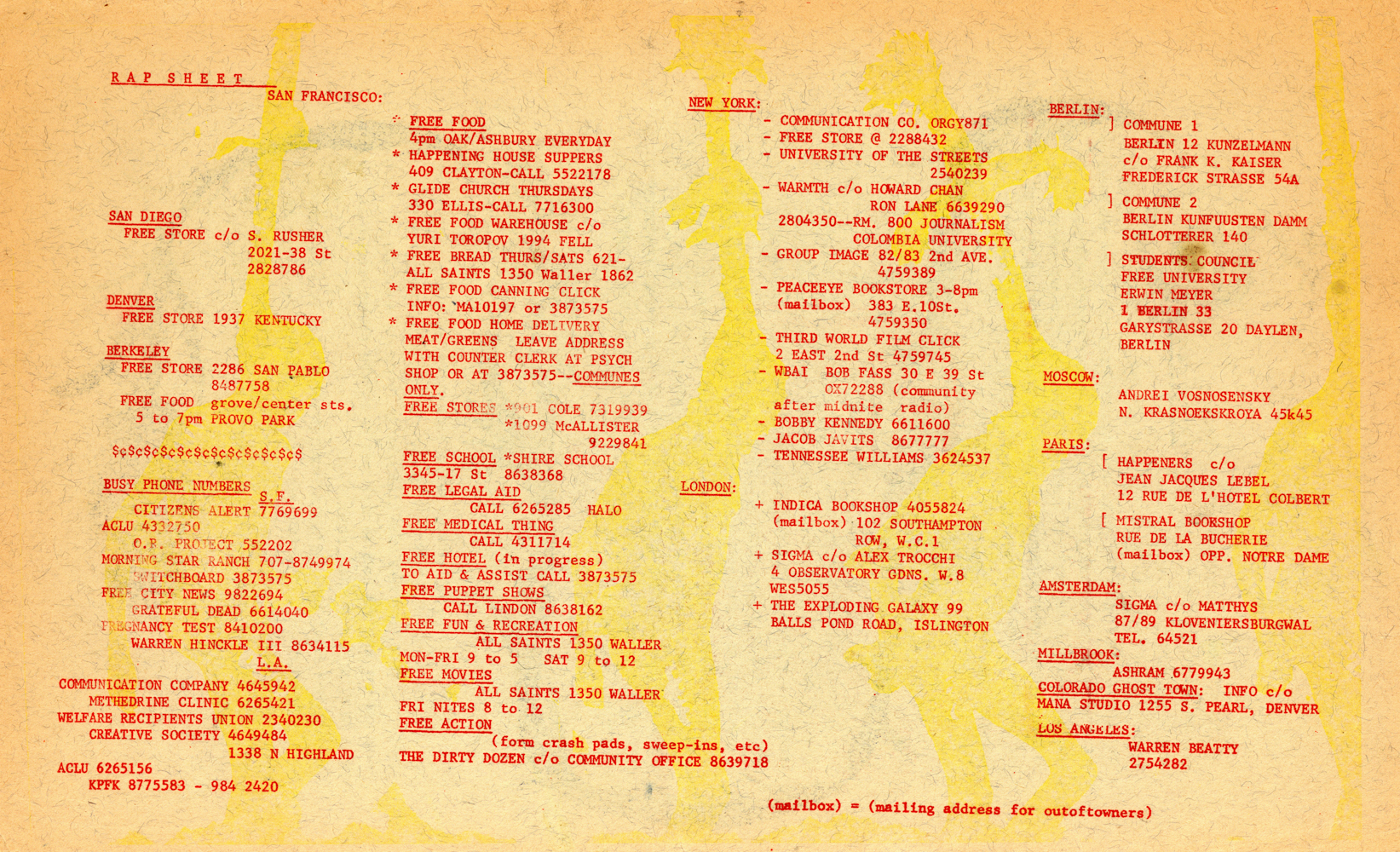
Cat. No.: FC-1-005b Full record BibCit: n.d., ca. 10/1/1967. Broadsheet. San Francisco: Free City Collective. Collection: SOLA-o; SS-o (MH). Abstract: This Free City “Rap Sheet” serves as a decentralized directory of countercultural and underground resources, linking San Francisco to a wider network of free stores, free food programs, communes, legal aid, media, bookstores, and contact points across the United States and Europe. More than a mere list, it maps the infrastructure of an emerging Free City world: practical, mobile, improvised, and translocal, with addresses and phone numbers standing in for a new social geography of mutual aid and alternative institutions. The ghosted yellow figures behind the red type give the page a loose, processional quality, as if this network were not static but already in motion.
Note: Note that the two operating free stores in San Francisco at this point are the Trip Without A Ticket (Cole Street) and the Black People's Free Store (McAllister Street).
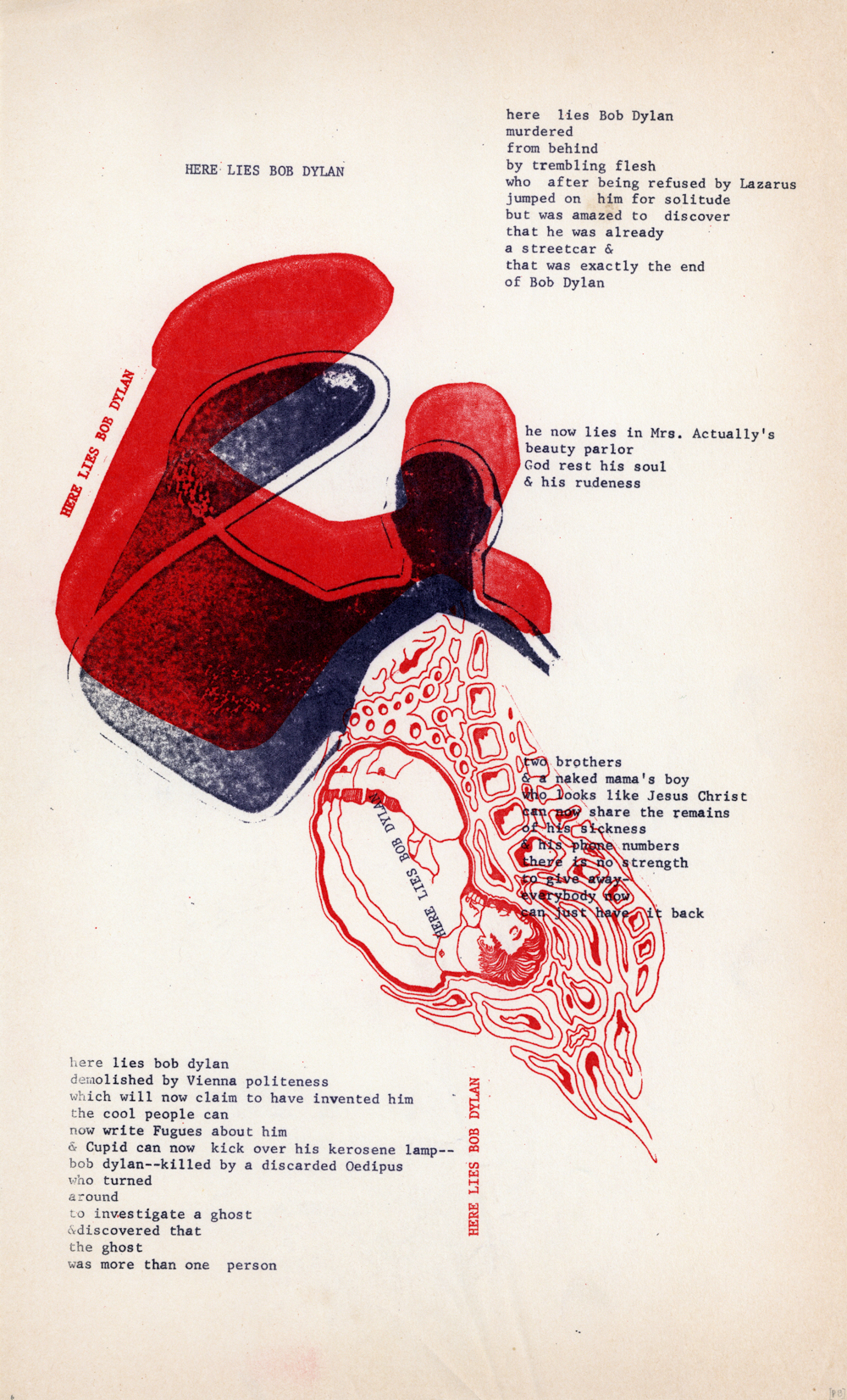
Cat. No.: FC-1-006 Full record BibCit: n.d., ca. 10/1/1967. Broadside. San Francisco: Free City Collective. Collection: SOLA-o; SS-o (MH). Abstract: This visually dense and sardonic broadside stages yet another symbolic death of Bob Dylan, not as obituary but as cultural exorcism. Through fractured typed verse, repeated funerary invocation, and biomorphic red-and-black imagery, it turns Dylan into a contested emblem—murdered, dispersed, and reclaimed by the overlapping projections of hip society, messianic longing, and psychic theater. The piece reads less as commentary on the man himself than as an attack on the making and unmaking of celebrity within the counterculture.
Note: See the article “Against the Stars” in Kaliflower, volume 3, for a resonant parallel to the idea behind this piece.
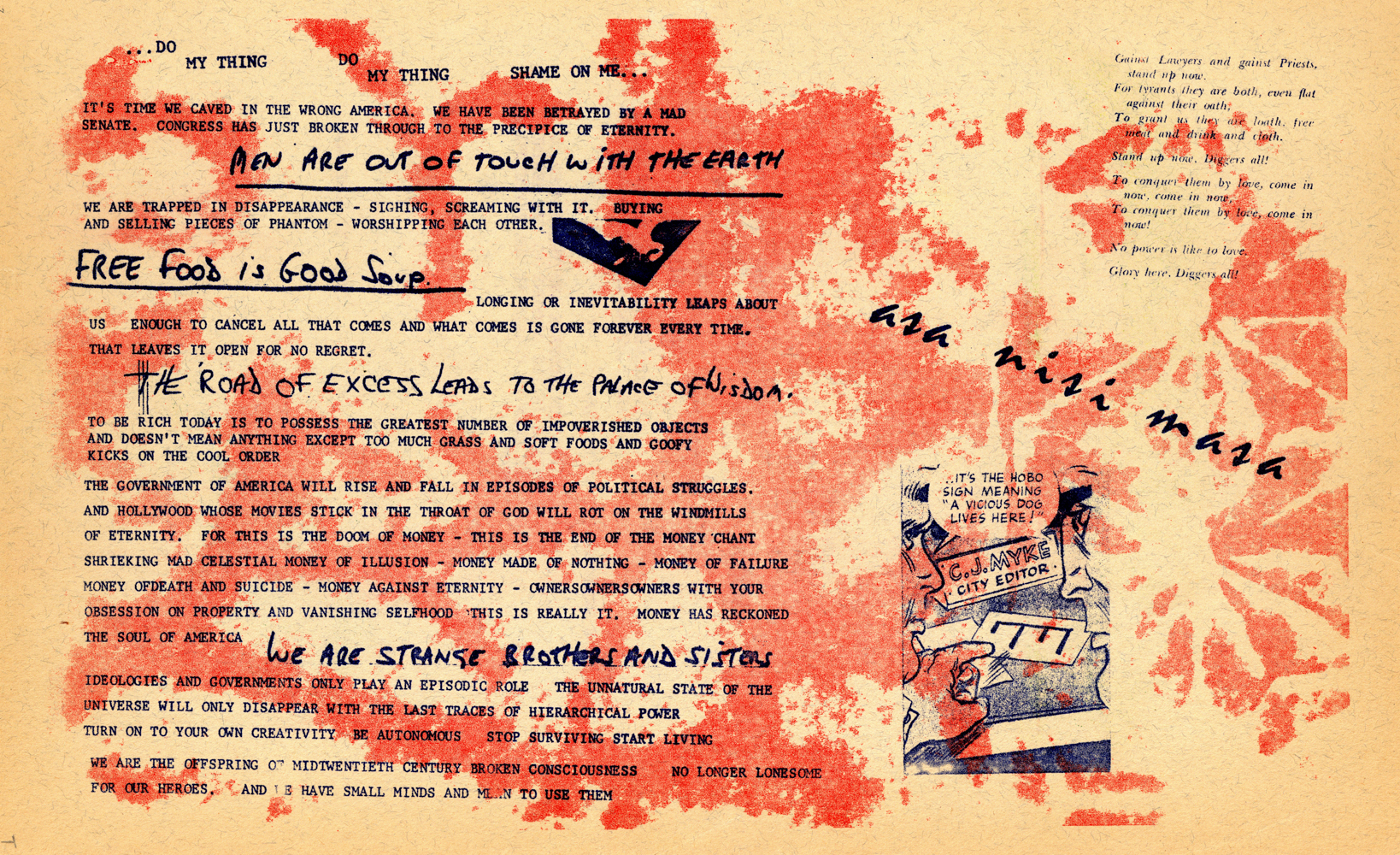
Cat. No.: FC-1-007a Full record BibCit: n.d., ca. 10/1/1967. Broadsheet. San Francisco: Free City Collective. Collection: SOLA-o; SS-o (MH). Abstract: This piece is a dense, improvisational Free City collage of manifesto, lament, and ecstatic exhortation, layering typed polemic, handwritten slogans, scattered quotations, and found imagery into a vision of America in spiritual and political collapse. Against denunciations of money, hierarchy, false power, and the dead weight of official politics, the sheet counters with Digger-style affirmations—free food, autonomy, brotherhood and sisterhood, and the insistence that people stop merely surviving and begin living. Its splattered red ground and fractured composition give the page the look of something half-broadcast, half-erupted, as though consciousness itself were breaking through the ruins of the established order.
Note: “The road of excess leads to the palace of wisdom,” from William Blake’s “Proverbs of Hell” in The Marriage of Heaven and Hell, was adopted by the Diggers as an early slogan. In Blake, the phrase suggests that wisdom comes not through prudence or restraint but through lived intensity. At the outset of Free Food in the Panhandle, it was painted on the side of the VW bus that delivered the hot stew every afternoon (Ringolevio, p. 249).
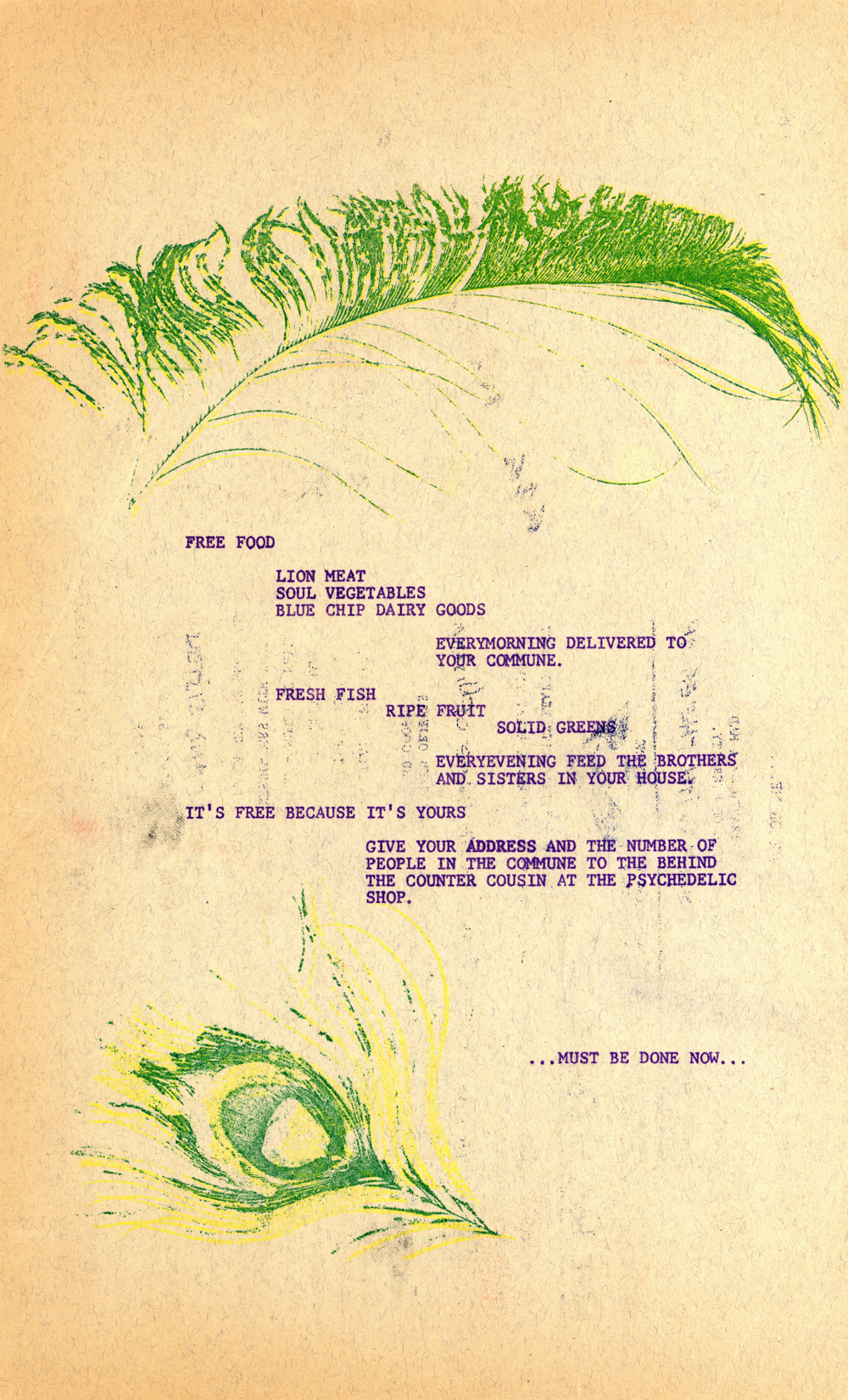
Cat. No.: FC-1-007b Full record BibCit: n.d., ca. 10/1/1967. Broadsheet. San Francisco: Free City Collective. Collection: SOLA-o; SS-o (MH). Abstract: This Free City sheet is a direct organizing notice for the expansion of free food beyond the Panhandle into the communes, calling for a practical network of daily distribution and shared provisioning. Listing donated staples—meat, vegetables, dairy goods, fish, fruit, and greens—it presents food not as charity or relief but as collective property: “It’s free because it’s yours.” The airy feather- or peacock-like imagery softens the page visually, but the message is urgent and concrete, ending with an insistence that the work of feeding “the brothers and sisters in your house” must begin at once.
Note: Of note, this sheet marks the shift from the public sphere to a more inward communal sharing. Grogan describes the “Free Food Home Delivery Service” in Ringolevio, p. 440.
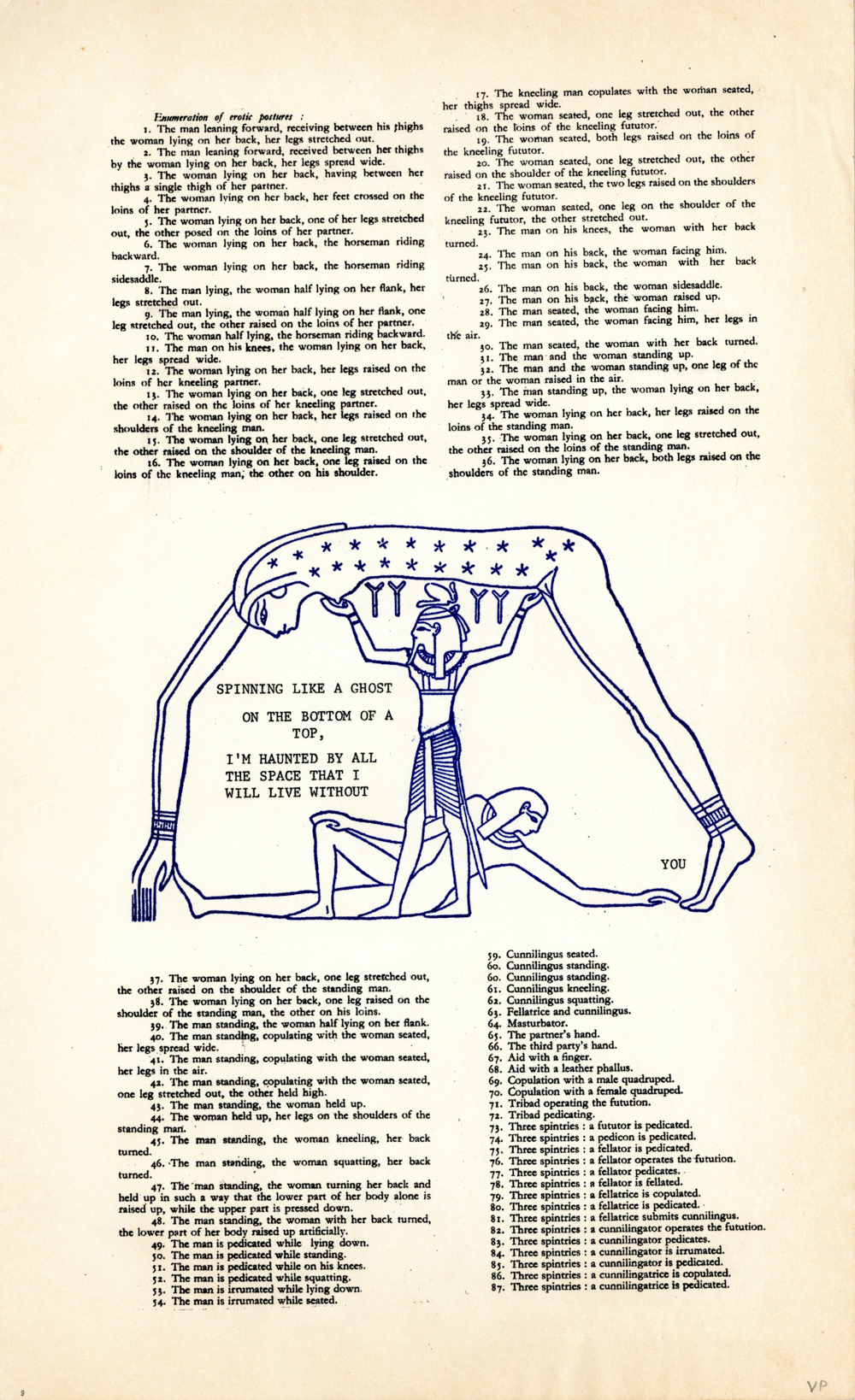
Cat. No.: FC-1-008 Full record BibCit: n.d., ca. 10/1/1967. San Francisco: Free City Collective. Collection: SOLA-o; SS-o (MH). Abstract: This striking Free City page juxtaposes a dry, encyclopedic list of sexual positions with an Egyptianizing central image and a brief lyric meditation on absence, desire, and haunted space. The effect is neither pornographic nor purely comic; rather, it turns erotic taxonomy into collage material, setting clinical enumeration against mythic imagery and poetic interiority. In the context of the Free City project, the piece reads as part of a broader effort to break down conventional boundaries between the sacred and the profane, information and art, body knowledge and visionary play.
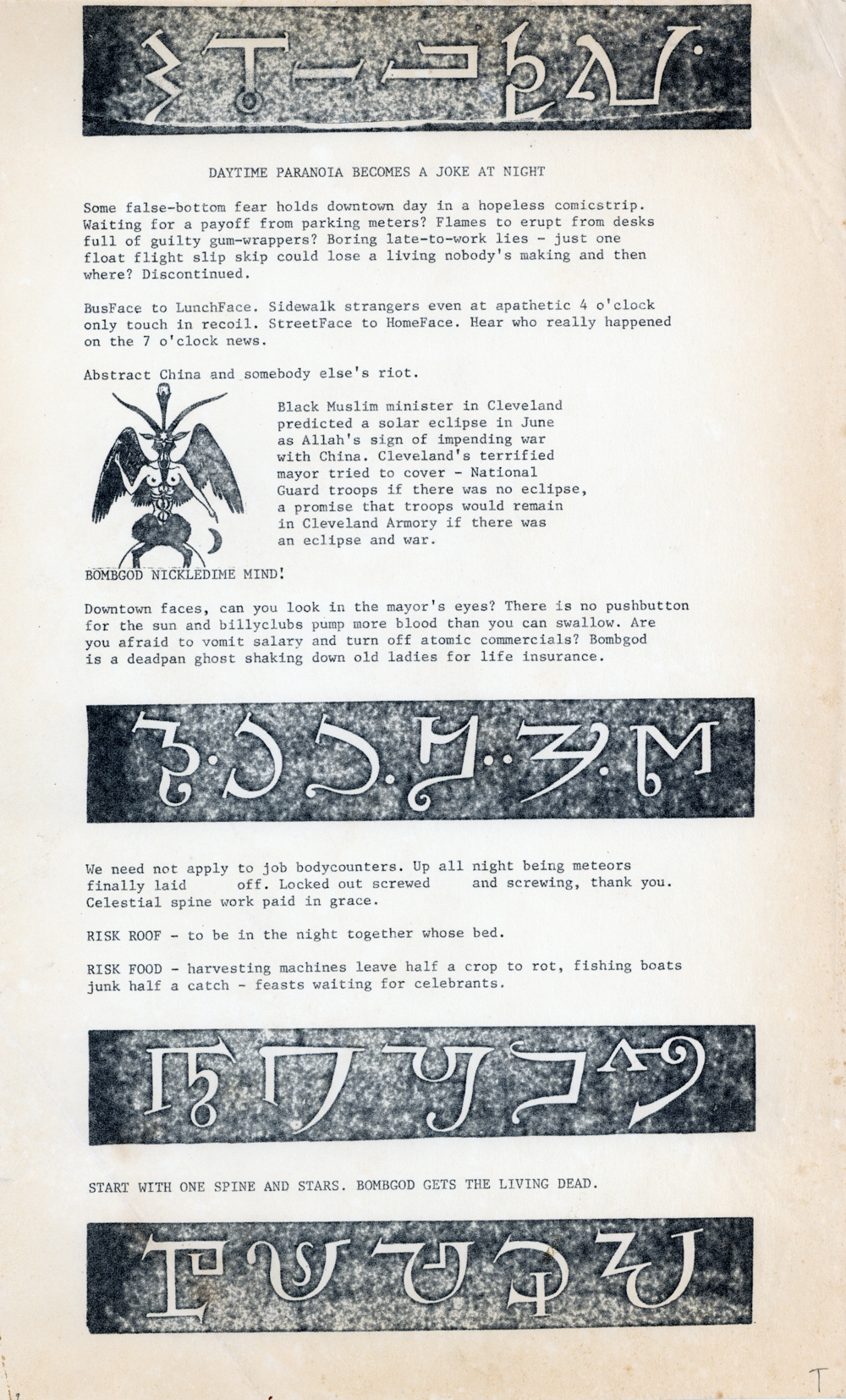
Cat. No.: FC-1-009 Full record BibCit: n.d., ca. 10/1/1967. Broadside. San Francisco: Free City Collective. Collection: SOLA-o; SS-o (MH). Abstract: Reads as a fevered prose poem of urban dread and countercultural refusal, contrasting the deadened routines of downtown work, media fear, and official paranoia with a visionary language of night, risk, grace, and collective release. Its jagged shifts—from Cleveland race panic and atomic dread to “Risk Food” and “Risk Roof”—suggest a world in which the administered realities of wage labor, news, and authority are already collapsing into absurdity. The mysterious letterforms and occult-like graphic framing deepen the page’s prophetic tone, as though the sheet were proposing an alternate script for those trying to escape the living death of ordinary America.
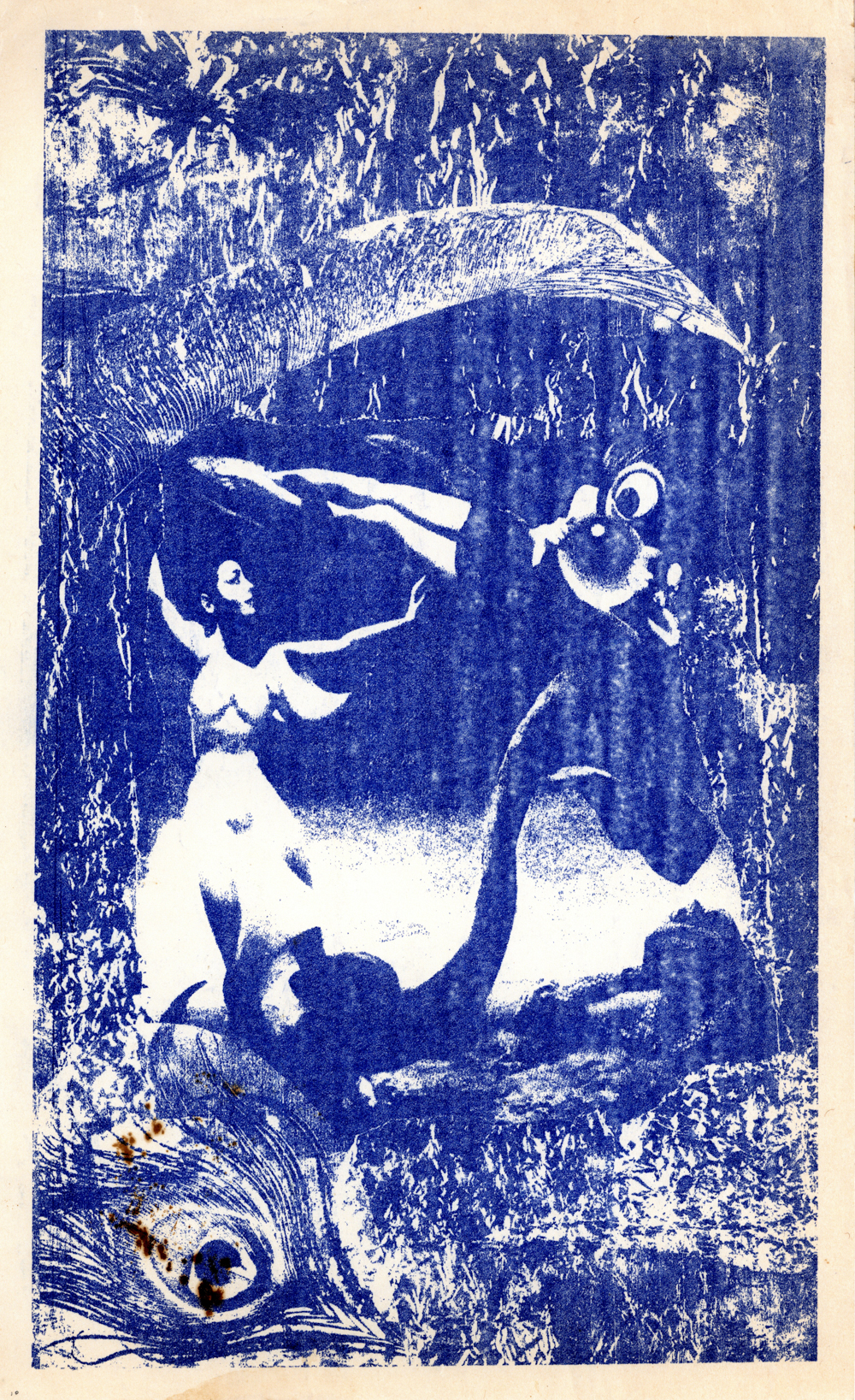
Cat. No.: FC-1-010 Full record BibCit: n.d., ca. 10/1/1967. Broadside. San Francisco: Free City Collective. Collection: SOLA-o; SS-o (MH). Abstract: This piece reads as a dream image or mythic interlude within the Free City sequence: a nude female figure stands beside or confronts a bird-headed, serpent-bodied creature in a lush, peacock-haunted environment. Printed in a dense monochrome blue, the image has the soft, degraded texture of a reproduced collage or altered illustration, which gives it an oneiric, half-submerged quality. In the context of Free City, it seems less like an argument than an atmosphere piece, bringing together eroticism, metamorphosis, fantasy, and the decorative excess that runs through much of the project’s visual language.
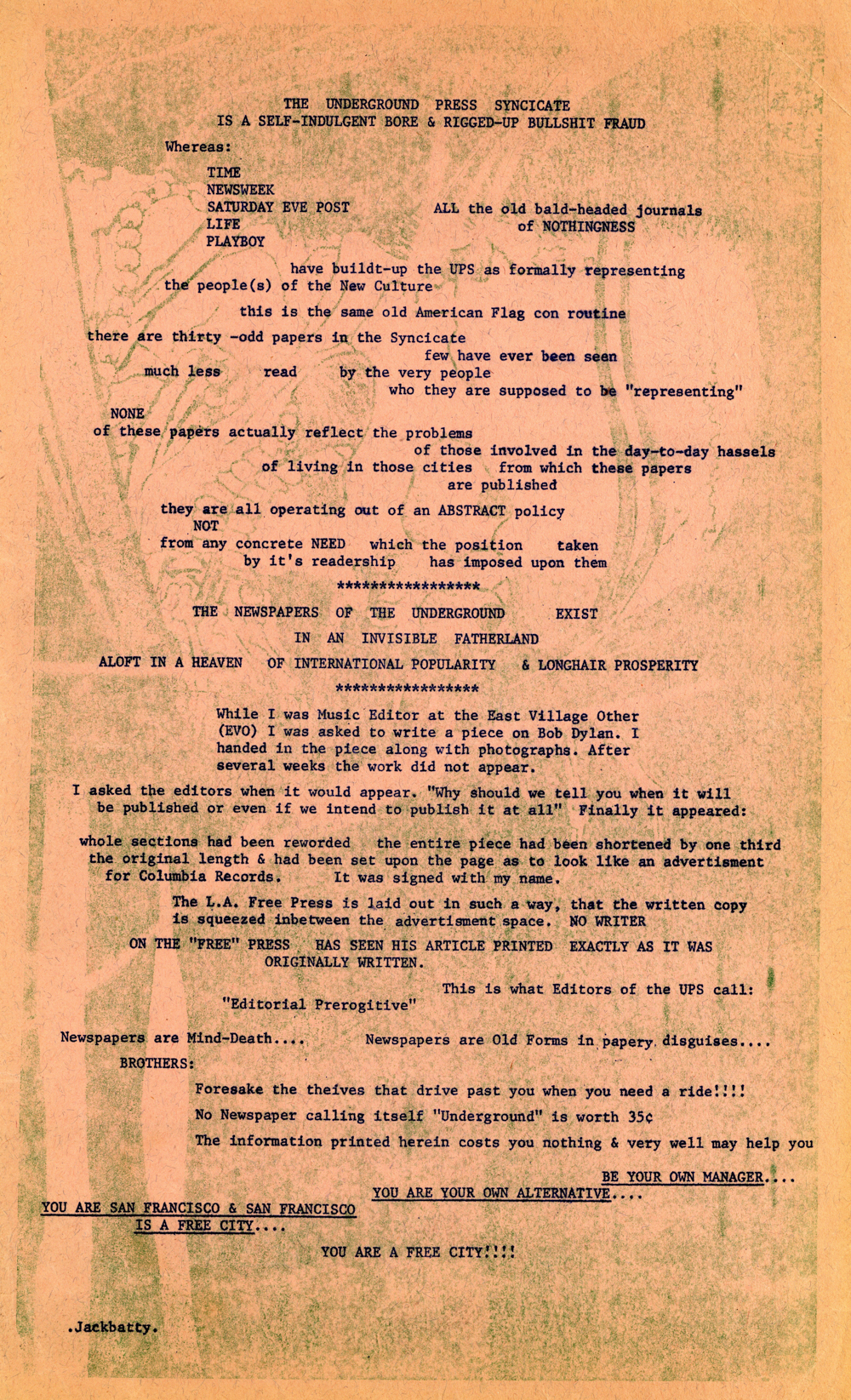
Cat. No.: FC-1-011a Full record BibCit: n.d., ca. 10/1/1967. Broadsheet. San Francisco: Free City Collective. Collection: SOLA-o; SS-o (MH). Abstract: A blistering attack on the Underground Press Syndicate, accusing the alternative press of reproducing the same hollow structures of mediation, editorial control, and false representation as the mainstream media it claimed to oppose. Mixing polemic with firsthand grievance, the text argues that underground papers do not arise from the concrete needs of their readers but from an abstract, self-important culture of editors, popularity, and packaged dissent. Its answer is the characteristic Free City reversal: do not look to newspapers, managers, or cultural intermediaries to speak for you—“you are your own alternative,” and San Francisco itself must become a free city through direct action and self-organization.
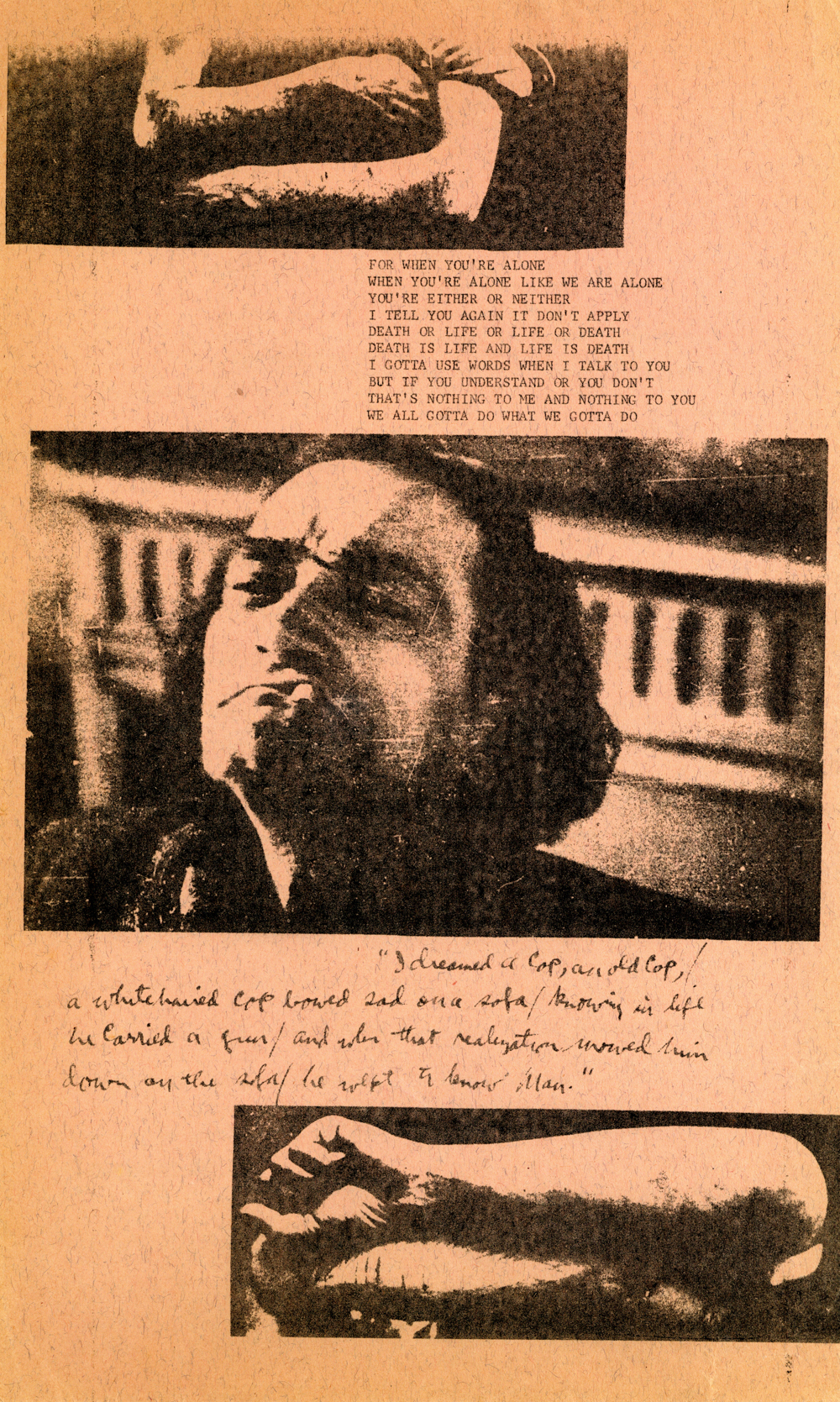
Cat. No.: FC-1-011b Full record BibCit: n.d., ca. 10/1/1967. Broadsheet. San Francisco: Free City Collective. Collection: SOLA-o; SS-o (MH). Abstract: Combines blurred photographic images, typed verse, and a handwritten dream fragment to create an atmosphere of solitude, mortality, and psychic unease. The repeated reclining figure, the stark portrait, and the lines about being alone and the interchangeability of life and death give the piece the feel of a dream document or private visionary notebook rather than a polemical broadside. In the context of Free City, it suggests the extent to which the project could also make room for intimate, haunted, inward material alongside its more public calls to action.
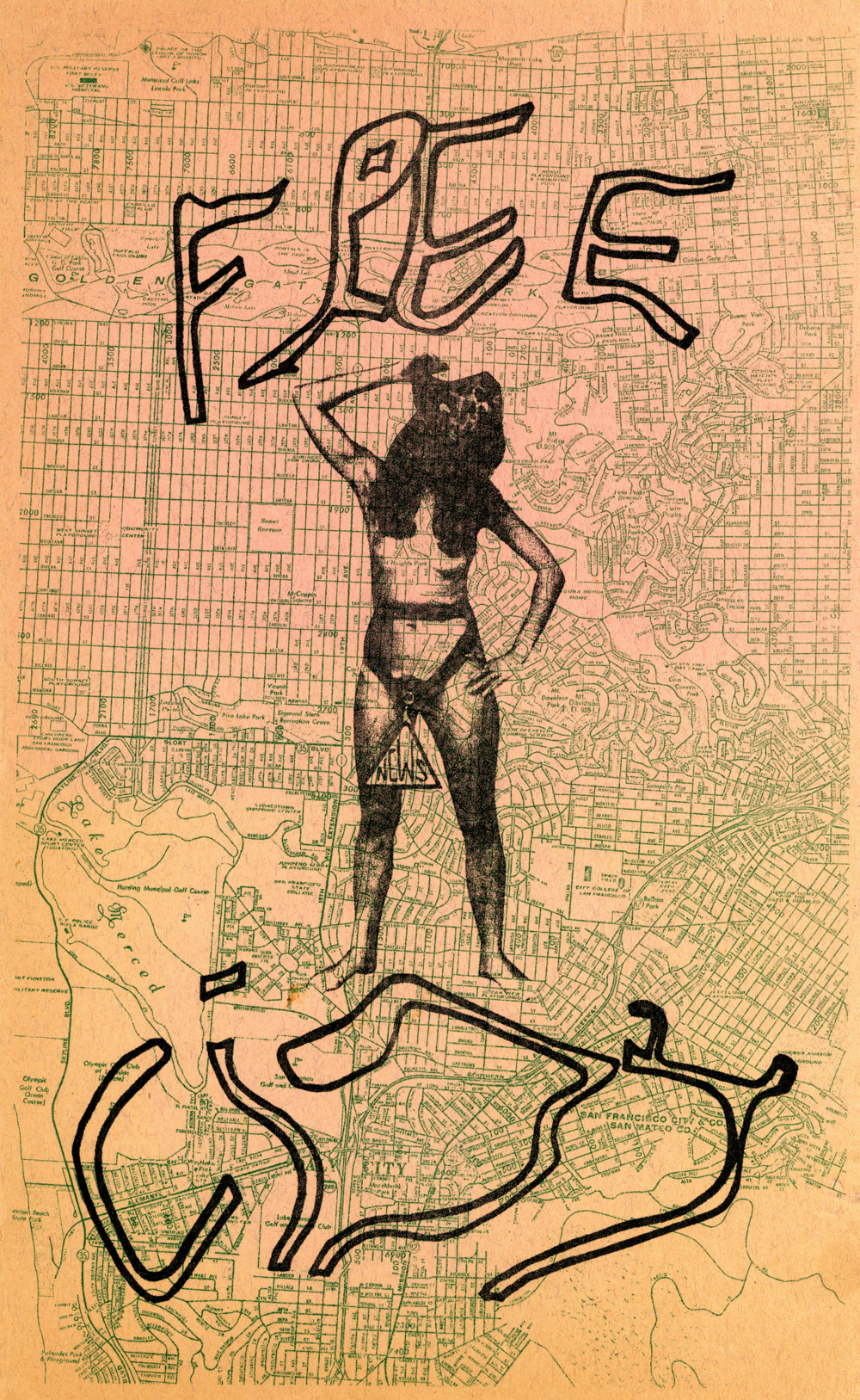
Cat. No.: FC-1-012 Full record BibCit: n.d., ca. 10/1/1967. Broadside. San Francisco: Free City Collective. Collection: SOLA-o; SS-o (MH). Abstract: As the parting image in Free City Set #1, this sheet recasts San Francisco itself as the terrain of a Free City imaginary, overlaying a street map with the large hand-drawn words FREE CITY and a central female figure poised like an emblem, muse, or tutelary spirit of the place. The belt or banner at her waist, bearing the word “NEWS” links that figure directly to the project of Free City as an alternative mode of communication, suggesting that the liberated city is not only inhabited but spoken, circulated, and imagined into being. The effect is both declarative and visionary: the existing grid of official geography is overlaid by a counter-map of freedom, desire, and collective possibility.